The world’s largest battery-electric ship has officially entered commercial service, marking a major milestone for the maritime industry and the growing use of electric propulsion in large passenger vessels.
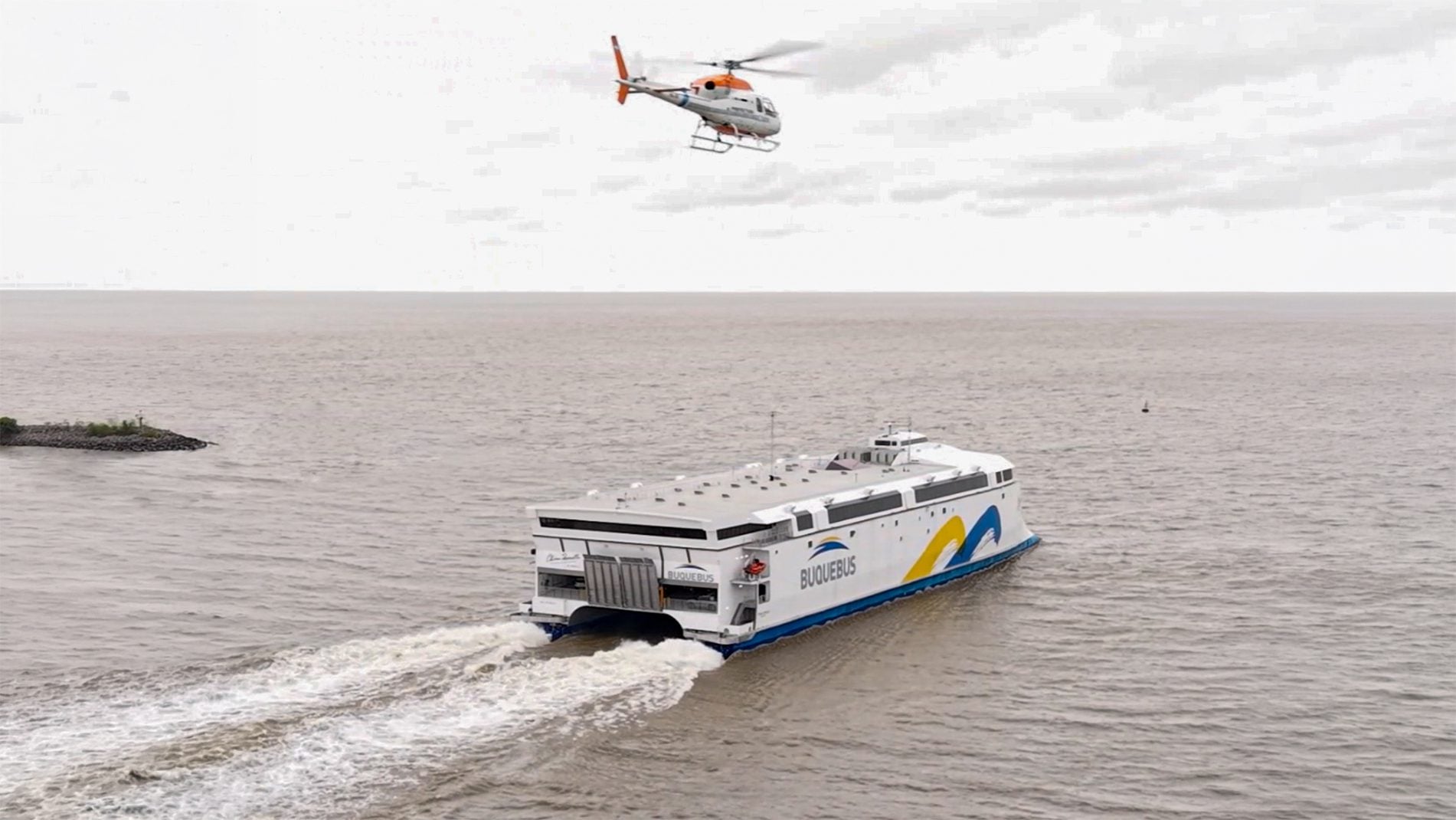
The 130-meter China Zorrilla, built by Australian shipbuilder Incat Tasmania for ferry operator Buquebus, completed its first commercial crossing between Buenos Aires, Argentina, and Colonia, Uruguay, on October 22.
The high-speed catamaran can carry up to 2,100 passengers and 225 vehicles across the River Plate, operating entirely on battery power without the need for conventional marine engines.
At the heart of the vessel is an energy storage system exceeding 40 megawatt-hours, made up of more than 250 tonnes of batteries. The system powers eight electrically driven waterjets, making China Zorrilla the largest battery-electric vessel ever constructed.
The ship is supported by dedicated high-power charging infrastructure at terminals on both sides of the river, allowing its batteries to be recharged between crossings.
The start of commercial service follows an official ceremony in Buenos Aires on October 21, attended by Incat Managing Director Craig Clifford, Buquebus representatives, and maritime authorities and government officials from Argentina and Uruguay.
Incat Chairman Robert Clifford described the achievement as one of the proudest moments in the company’s history, and credited hundreds of workers at Incat’s Hobart shipyard with overcoming significant engineering challenges to deliver the vessel, which represents one of the most ambitious projects in the company’s history.
“This ship proves that large, high-capacity commercial vessels can operate on electric power,” Clifford said.
Beyond its size and technical capabilities, China Zorrilla also offers a different passenger experience. Without conventional diesel engines, the vessel operates with significantly less machinery noise and vibration, while producing no direct exhaust emissions during crossings.
Craig Clifford, who traveled aboard the vessel during its maiden commercial voyage, said the difference was immediately noticeable.
He noted that passengers aboard a vessel of this size would normally expect to hear and feel powerful engines operating beneath them, but that familiar noise and vibration are largely absent.
The ferry also features extensive passenger amenities, including approximately 2,300 square meters of duty-free retail space.
The project’s completion is particularly significant given its evolution during construction. Originally designed to use dual-fuel engines capable of burning diesel and liquefied natural gas, the vessel was ultimately redesigned for fully electric propulsion, requiring substantial engineering changes.
Its entry into service demonstrates the growing potential for battery-electric technology in high-capacity ferry operations, particularly on fixed routes where shore-based charging infrastructure can support regular crossings.
For Incat, the milestone is also part of a broader shift toward electric vessel construction.
The Tasmanian shipbuilder is currently building three 129-meter battery-electric ferries for Danish operator Molslinjen, along with two 78-meter hybrid-electric vessels at its Hobart facility.
With China Zorrilla now carrying paying passengers, the company has moved one of the maritime industry’s most ambitious electric vessel projects from the shipyard into everyday commercial operation.

 Join The Club