A new study says the United States has enough spare ethanol production capacity to supply a meaningful share of the global marine fuel market, offering shipowners another fuel option as the number of methanol-capable vessels continues to grow.
The report, Marine Ethanol: Unlocking the US Opportunity, published Wednesday by the Maritime Ethanol & Methanol Alliance (MEMA), argues that ethanol could be used in existing methanol dual-fuel engines and bunkering infrastructure with relatively minor modifications, potentially easing concerns over the availability of low-emission methanol.
According to the study, more than 300 methanol-capable vessels are already operating or on order, creating a potential market for ethanol either as a standalone marine fuel or blended with methanol.
The United States is particularly well-positioned to meet that demand. U.S. ethanol plants have an annual production capacity of approximately 18.5 billion gallons, compared with actual production of 16.4 billion gallons in 2025, leaving roughly 2 billion gallons of unused capacity.
The country already accounts for slightly more than half of global fuel ethanol production and exports to approximately 80 countries, supported by an established distribution network that includes Gulf Coast terminals near major bunkering hubs.
The study estimates that supplying just 1% of shipping’s annual fuel consumption by mass would require approximately 1 billion gallons of ethanol, an amount that could be covered by existing U.S. spare capacity. A 5% market share by the mid-2030s would require around 5 billion gallons annually, necessitating additional production or a shift in existing demand.
The findings come as ethanol begins moving beyond demonstration projects and into commercial shipping operations.
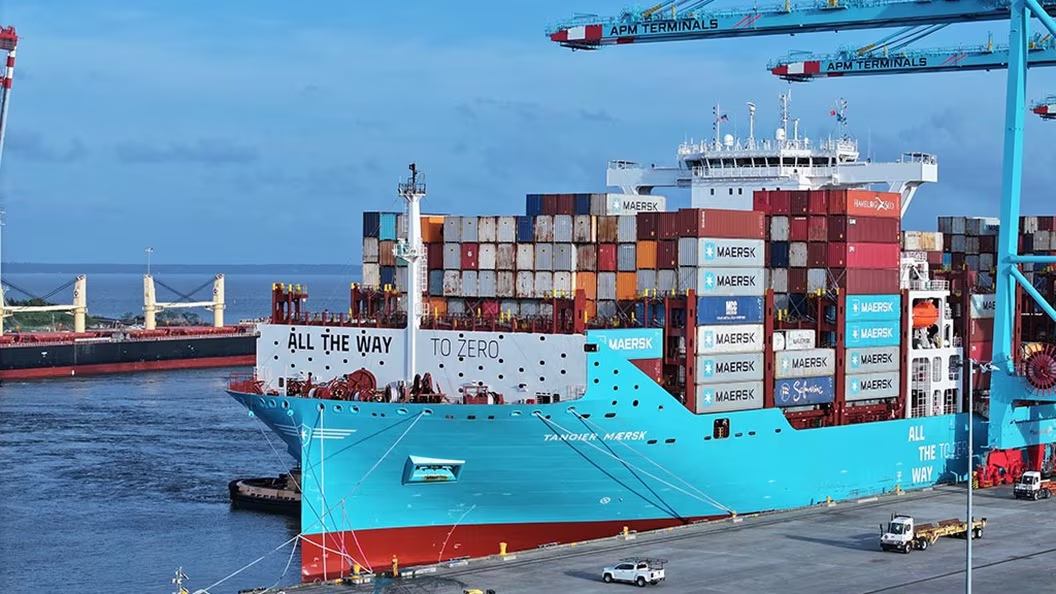
In September, A.P. Moller-Maersk completed the first publicly announced commercial ship-to-ship ethanol bunkering of a deep-sea containership in the United States. The operation involved the dual-fuel Tangier Maersk, which received U.S.-produced corn ethanol in Houston.
As gCaptain reported at the time, the operation was intended to provide practical experience with ethanol sourcing, handling, bunkering and onboard use as Maersk explores additional fuel options for its growing fleet of alcohol-capable vessels.
Engine developer WinGD subsequently confirmed that the vessel successfully sailed from Houston to New York using ethanol, marking the first in-service operation of its X-DF-M/E alcohol-fuel engine platform on the fuel.
The new study rates ethanol’s technology readiness at level 8–9, indicating that the underlying technology is mature, although widespread commercial deployment remains at an early stage.
It also highlights ethanol’s potential to reduce conventional air pollutants compared with heavy fuel oil. According to the report, ethanol virtually eliminates sulfur oxide emissions, reduces nitrogen oxides by 40% to 94%, depending on engine technology, and cuts particulate matter by 90% to 99%.
Those reductions concern emissions from fuel combustion rather than ethanol’s overall lifecycle greenhouse gas footprint, which depends on feedstock, production methods and supply-chain emissions.
The study also identifies potential cost advantages. It estimates ethanol’s net production cost, after accounting for revenue from co-products, at less than $1 per gallon, although that figure does not represent the delivered price of marine fuel.
Despite those advantages, significant hurdles remain before ethanol can become a widely traded marine fuel. These include developing consistent fuel specifications, establishing reliable certification and traceability systems, and ensuring that ethanol can meet the environmental requirements of emerging shipping regulations.
“Ethanol is moving beyond pilots, and this study shows the United States has the production base and export infrastructure to supply shipping at scale,” said Clarence Woo, managing director of the Global Centre for Green Fuels.
“The next challenge is consistency. As international bunkering grows, shipping needs standardised and fungible marine fuel specifications, together with traceable feedstocks and a robust chain of custody, so that ethanol from different producers and regions can be used with confidence.”
The study arrives as the International Maritime Organization prepares for another round of negotiations over its proposed Net-Zero Framework.
The IMO’s Marine Environment Protection Committee is scheduled to meet from November 30 to December 3, with a resumed extraordinary session provisionally planned for December 4, subject to confirmation. The discussions could influence how alternative fuels are assessed and rewarded under future international shipping emissions rules.
For U.S. ethanol producers, the marine fuel market represents a potential new source of demand, while shipowners could gain access to an established fuel supply chain without waiting for production of renewable methanol to expand.
However, the study’s projections remain illustrative, and the extent to which ethanol can compete with other marine fuels will depend on its delivered cost, lifecycle carbon intensity, regulatory treatment and commercial acceptance.
The report was published by MEMA, a platform of the Singapore-based Global Centre for Green Fuels. Classification society ABS provided technical analysis as a knowledge partner, while U.S. ethanol producer Marquis Energy contributed industry input. The findings and recommendations are those of MEMA.
The full study is available at Global Centre for Green Fuels

 Join The Club