Australia has completed its first green ammonia bunkering operation involving an ammonia-powered bulk carrier, marking another step toward bringing alternative fuels into commercial shipping.
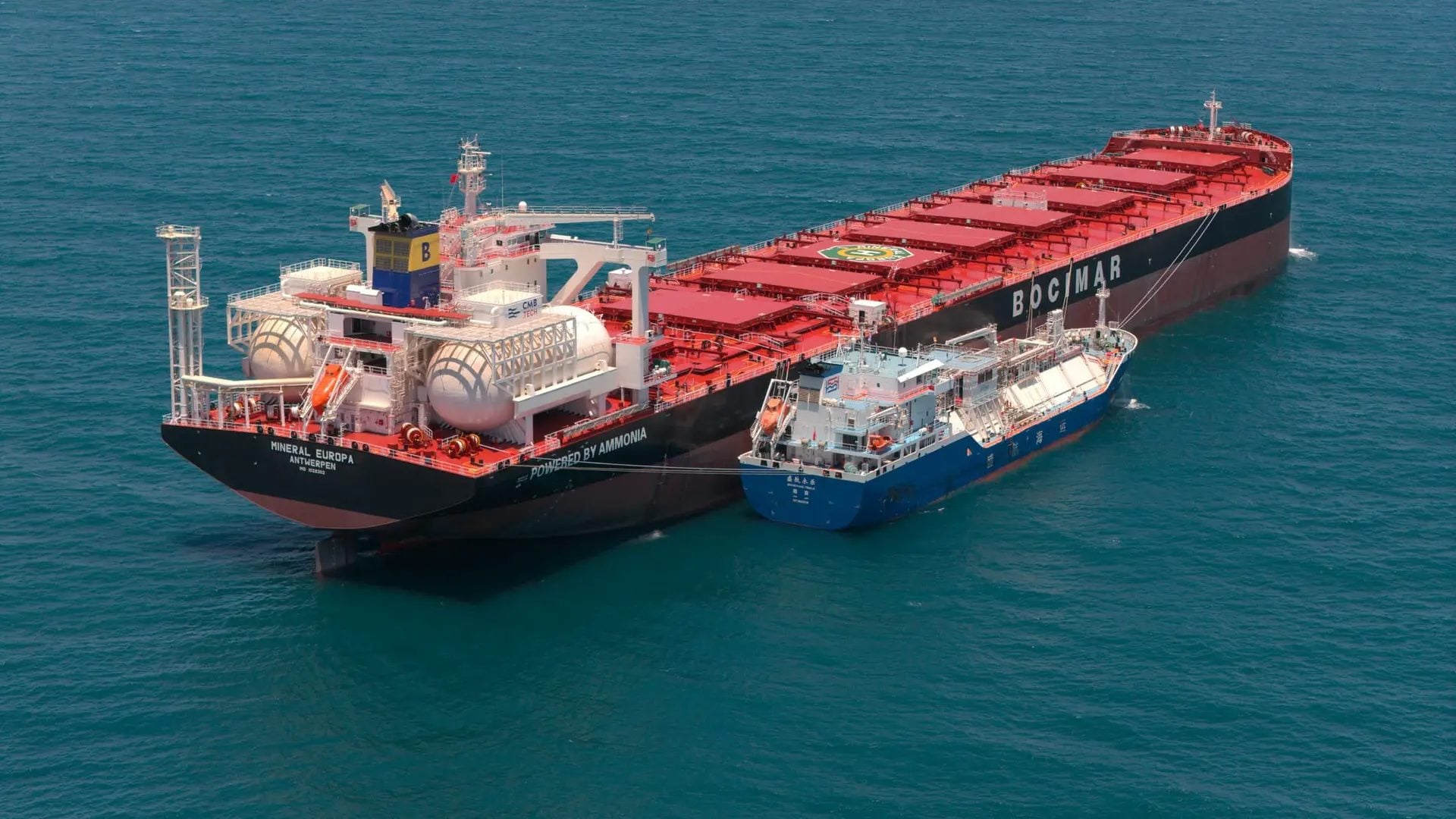
The operation took place earlier this week at the Port of Port Hedland in Western Australia, where the 300-meter Mineral Europa received certified green ammonia from a bunker vessel before entering port to load iron ore bound for China.
The vessel, described as the world’s first ammonia-powered dry bulk carrier, is operated by CMB.TECH and chartered to Australian mining giant Fortescue.
According to a joint announcement from Fortescue, Pilbara Ports and CMB.TECH, the ship-to-ship transfer took approximately two hours and was completed successfully at 8:42 a.m. local time.
The operation required extensive planning, including vessel compatibility assessments, ammonia dispersion modeling, emergency response procedures, and additional marine support. Port authorities said the trial proceeded only after all safety and operational requirements had been met.
The successful bunkering is particularly significant for the iron ore trade, which relies heavily on large bulk carriers transporting Australian exports to Asian steelmakers. Fortescue is seeking to reduce emissions from those voyages by introducing ammonia-powered vessels and developing a reliable supply of green marine fuel.
Unlike conventional marine fuels, ammonia contains no carbon and produces no carbon dioxide when used as fuel. Its overall emissions benefits, however, depend on how it is produced and on controlling other emissions, including nitrous oxide. Ammonia’s toxicity also presents additional challenges for ship operators, ports and bunker suppliers.
Fortescue Metals CEO Dino Otranto said the operation demonstrated that ammonia bunkering is moving beyond small-scale testing toward practical use in major commercial ports.
“Industry has moved ahead of regulation to prove the technology,” Otranto said.
He added that policy certainty and long-term fuel purchasing commitments would be needed to support further investment in green ammonia production and bunkering infrastructure.
Fortescue has been an early supporter of ammonia as a marine fuel. In 2024, its Fortescue Green Pioneer completed ammonia-fueled propulsion trials in Singapore, demonstrating the technology aboard a converted offshore support vessel.
The company has since expanded its commercial shipping ambitions through a partnership with CMB.TECH. In addition to Mineral Europa, Fortescue charters nine other vessels from the shipping group that can be converted to operate on ammonia in the future. The companies also announced an agreement earlier this year covering up to 12 ammonia-capable bulk carriers.
The Port Hedland operation builds on an earlier ship-to-ship ammonia transfer trial at nearby Dampier in September 2024, which helped establish procedures for handling ammonia between vessels.
Pilbara Ports is now studying the development of a clean fuel bunkering hub in the region, with the latest trial expected to inform future operations.
While ammonia-powered shipping still faces substantial hurdles involving fuel cost, availability, safety and regulatory standards, the Port Hedland operation demonstrates how the fuel could be supplied to large commercial vessels at one of the world’s busiest bulk export ports.
The companies did not disclose the quantity of green ammonia transferred during the operation.

 Join The Club