When you think of a Coast Guard rescue swimmer, the first thought that comes to mind is of a Coastie jumping out of a helicopter to pull someone to safety. But the Coast Guard has another kind of swimmer… the cutter surface swimmer.
The cutter surface swimmer program takes volunteer crewmembers with strong swimming skills and maritime knowledge and trains them in basic life-saving skills and recovery situations. The candidates go through a physical and written qualification process, where only the best qualified members are selected.
“The training builds you up to get you in the ocean. You learn in a controlled environment, and then, apply the training to a real life situation,” said Coast Guard Seaman Joshua Angelica, a cutter surface swimmer stationed aboard Coast Guard Cutter Waesche, homeported in Alameda, Calif
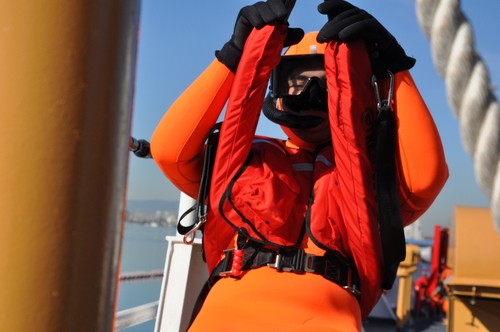
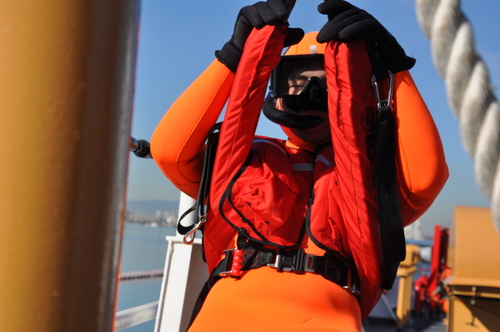
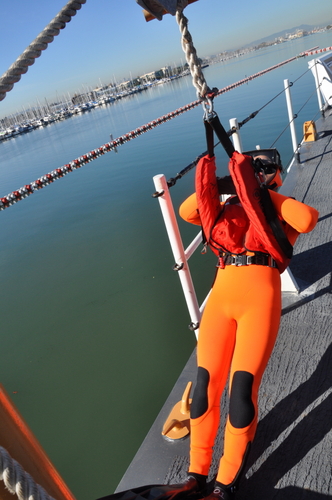
Seaman Angelica is one of two cutter surface swimmers aboard the Waesche and is constantly training and honing his qualifications in the event of a search and rescue mission. Coast Guard photo by Seaman Adam Stanton.
All cutters have at least one qualified surface swimmer aboard whereas cutters with flight decks have a minimum of two cutter surface swimmers aboard while the cutter is underway. Because deploying a surface swimmer off a cutter comes with risks, a certified line tender, responsible for tending the swimmer’s line and maintaining communication through a series of hand signals, is partnered with every surface swimmer.
The program has a dual purpose; providing for the safety of the general public in distress and for the crew in the event there is a shipmate overboard. While rescuing someone in a small boat is the preferred recovery method for persons in the water, a surface swimmer can be an ideal asset especially in cases where survivors are fatigued, entangled or injured.
“Its an eye opener of how challenging the conditions are in the ocean and in rough seas,” said Angelica discussing the training he and his fellow swimmers do on the open ocean. “As a cutter surface swimmer, you think about that worse case scenario where a person can’t move and a small boat cant get to them in really rough seas, we need to be prepared for that.”
The rigid training schedule surface swimmers maintain prepares them for real-life situations where every second counts. When disaster strikes at sea, and a life is in peril, you can count on the Coast Guard’s cutter surface swimmers to be ready to respond.
This article was originally posted to CG Compass by LTJG Stephanie Young
Story and photos by Seaman Adam Stanton
Tags:
Subscribe for Daily Maritime Insights
Sign up for gCaptain’s newsletter and never miss an update
The Coast Guard’s new credentialing portal promises complete applications and faster processing. One American ship captain tested it. What he found raises serious questions about automation, accountability, and whether Washington...
Rauma Marine Constructions in Finland has made rapid progress on the first of two Arctic Security Cutters it is building for the U.S. Coast Guard, with almost half of the vessel's blocks already launched and construction of the second ship approaching, according to the Finnish shipbuilder's chief executive.
The United States is watching China's presence in its Arctic zone "very closely" amid concerns regarding the security of the US homeland, a senior US Arctic military official said.
September 21, 2026
Total Views: 3676
Get The Industry’s Go-To News
Subscribe to gCaptain Daily and stay informed with the latest global maritime and offshore news
— just like 106,374 professionals
Secure Your Spot
on the gCaptain Crew
Stay informed with the latest maritime and offshore news, delivered daily straight to your inbox
— trusted by our 106,374 members
Your Gateway to the Maritime World!
Essential news coupled with the finest maritime content sourced from across the globe.

 Join The Club