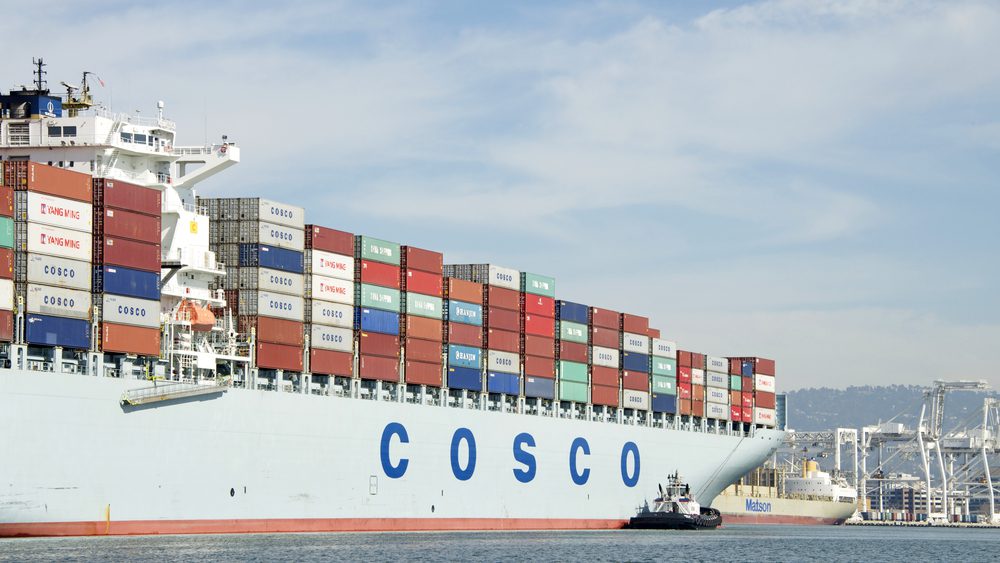
Import cargo volume at major U.S. container ports is forecast to hit its slowest monthly levels of the year in November and December as retailers complete their holiday stockpiling amid ongoing tariff volatility, according to the latest Global Port Tracker report from the National Retail Federation and Hackett Associates.
With most holiday merchandise already secured in warehouses or on store shelves, November volumes are projected at 1.85 million Twenty-Foot Equivalent Units, down 14.4% year-over-year, while December is expected to fall further to 1.75 million TEU, down 17.9%.December’s forecast would mark the slowest month since March 2023.
“We’ve spent most of the year worried about the impact of tariffs on both inflation and the supply chain but the holiday season is here and mitigation efforts appear to have paid off,” said NRF Vice President for Supply Chain and Customs Policy Jonathan Gold. “Store shelves are well stocked and the effect on prices has been minimized, largely thanks to retailers taking steps like frontloading imports during times of low or delayed tariff increases or absorbing the costs themselves. Consumers should be able to find the products they want at prices they like.”
The import slowdown comes against a backdrop of rapidly shifting trade policy. A 20% “fentanyl” tariff on China was reduced to 10% on November 10, and a twice-delayed increase in “reciprocal” tariffs has been pushed back for a year. However, an existing 10% reciprocal tariff under the International Emergency Economic Powers Act remains in place, with the Supreme Court having heard arguments on the legality of such tariffs.
U.S. ports handled 2.1 million TEU in September, down 9.3% from August and down 7.4% year-over-year.July’s peak of 2.39 million TEU now appears firmly in the rearview mirror as the traditional end-of-year slowdown takes hold.
The steep year-over-year declines are partially attributable to elevated 2024 volumes driven by port strike concerns, as well as this year’s tariff-driven frontloading that pulled forward late-year cargo.
“These conditions make market forecasting highly uncertain,” said Hackett Associates Founder Ben Hackett. “Our trade outlook is for a small decline in imports this year compared with 2024 and a further, larger decline in the first quarter of 2026.”
Data from Descartes’ global trade intelligence platform shows U.S. container imports declined 0.1% from September, reaching 2,306,687 TEUs in October—only the second October in the past decade to record a month-over-month decline. After volume declines in August and September, imports from China were up 5.4% over September but down 16.3% year-over-year. China’s share of total U.S. imports increased to 34.9% in October from 33.0% in September.
Top Chinese import categories all contracted year-over-year: toys/sporting goods fell 30.4%, furniture/bedding declined 13.6%, and electrical machinery dropped 17.2%.
“October’s performance likely signals ongoing caution among U.S. importers facing persistent geopolitical friction and regulatory volatility, which drive higher levels of supply chain uncertainty and complexity as policies shift and evolve quickly,” said Jackson Wood, Director of Industry Strategy at Descartes.
Despite the slowdown, NRF’s Global Port Tracker showed that the first half of 2025 totaled 12.53 million TEU, up 3.7% year-over-year. The full year is now forecast at 24.9 million TEU, down 2.3% from 2024’s 25.5 million TEU.
Looking into 2026, the NRF’s outlook remains challenging with January forecast at 1.98 million TEU (down 11.1%), February at 1.85 million TEU (down 9%), and March at 1.79 million TEU (down 16.7%).
The developments come as NRF forecasts 2025 holiday sales will increase between 3.7% and 4.2% compared with 2024 to just over $1 trillion.
Editorial Standards · Corrections · About gCaptain

 Join The Club