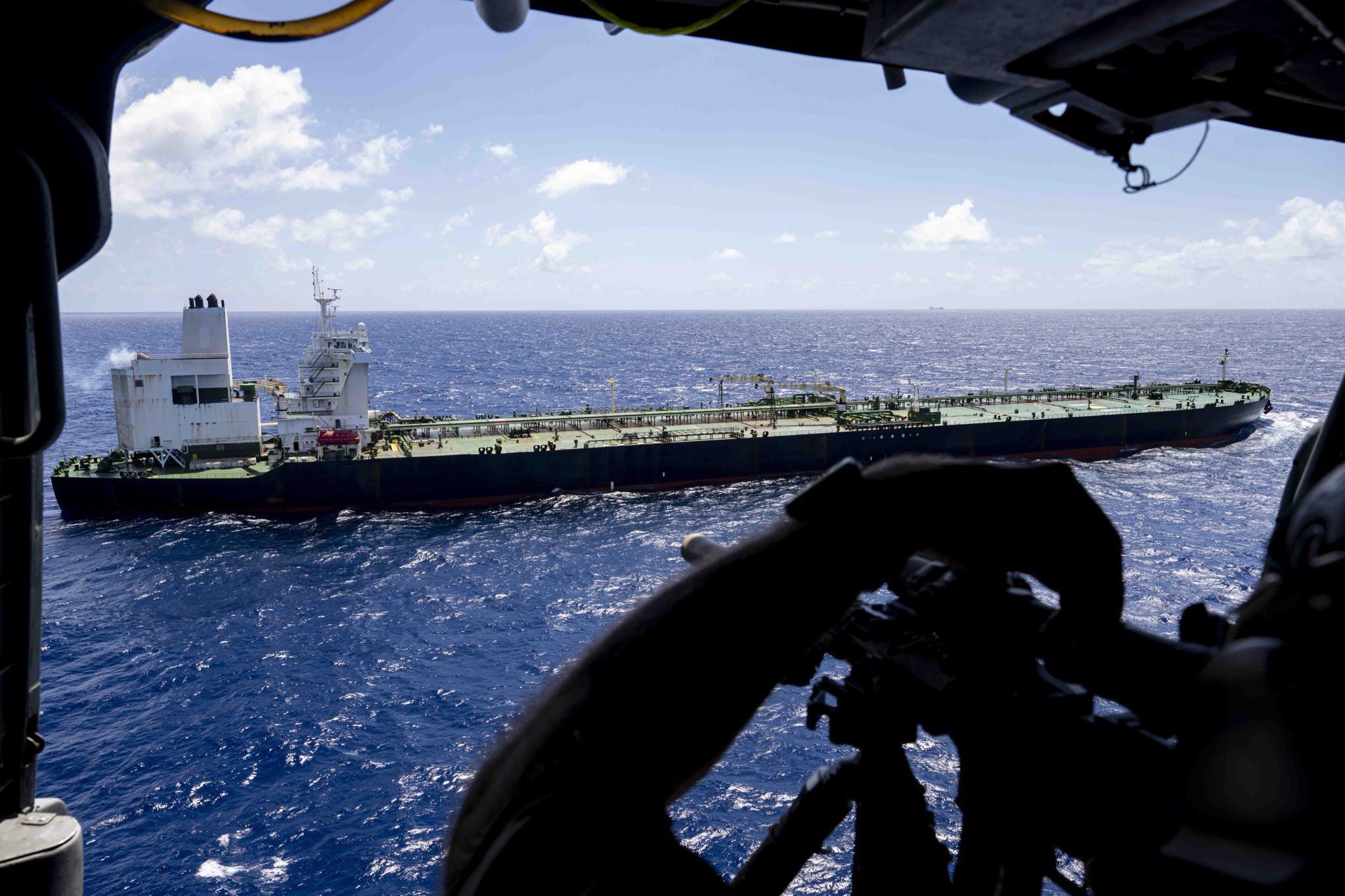
U.S. forces have boarded the sanctioned oil tanker Bertha in the Indian Ocean, marking the tenth vessel seized or interdicted in an intensifying campaign against the shadow fleet transporting illicit Venezuelan oil—one that spans from the Caribbean to the far reaches of the Indo-Pacific.
The Department of War announced the interdiction via social media, stating: “Three boats ran and now all three have been captured.”
“Overnight, U.S. forces conducted a right-of-visit, maritime interdiction and boarding of the Bertha without incident in the INDOPACOM area of responsibility,” the department said. “The vessel was operating in defiance of President Trump’s established quarantine of sanctioned vessels in the Caribbean and attempted to evade.”
The interdiction represents a significant milestone in what has become a globe-spanning enforcement operation. “From the Caribbean to the Indian Ocean, we tracked it and stopped it,” the Department of War said. “No other nation has the global reach, endurance, or will to enforce sanctions at this distance.”
Final Target in Sight
According to maritime intelligence firm TankerTrackers, Bertha (IMO: 9292163) was the last remaining oil-laden tanker from the original sixteen vessels that broke through the U.S. Navy blockade on January 3.
The tanker was sanctioned by the U.S. in December 2024 over its illicit transport of Iranian oil dating back to at least 2022. The vessel was managed and operated by China-based Shanghai Legendary Ship Management Company Limited at the time of the sanctions designations.
“The US Coast Guard has now managed to interdict BERTHA (9292163) just nine days after our tweet,” TankerTrackers stated, referring to their earlier prediction that the vessel’s capture was “only a matter of time.” The vessel operates under the alias “EKTA” in an attempt to evade detection.
“Enforcement actions like this should focus renewed attention on sanctioned tanker activity in the Eastern Outer Port Limits (EOPL) off Malaysia, near the Singapore Strait, where high-risk, illicit ship-to-ship transfers remain a critical node in the illicit oil supply chain,” said Charlie Brown, Director of the UANI Tanker Tracking Program. “Persistent monitoring, proactive info-sharing and coordinated enforcement are the only way to end the impunity with which dark fleet tankers have operated in the waters and sea lanes of Southeast Asia.”
Part of a Broader Crackdown
The boarding of Bertha comes just days after U.S. forces intercepted the Veronica III on February 15 in the South Indian Ocean, laden with Venezuelan fuel oil and crude oil. That vessel, which departed Venezuela on January 3—the same day Venezuelan leader Nicolás Maduro was captured—was carrying approximately 1.9 million barrels of crude oil and fuel oil.
The falsely-flagged Veronica III had also been sanctioned by the Treasury Department on December 2024, as part of a sweeping action targeting 35 entities and vessels linked to Iran’s petroleum trade. Treasury identified the tanker as managed by Shanghai Future Ship Management Co. Ltd., a Chinese firm accused of facilitating illicit Iranian oil shipments for years.
The February 9 interdiction of the Aquila II following a 10,000-mile pursuit from the Caribbean to the Indian Ocean marked the eighth tanker seizure or interdiction, and the first in the Indian Ocean, in the expanding crackdown.
The enforcement campaign accelerated sharply after President Trump announced a “complete blockade” of sanctioned oil tankers entering or leaving Venezuela in mid-December. Earlier seizures included the Veronica on January 15, the Olina on January 9, the M Sophia and Marinera on January 7, and the Skipper and Centuries in December.
Global Enforcement, Regional Tensions
“International waters are not a refuge for sanctioned actors,” the Department of War declared. “By land, air, or sea, our forces will find you and deliver justice.”
Russia has condemned the interdictions as illegal and warned of potential retaliation against U.S.-flagged vessels. U.S. Southern Command has defended the actions as lawful enforcement of U.S. sanctions policy, supported by significant military presence including carrier strike groups and amphibious forces in the region.
Targeting the Shadow Fleet
Treasury officials say the goal of the campaign is to choke off revenue streams tied to sanctioned oil exports while raising risks for insurers, traders, and service providers that continue to support shadow-fleet operations.
Iran, Russia, and Venezuela rely on sprawling networks of aging tankers and opaque ship management firms operating across multiple jurisdictions, using tactics such as false documentation, AIS manipulation, and constant changes to vessel names and flags to evade detection.
The pursuit and seizure operations underscore both the increasing lengths sanctioned operators will go to avoid detection—and the expanding geographic scope of U.S. efforts to stop them. The campaign now spans three oceans and shows no signs of slowing.
Editorial Standards · Corrections · About gCaptain

 Join The Club