Freight Audit & Payment is no longer defined only by invoice processing. It is evolving into a strategic discipline centered on governance, automation, intelligence, opportunity identification, and measurable business outcomes.
Global transportation has always been exposed to disruption. Geopolitical tension, maritime chokepoints, port congestion, labor uncertainty, fuel volatility, infrastructure constraints, regulatory changes, and capacity shocks are all part of the environment shippers operate in today.
The Strait of Hormuz is one example. The Red Sea is another. The Panama Canal, port labor disruptions, energy market volatility, changing trade policies, and shifting transportation provider networks all tell a similar story.
But the story should not be about one waterway, one headline, or one disruption. The larger story is that transportation has become too complex, too volatile, and too financially important to be managed through invoice processing alone.
That is why Freight Audit & Payment has reached a turning point. It is evolving from a back-office invoice function into Transportation Financial Intelligence: the ability to validate, understand, and act on transportation cost with speed, accuracy, and confidence.
The Evidence Behind the Evolution
The need for this evolution is already visible in the data. Freight invoices continue to contain measurable financial risk, and the findings are significant enough to matter at a global scale.
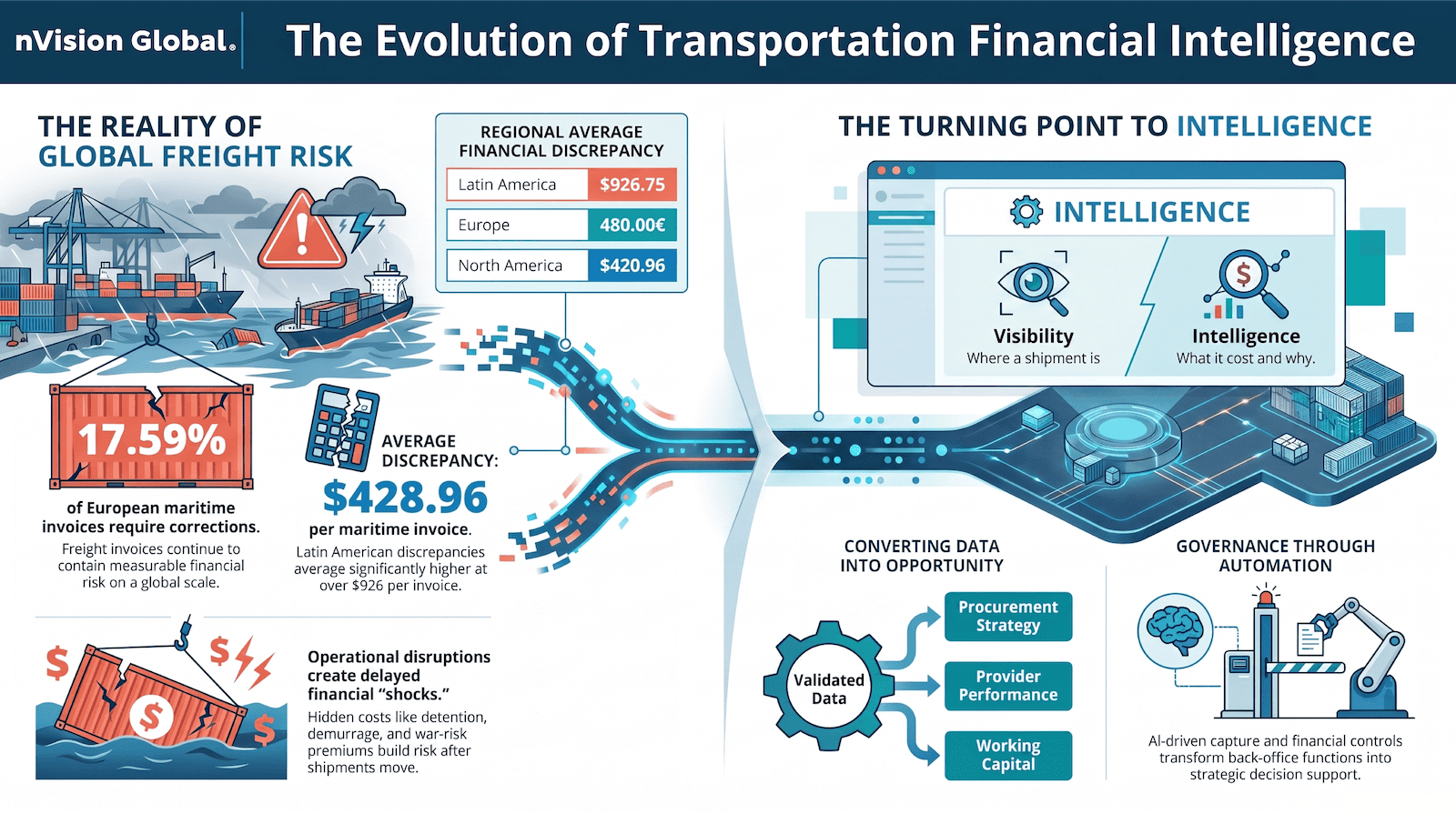
17.59% of all European maritime freight invoices reviewed by nVision Global require financial corrections.
11.19% of North American maritime invoices and 11.95% of European maritime invoices contain errors on average.
$428.96 is the average financial discrepancy nVision identifies across all maritime invoices; the average is $420.96 in North America, 480 euros in Europe, and $926.75 in Latin America.
Historically, numbers like these explain why companies around the world have needed Freight Audit & Payment: to validate invoices, prevent overpayments, recover discrepancies, and protect margin. Today, they also point to the next evolution of the industry.
When discrepancy data is connected across regions, transportation providers, lanes, contracts, accessorials, business units, and exception types, it becomes more than an audit result. It becomes intelligence. It helps organizations identify opportunities for cost reduction, contract improvement, procurement strategy, provider performance, process improvement, compliance, governance, working capital, and customer service.
Transportation Risk Has Become Financial Risk
Most organizations do not control geopolitical events. They do not control whether vessels are rerouted, insurance premiums increase, fuel prices move, ports become congested, or transportation providers introduce emergency surcharges.
What they can control is how prepared they are to manage the financial impact.
When disruption occurs, the operational impact is usually visible first. Shipments are delayed, routes change, capacity tightens, service levels shift, and procurement teams look for alternatives. The financial impact often appears later in freight invoices, accessorial charges, fuel adjustments, detention and demurrage bills, spot rate exceptions, war-risk premiums, emergency surcharges, and contract variances.
That gap between transportation activity and financial understanding is where risk builds. The question is no longer simply, “Where is my shipment?” The better question is, “What is the financial impact of what just happened across my transportation network?”
Freight Audit & Payment Has Reached a Turning Point
For decades, Freight Audit & Payment was measured by the number of invoices processed, payment accuracy, and operational efficiency. Those capabilities remain important, but they no longer define industry leadership.
Today, organizations expect Freight Audit & Payment to deliver governance, financial intelligence, opportunity identification, measurable business outcomes, and better decision support. They need more than invoice validation. They need to understand why costs are changing, where risk is increasing, and what actions can improve financial performance.
The invoice is not just a payment document. It is a financial record of what happened across the transportation network. It reflects contracted rates, routing decisions, accessorial charges, fuel formulas, service-level changes, approval workflows, documentation quality, transportation provider behavior, exception management, and the operational realities that occurred before the invoice was ever received.
When connected and analyzed properly, that information becomes a source of business intelligence. That is the turning point. The next generation of Freight Audit & Payment is defined by the ability to convert validated freight data into insight, control, and action.
From Visibility to Intelligence
Transportation visibility tells a company where a shipment is. Transportation Financial Intelligence explains what that shipment cost, why it cost that amount, whether the charge was valid, and what the business should learn from it.
That distinction matters. Visibility alone does not validate a fuel surcharge, confirm whether a risk fee applied to the correct lane, identify duplicate accessorials, show whether a spot move was approved, or explain why one business unit is seeing higher cost increases than another.
That requires a different level of intelligence. By connecting Freight Audit & Payment expertise, data capture, contract validation, exception management, analytics, and business intelligence, companies can see not only what changed, but why it changed and what it means financially.
Opportunity Identification Is the New Standard
Disruption creates exceptions, and exceptions create opportunity. A shipment may move under a different contract. A routing guide may be bypassed. A spot rate may be approved. A higher-cost service may be used to protect production or customer commitments. Each decision may be necessary, but collectively these exceptions can create significant financial exposure if they are not documented, validated, and analyzed.
The goal is not only to catch invoice errors after the fact. The goal is to understand the pattern behind the exceptions. Which transportation providers are producing the most exceptions? Which lanes are creating the greatest financial risk? Which accessorials are increasing the fastest? Which business units are approving the most off-contract moves? Where should procurement renegotiate? Where can better controls prevent future leakage?
This is where Freight Audit & Payment becomes a decision-support function. Optimization may be one outcome, but the broader objective is opportunity identification: using validated transportation financial data to find better decisions across logistics, procurement, finance, and leadership.
Why nVision Global Is Different
nVision Global is helping lead the evolution of Freight Audit & Payment into Transportation Financial Intelligence by combining capabilities that many organizations still manage separately.
Unlike traditional Freight Audit & Payment providers that primarily validate invoices and issue payments, nVision brings together AI-driven data capture, governance, financial controls, transportation intelligence, business intelligence, exception management, global operations, and supply chain solutions within one connected ecosystem.
Through Freight Audit & Payment, IMPACT TMS, nSure AI Data Capture, claims management, procurement support, and business intelligence, nVision helps organizations validate transportation provider invoices, identify cost trends, manage exceptions, strengthen financial controls, improve visibility, reduce manual effort, support better procurement decisions, and protect transportation investments.
The data behind invoice corrections and discrepancies is not only used to recover or prevent overpayments. It also helps reveal where costs are changing, where contracts need attention, where provider performance is creating exposure, where processes are breaking down, and where the business has opportunities to improve.
The Future of Freight Audit & Payment
The companies best prepared for the future will not be the ones that simply react to each market event as it happens. They will be the ones that have already built the systems, controls, data discipline, and intelligence needed to understand and manage transportation cost in any environment.
The headline may change. The geography may change. The transportation mode may change. The cause may change. But the financial pattern is often the same: uncertainty creates cost, cost creates invoice complexity, invoice complexity creates risk, risk requires control, and control requires intelligence.
This is where Freight Audit & Payment is headed. Not just invoice processing. Not just payment accuracy. Not just visibility. Transportation Financial Intelligence.
And that is why nVision Global is helping define and lead the evolution of Freight Audit & Payment into Transportation Financial Intelligence.
Tags:

 Join The Club