The world’s most vital energy artery is under siege. Following coordinated U.S. and Israeli strikes that killed Iran’s Supreme Leader Ayatollah Ali Khamenei and top military commanders, the Strait of Hormuz—through which roughly 20% of global oil supply flows—has become a war zone, forcing major shipping lines to halt operations and sending hundreds of vessels to seek shelter in open waters.
The escalation has been swift. Iran’s Revolutionary Guard Corps responded with sustained missile and drone attacks targeting both military installations and commercial shipping across the region. Three U.S. service members have been killed in action, while Iranian strikes on civilian vessels mark an ominous expansion of the conflict’s scope.
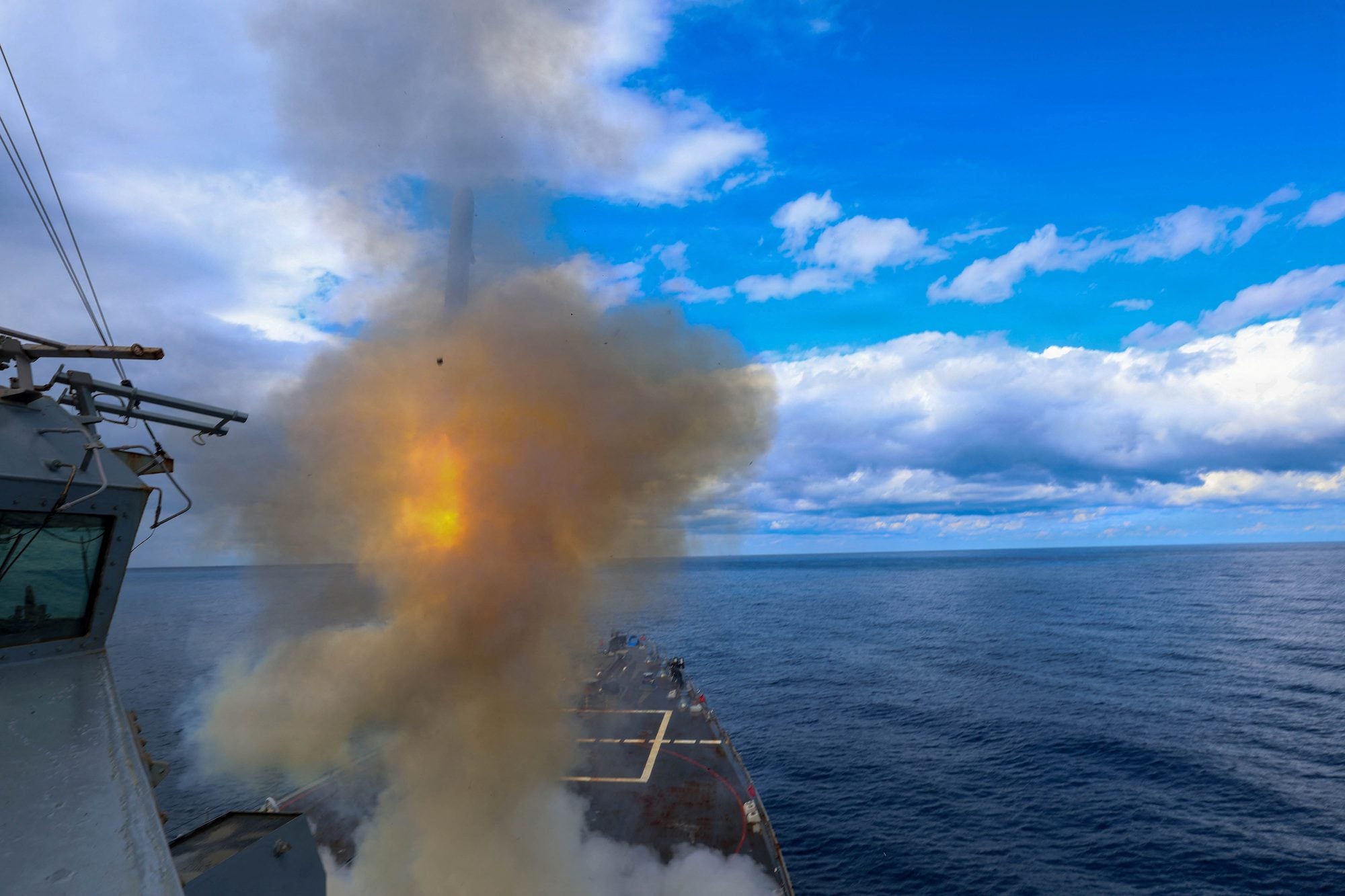
President Trump confirmed the sinking of nine Iranian naval vessels in a social media post, declaring: “We are going after the rest – They will soon be floating at the bottom of the sea, also! In a different attack, we largely destroyed their Naval Headquarters.”
U.S. Central Command previously confirmed the sinking of an Iranian Jamaran-class corvette at a pier in Chah Bahar during the opening hours of the operation, which the Trump Administration is calling Operation Epic Fury.
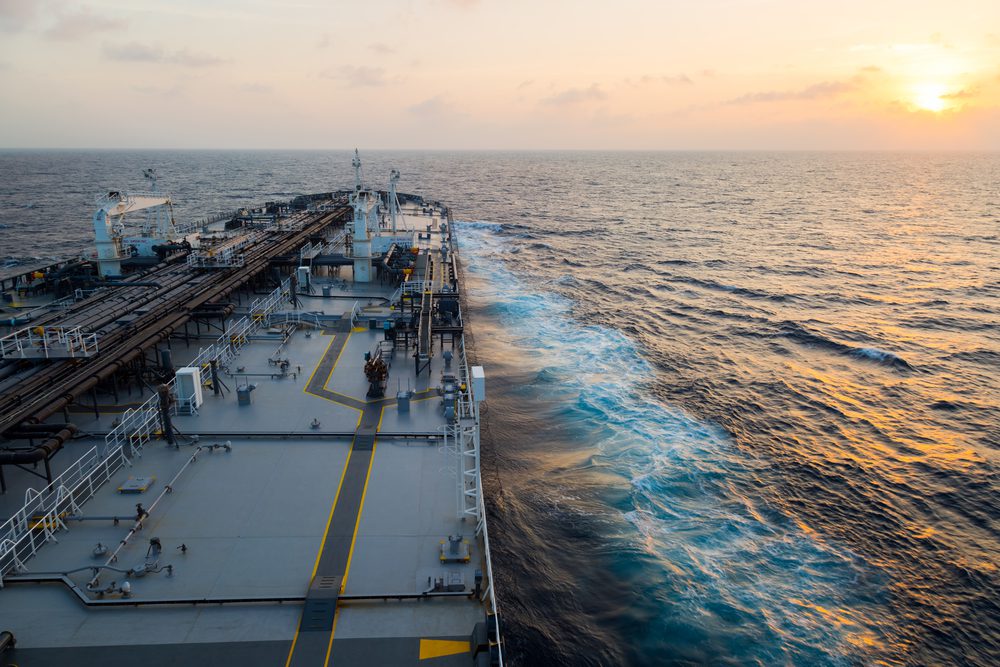
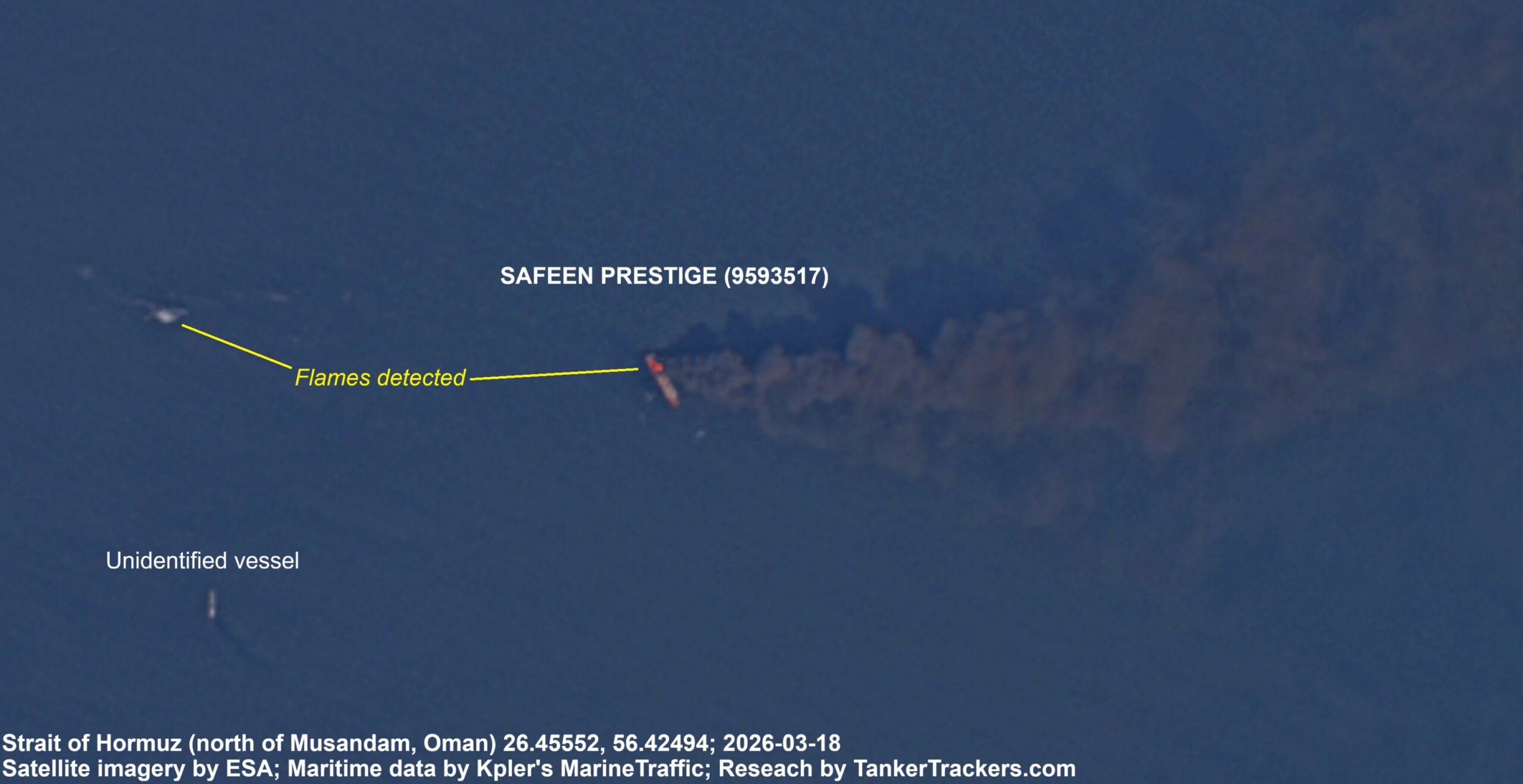
The impact on commercial shipping has been immediate and severe. Within 24 hours, at least three tankers had been struck by missiles or drones in what maritime security officials describe as indiscriminate attacks. The oil tanker Skylight was hit 5 nautical miles north of Khasab, Oman, forcing crew evacuation and injuring four. The crude carrier MKD Vyom took a projectile strike above the waterline, sparking an engine room fire that was later controlled. A third vessel, the Sea La Donna, also reported an attack.
Concerningly, the Joint Maritime Information Center has “found no association that would make these vessels a viable candidate for targeting and attack,” underscoring that merchant ships of any flag or nationality now face existential risk in Gulf waters.
The JMIC has elevated the regional threat level to CRITICAL—its highest classification—warning that “an attack is almost certain.” While Iran has not formally closed the Strait of Hormuz, the operational reality reflects “active kinetic hazard conditions” throughout the waterway.
Major shipping companies have responded with unprecedented action. Maersk announced it is “suspending all vessel crossings in the Strait of Hormuz until further notice,” while also rerouting its ME11 and MECL services around the Cape of Good Hope to avoid the Bab el-Mandeb Strait.
MSC Mediterranean Shipping has taken even more drastic measures, instructing “all MSC vessels currently operating in the Gulf region, as well as those en route” to proceed to “designated safe shelter areas until further notice.” The company has also temporarily suspended all worldwide cargo bookings to the Middle East region.
German carrier Hapag-Lloyd said Sunday it has suspended all vessel transits through the Strait of Hormuz.
CMA CGM has activated emergency security measures and ordered all vessels inside or bound for the Gulf to proceed to shelter, suspended Suez Canal transits, and is rerouting ships via the Cape of Good Hope. The French carrier says it will impose an Emergency Conflict Surcharge effective March 2, 2026, citing security risks tied to escalating tensions. The surcharge ranges from $2,000 per 20-foot container to $4,000 for reefers and special equipment, covering cargo to and from Gulf and Red Sea countries. It applies to new bookings, unshipped cargo, and cargo already afloat.
“The safety of seafarers is paramount,” stressed World Shipping Council President and CEO Joe Kramek said. “Seafarers must not be targeted or placed at risk as a result of conflict, and the fundamental principle of freedom of navigation must be respected.”
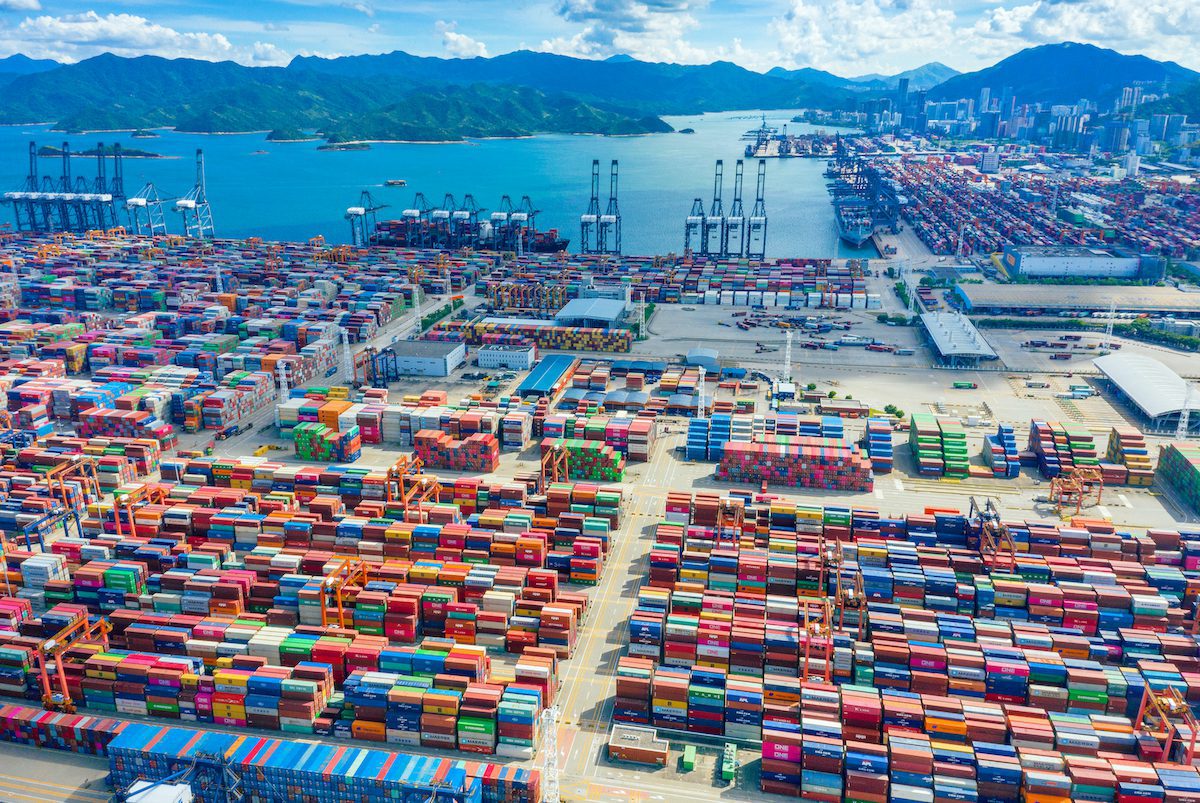
An update from Poten & Partners indicated Japanese shipping giants Nippon Yusen, Mitsui O.S.K. Lines, and Kawasaki Kisen have similarly halted all Hormuz operations, directing vessels to anchor in safe waters. Shipping data indicates hundreds of crude and LNG tankers have dropped anchor outside the chokepoint, clustered off the Gulf and Arabian Sea in what amounts to a near-standstill in transit, according to Poten.
The traffic slowdown is measurable. Historical data shows an average of 138 vessels transit the Strait daily. In the past 24 hours, only 110 vessels made the passage—a reduction that may represent “a temporary reactionary pause or surge displacement rather than a sustained structural decline,” according to JMIC’s update the situation.
Compounding navigation risks, significant GNSS interference continues across the region, causing positional offsets, AIS anomalies, and intermittent signal degradation. Under the current aerial threat environment and congestion challenges, this “degraded positional integrity acts as a risk amplifier, increasing probability of navigational incident or miscalculation,” maritime authorities warned.
The insurance market has moved decisively in response. Steamship Mutual issued a formal Notice of Cancellation of War Risks coverage for the Persian/Arabian Gulf and adjacent waters, with cancellation effective 72 hours after 0000 GMT on March 1, 2026. “Insurance market posture now aligns with the JMIC elevation of the regional maritime risk level to CRITICAL,” the agency noted.
Oil markets have reacted sharply. As of March 1, Brent Crude jumped approximately 10% in over-the-counter trading to around $80 per barrel, up from roughly $73 before the weekend strikes, according to Poten’s update. JPMorgan and Barclays analysts warn prices could spike to $100–$130 per barrel if the conflict results in prolonged supply disruption.
Judah Levine, Head of Research at Freightos, assessed the broader implications: “The US-Israel strikes on Iran and subsequent Iranian retaliation targeting multiple countries in the area are driving significant logistics disruptions in the region which could start to be felt more broadly if the conflict stretches on.”
He added: “While Iran has banned US vessels from transiting, it has not officially closed the Strait of Hormuz. But two oil tankers were attacked on Sunday nearby and the Iranian Revolutionary Guard Corps has warned passing vessels that transits are not safe.”
Alternative export routes exist but remain severely limited. Saudi Arabia can utilize a pipeline into the Red Sea carrying about 5 million barrels per day, while the UAE can pipe 1.5 million barrels daily to Fujairah for export. Iraq can move some crude into the Mediterranean but only from northern oil fields. Others, including Iran, have no options but to transit Hormuz via ship for export.
The conflict has also expanded to U.S. allies and infrastructure. U.S. Central Command said in a statement on social media that the Iranian regime is “actively targeting civilians,” alleging missile and drone strikes against more than a dozen civilian sites across the region. CENTCOM listed major infrastructure and residential targets including Dubai International Airport, Kuwait International Airport, Zayed International Airport, Erbil International Airport in Iraq, multiple hotels in Dubai and Bahrain, the Port of Dubai, and residential neighborhoods in Israel, Bahrain, and Qatar.
The UAE Ministry of Defence confirmed that two Iranian drones targeted a warehouse at Al Salam naval base in Abu Dhabi, causing a fire with no casualties. The ministry condemned the attack as “a blatant act of aggression and a flagrant violation of national sovereignty and international law,” affirming the UAE “reserves its full right to respond to this escalation.”
French Health Minister of Armed Forces and Veterans Catherine Vautrin said a hangar at France’s naval base in Abu Dhabi—located next to an Emirati facility—was struck in a drone attack targeting the port. She described the damage as limited and purely material, with no injuries reported, adding that French forces remain on maximum alert as the situation continues to evolve hour by hour. France has reportedly deployed its aircraft carrier Charles de Gaulle to the Eastern Mediterranean following the attacks.
Meanwhile, the Yemen-based Houthis have threatened to launch new attacks against Israel and U.S. ships interest and shipping in the Red Sea and the Gulf of Aden.
Global leaders are urging a return to diplomatic talks as concerns mount over uncontrollable escalation and the potential for broader regional war. Yet the operational outlook for the next 24-48 hours remains grim. Maritime authorities project that “the aerial threat from missiles and drones will not change” and that “the risk of collateral damage remains HIGH.”
For now, the maritime industry faces an unprecedented crisis. With the world’s most critical energy chokepoint under active fire, hundreds of vessels at anchor, and insurance coverage withdrawn, the global supply chain confronts a disruption that could reshape trade flows for months to come.
Updated: March 19, 2026 (Originally published March 1, 2026)
Editorial Standards · Corrections · About gCaptain

 Join The Club