File photo (c) MarineTraffic.com
 By Phil Stewart and Jonathan Saul
WASHINGTON/LONDON, May 14 (Reuters)
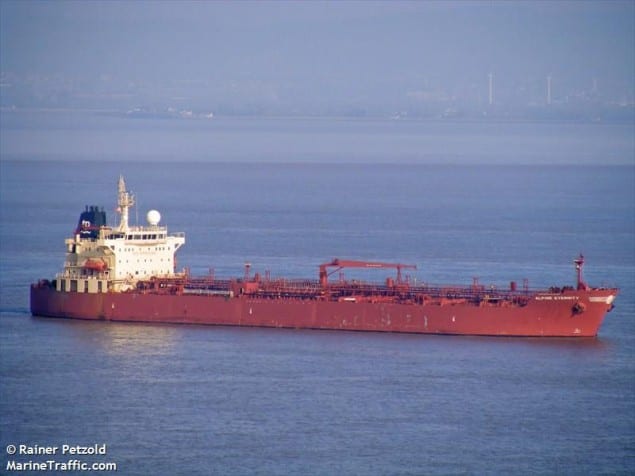
[contextly_sidebar id=”KXrbkbxPc1qzriXUwW2cpUpQTTq0VKpE”]Iranian naval vessels fired shots at a Singapore-flagged tanker in the Gulf on Thursday, in what appeared to be Iran’s latest attempt to settle a legal dispute by force with passing commercial vessels, U.S. officials said.
The incident unnerved the shipping industry just as President Barack Obama met with Gulf allies to try to allay their concerns that Iran would be empowered by a deal to curb Tehran’s nuclear program in exchange for the West lifting sanctions.
U.S. officials, speaking to Reuters on condition of anonymity, said five Iranian Revolutionary Guard Corps Navy ships approached the Alpine Eternity oil products tanker at about noon (0800 GMT), prompting the ship to flee to safety in United Arab Emirates’ waters.
One U.S. official, speaking on condition of anonymity, said Iran had attempted to intercept the vessel in international waters because Tehran says the tanker is liable for damage to an Iranian-owned oil platform it hit on March 22.
The White House, Pentagon and State Department declined to confirm emerging details about the episode but acknowledged concern about Iran’s conduct.
“This is exactly the type of challenge that many of the (Gulf) partners are focused on,” said White House Deputy National Security Adviser Ben Rhodes.
Two weeks ago, Iranian patrol ships diverted a Marshall Islands-flagged container vessel from the Strait of Hormuz to settle a years-old debt case.
Shipping industry officials said they were bracing for the likelihood of even more tensions at sea, which could lead to a spike in shipping costs.
“The pattern looks like the Revolutionary Guards are using a commercial pretext to intervene in the incidents to date,” said one shipping underwriter. “This could start to impact upon (insurance) rates.”
The Pentagon did not rule out again ordering U.S. warships to accompany commercial vessels passing through the Strait of Hormuz, as it did after the last incident.
The tanker’s owner, South Maritime Pte Ltd, said in a statement that the ships, which it believed to be Iranian, first fired warning shots but then directly fired on the vessel after it ignored an order to stop.
“No serious damage was sustained by the vessel and none of the 23 crew members were injured,” the statement said. The owner said the vessel safely reached the port of Jebel Ali.
Millions of barrels of oil are transported daily through the Bab el-Mandeb and Strait of Hormuz to Europe, the United States and Asia, waterways which pass along the coasts of Yemen and Iran respectively.
The episode in the Gulf coincided with mounting concern over an Iranian cargo ship headed to Yemen. A Saudi Arabia-led coalition has imposed an air and maritime blockade to stop weapons supplies reaching the Iran-allied Houthi rebels.
Brigadier General Massoud Jazayeri, Deputy Chief of Iran’s Armed Forces, warned of war if the ship, which Tehran says is carrying humanitarian supplies, was attacked.
Still, the Pentagon on Thursday said Iran had so far at least refrained from dispatching warships to accompany the cargo vessel, despite announcing plans to do so. (Reporting by Phil Stewart in Washington and Jonathan Saul in London; Editing by Will Dunham, James Dalgleish, Grant McCool)
© 2015 Thomson Reuters. All rights reserved.
Updated: May 22, 2015 (Originally published May 14, 2015)
Editorial Standards · Corrections · About gCaptain
This article contains reporting from Reuters, published under license.

 Join The Club