Above is an AIS recreation of the refloating from VesselTracker:
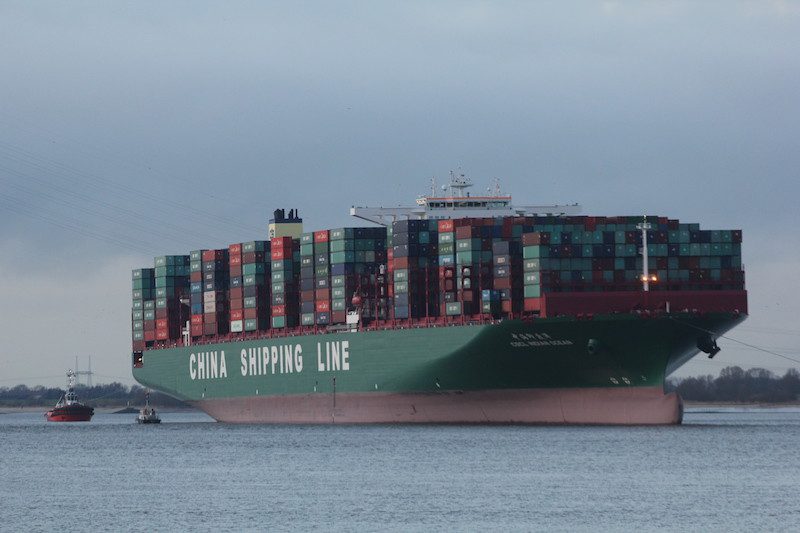
One of the world’s largest containerships was pulled free overnight after spending five days hard aground on Germany’s Elbe River.
The operation to refloatCSCL Indian Ocean began at precisely 2 a.m. when an army of 12 tugboats were simultaneously ordered to push and pull the 399-meter ‘megaship’ until it dislodged from the sandy riverbed.
By 2:06 a.m., the On-Scene Coordinator for Germany’s Central Command for Maritime Emergencies (CCME) radioed to the fleet: “the stern of the vessel has been towed off the bank”. By 2:20 a.m., the CSCL Indian Ocean was fully afloat and back in the shipping channel leading to the port of Hamburg. The vessel was later towed the port by five tugs and tied up at Eurogate Container Terminal Predöhlkai.
According to the CCME, leading the salvage, initial inspections showed that the ship is fully functional, including operation of the rudder which some have speculated may have failed and contributed to the grounding.
A pollution control vessel monitoring the salvage has confirmed no pollution in the river.
Since the grounding of CSCL Indian Ocean last Wednesday night, crews have worked to lighten the ship and dredge soil from around the vessel in preparation for Tuesday morning’s salvage attempt, when an extra-high spring tide meant high water more than one meter above average.
In the four days leading up to the refloat, the ship was lightened by more than 6,500 tons through the removal of heavy fuel oil, gas and ballast water, while dredgers removed 65,000 cubic meters of soil from around the grounded ship. Twenty-six vessels and pollution control aircraft were involved in the operation since it was handed over to the CCME after initial attempts to refloat the ship that first day were unsuccessful.
The MV CSCL Indian Ocean, one of the world’s largest containerships, aground on the Elbe River, February 5, 2016. Photo: Central Command for Maritime Emergencies
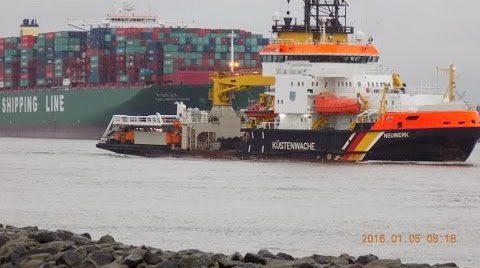
Assisting CCME in Tuesday morning’s operation, KOTUG Offshore and Smit Salvage helped draw up the salvage plan, which involved the oceangoing tugs Union Manta and Fairmount Expedition, six Bugsier tugs, four from Kotug, two water police boats, the multi-purpose vessel Neuwerk, a local fire department and a Do228 aircraft.
The CSCL Indian Ocean was en-route to Hamburg when it ran aground at about 22:00 hrs Wednesday, Feb 3, on the Elbe near Lühesand. The ship is one of 5 China Shipping Container Lines ships with the capacity to carry 19,100 twenty foot containers and used to transport goods from Asia to Northern Europe.
The Elbe River has been reopened to ship traffic after being closed during the reloating operation. The river remained open but with minor restrictions throughout the salvage.
Dec 11 (Reuters) – Germany’s top fiscal court has ruled that authorities cannot for now sell or otherwise use an oil tanker and its cargo seized off the Baltic Sea coast, siding with the vessel’s owners...
(Bloomberg) — China disputed Germany’s accusation that one if its warships behaved dangerously toward a military aircraft in the Red Sea, an incident that Chancellor Friedrich Merz called “totally unacceptable.”...
Germany summoned the Chinese ambassador to the foreign ministry on Tuesday after saying China's military had laser targeted a German aircraft taking part in an EU operation in the Red Sea.
July 8, 2025
Total Views: 1514
Get The Industry’s Go-To News
Subscribe to gCaptain Daily and stay informed with the latest global maritime and offshore news
— just like 107,342 professionals
Secure Your Spot
on the gCaptain Crew
Stay informed with the latest maritime and offshore news, delivered daily straight to your inbox
— trusted by our 107,342 members
Your Gateway to the Maritime World!
Essential news coupled with the finest maritime content sourced from across the globe.

 Join The Club