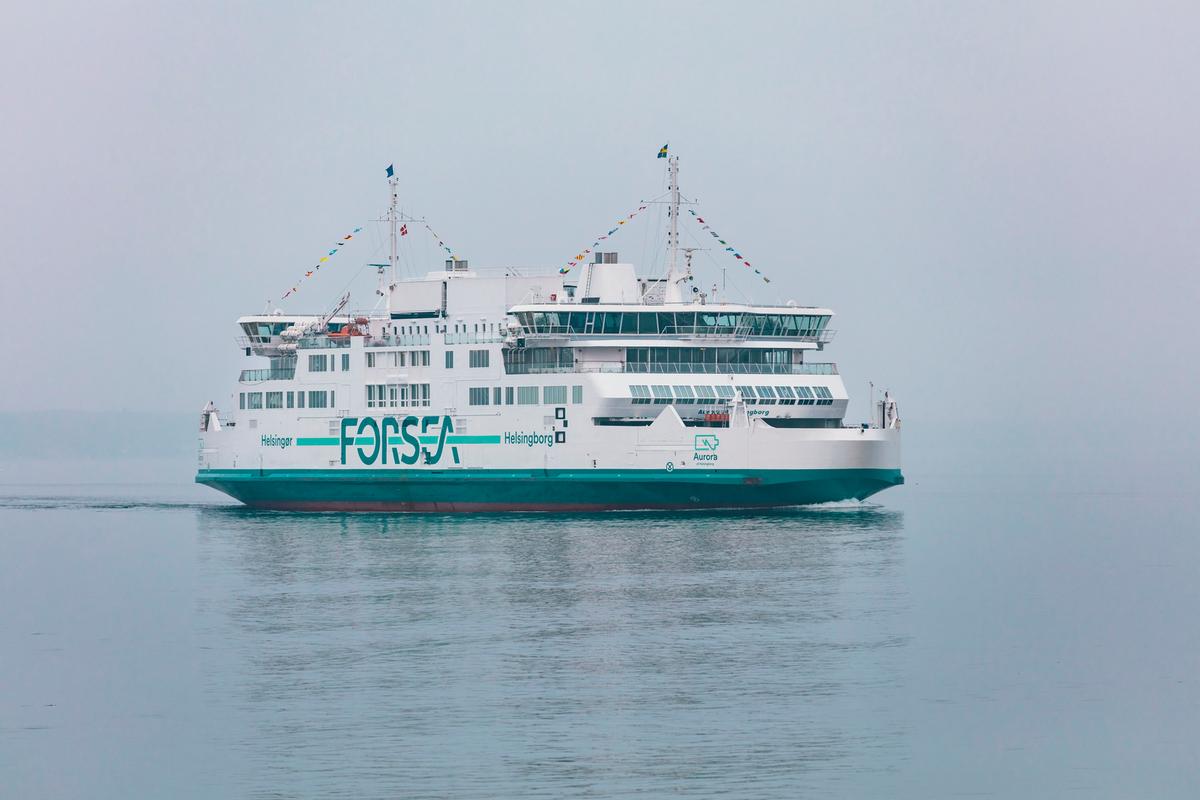
ForSea’s battery-powered Aurora ferry. Photo: Forsea / Anders Ebefeldt
 By Ilze Filks HELSINGOR, Denmark, March 14 (Reuters) – A quiet revolution has taken place in the Oresund Strait between Sweden and Denmark where two of the world’s largest battery-powered ferries ply the waters after being converted from polluting diesel power.
The Tycho Brahe and Aurora ferries operated by Sweden’s ForSea are over 100 meters long and work the busy 4 km crossing between Helsingborg in Sweden and Helsingor in Denmark.
The route handles more than 7 million passengers and almost 2 million vehicles each year with crossings every 15 minutes.
Conversion of the two ships involved the installation of 4.16 megawatts of battery power on each ferry as well as shore-based infrastructure.
Using industrial robotics and wireless communications to optimize connection times, charging takes less than 6 minutes in Denmark and 9 minutes in Sweden, according to Christian Andersson, a senior chief engineer at ForSea.
The company, in support of Stockholm’s aim to be greenhouse gas emissions neutral by 2045, is also sourcing the power for the batteries from renewable energy sources only.
“All the power is from wind or water power so it’s totally green,” Andersson told Reuters.
“I think the greatest feature of this is the transformation from a conventional diesel electric ship to a battery-powered ship. We have done this transformation in about eight weeks,” Andersson said.
The output of some 28,000 tonnes of carbon dioxide per year had been prevented, he said, adding this would have a positive impact on the air quality in both cities.
Crossing times have not changed but as drivers of electric vehicles experience, the response from electric power is more immediate, Andersson said.
“When the captain is maneuvering the ship he will get the power much more quicker,” he said.
The Tycho Brahe and Aurora entered service last November and are currently the world’s largest emissions-free ferries operating on a high-intensity route, according to ForSea.
(Reporting by Ilze Filks; editing by Jason Neely)
(c) Copyright Thomson Reuters 2019.

 Join The Club