Don’t Miss Your Daily Briefing for the Maritime Industry
Join the leading maritime news network
— trusted by our 107,414 members
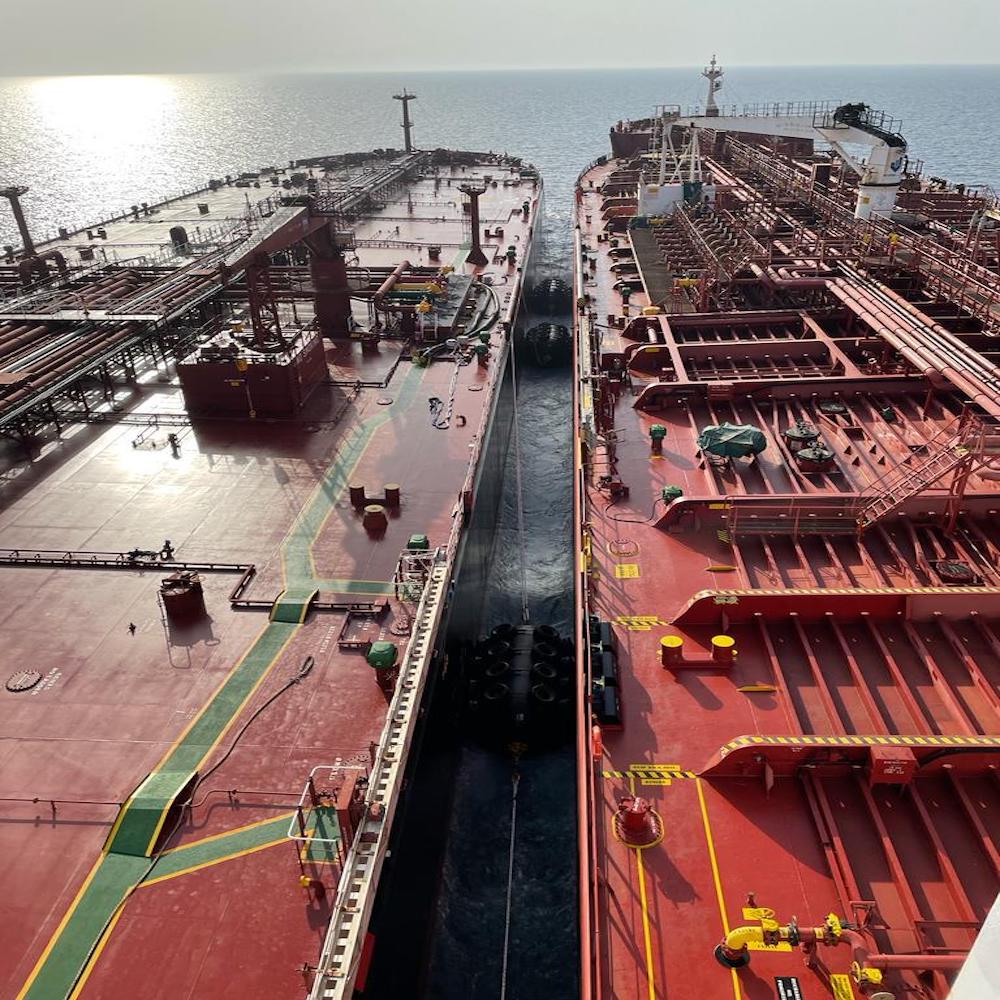
The Saudi Ports Authority (Mawani) and Aramco Trading have joined forces to unveil a new Ship-to-Ship (STS) transfer service for petroleum products at the King Fahad Industrial Port in Yanbu. Photo Credit Mawani.
Supertankers Build Up in Red Sea as Saudi Arabia Races to Bypass Hormuz
Mar 13, 2026 (Bloomberg) –Saudi Arabia’s race to bypass the Strait of Hormuz has led to a buildup of oil supertankers waiting off the kingdom’s Red Sea coast to collect cargoes, as Riyadh tries to overcome unprecedented disruption caused by the Iran war.
In the past day or so, 11 very-large crude carriers reached the port of Yanbu and are now waiting nearby before starting loading, ship-tracking data compiled by Bloomberg show.
Saudi Aramco, the state oil giant, has said shipments will soon reach 5 million barrels a day, but the infrastructure to do that has never been tested to this extent before.
That’s left traders watching closely the pace at which the country can load cargoes onto an influx of tankers racing toward the port.
Oil prices have surged to near $100 a barrel since the Iran war began, with the International Energy Agency describing the effective closure of the critical Hormuz choke-point as the biggest hit to global production on record.
Waiting Normal
One-day waiting times outside ports are quite normal for arriving tankers and can be because paperwork is being sorted out, or just relate to the logistics of berthing.
However, Yanbu export flows remain — averaging 2.7 million barrels a day so far this month — just above half the target level, meaning they are expected to keep rising in the coming days. They averaged 2.9 million barrels a day in the week to March 12, up from 1.9 million in the first five days of the month.
Yanbu has huge capacity to load barrels. There are two crude export terminals — Yanbu North and Yanbu South, also known as Al Mu’ajjiz. Between them, the two facilities have a total of seven berths, each theoretically capable of loading about one VLCC per day.
VLCC off Saudi Arabia’s Red Sea coast on March 13. (Source: MagicPort Maritime Intelligence)
It’s likely to take anywhere from four to 10 days for any increase in the amount of crude put into Saudi Arabia’s East-West pipeline at Abqaiq to show up at Yanbu, using standard pipeline flow rates of between three and eight miles an hour. Saudi Aramco Chief Executive Officer Amin Nasser said on Tuesday that the company is ramping up crude flows through the pipeline, suggesting that additional barrels could start arriving on the Red Sea coast this weekend.
Beyond the surge in overall export levels, there has also been a marked redirection in where Yanbu shipments are going.
The vast majority are now headed toward Asia and away from more traditional deliveries to the Sumed pipeline that crosses Egypt from the Red Sea to the Mediterranean coast.
Energy export data shows South Korean jet fuel exports to the United States West Coast is dropping as countries around the world are holding onto the energy for its own self-preservation.
Oil supply cuts in the Middle East are deepening, shaving about 6% off global output, as the effective closure of the Strait of Hormuz piles more pressure on producers with every day the Iran war goes on.
Oil prices surged to more than $119 a barrel on Monday, hitting levels not seen since mid-2022, as some major producers cut supplies and fears of prolonged shipping disruptions gripped the market due to the expanding U.S.-Israeli war with Iran.
March 9, 2026
Total Views: 866
Get The Industry’s Go-To News
Subscribe to gCaptain Daily and stay informed with the latest global maritime and offshore news
— just like 107,414 professionals
Secure Your Spot
on the gCaptain Crew
Stay informed with the latest maritime and offshore news, delivered daily straight to your inbox
— trusted by our 107,414 members
Your Gateway to the Maritime World!
Essential news coupled with the finest maritime content sourced from across the globe.

 Join The Club