Off the coast of Sheerness in Kent, England, lies one of the world’s most dangerous shipwrecks. The SS Richard Montgomery, a US Liberty Ship built in 1943 during World War II, rests precariously on a sandbank in the Thames Estuary. Its deadly cargo—approximately 1,400 tons of unexploded ordnance—remains entombed within its deteriorating hull.
The SS Richard Montgomery’s ill-fated journey began in August 1944 when it joined convoy HX-301. Laden with 7,000 tons of munitions bound for the UK and Cherbourg, France, the ship met disaster on August 20, 1944.
While navigating the Thames Estuary, its anchor failed to hold in shallow waters, causing it to drag along the seabed. The massive vessel ground to a halt on a sandbank perilously close to the busy Medway Approach Channel.
In the aftermath, a frantic race against time ensued. Salvage teams worked tirelessly to offload the dangerous cargo, but their efforts were thwarted. Only about half the munitions were removed before disaster struck. The ship’s hull, weakened by stress, succumbed to the relentless sea. Water flooded the holds, forcing salvage teams to abandon their efforts—leaving behind a ticking time bomb on the ocean floor.
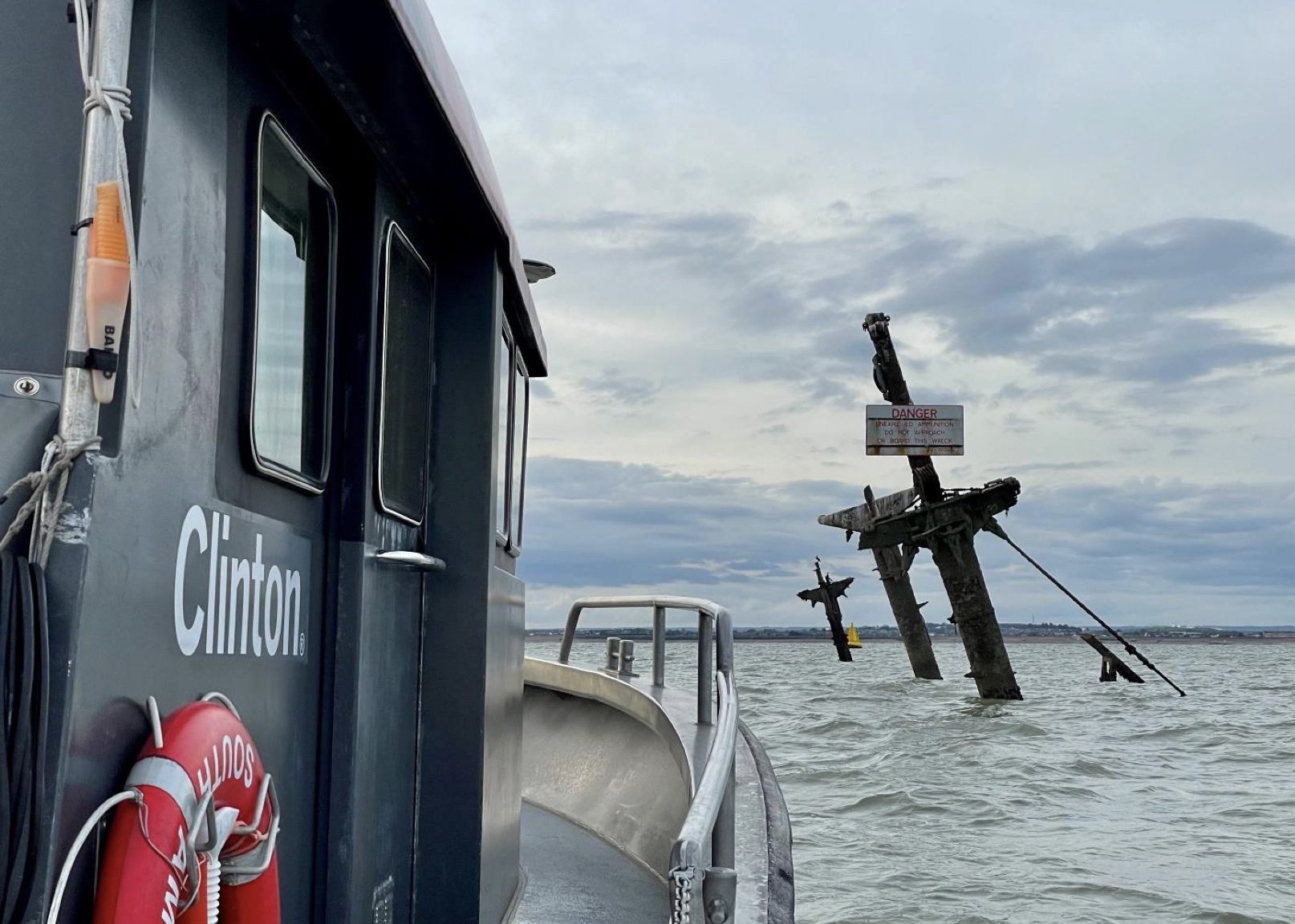
Today, more than seven decades later, the SS Richard Montgomery remains where it sank, a silent sentinel of past conflicts. Its rusted masts protrude above the water’s surface at all tide levels, a stark reminder of the danger lurking beneath.
While opinions on the danger vary, some experts believe an explosion could generate a massive wave up to 40 feet high, potentially devastating nearby Sheerness and impacting an area stretching from Margate to central London.
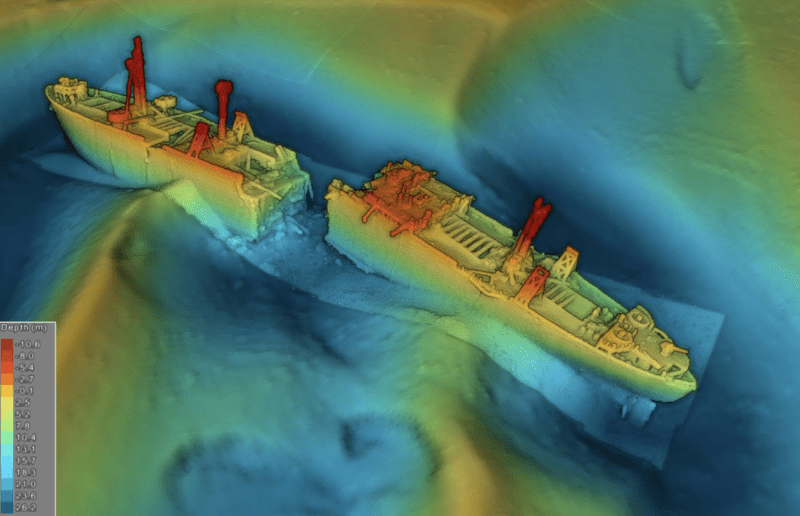
Overview picture of SS Richard Mountgomery. Point cloud data, including lidar, overlaid on a digital terrain model of the surrounding seabed. Image courtesy SSRM
The Maritime and Coastguard Agency (MCA) regularly monitors the wreck’s condition. A recent survey in October 2023 raised alarm bells. The report revealed, “The whole forward section of the wreck appears to have an increase in lean, approximately 10-15cm, eastward.” This shift could destabilize the delicate balance of unexploded ordnance. Furthermore, “The deck space near hold 3 appears to have started to collapse on the port side,” indicating the vessel’s weakening structural integrity.
While authorities maintain that “the risk of a major explosion is believed to be remote,” the wreck’s gradual decay is undeniable. The site’s potential danger has led to its classification under the Protection of Wrecks Act 1973, establishing a strictly enforced no-entry exclusion zone to minimize accidental detonation risks and protect maritime traffic and nearby communities.
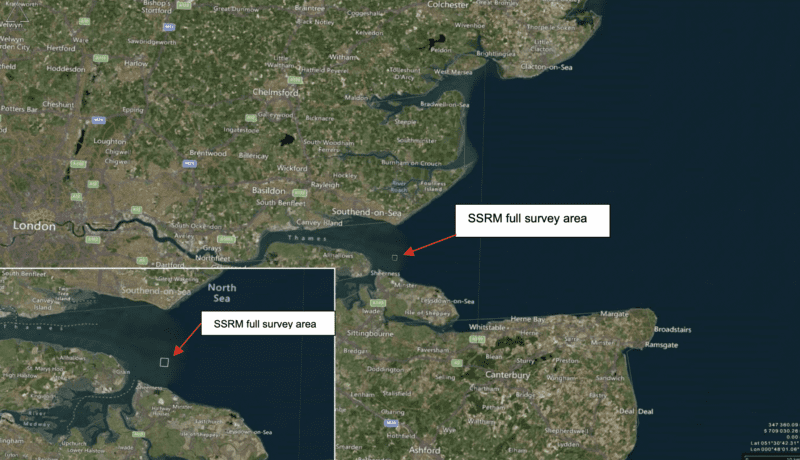
Location of the SSRM full survey area.
Medway Ports, under MCA contract, has implemented comprehensive safeguards. Warning notices on the wreck’s visible masts remind passing vessels of the underlying danger. A ring of buoys demarcates the exclusion zone, and 24-hour radar surveillance detects and prevents unauthorized incursions.
As the SS Richard Montgomery slowly decays, questions arise about long-term management and resolution of this explosive dilemma. While current measures mitigate immediate risks, the wreck’s presence serves as a poignant reminder of war’s enduring consequences and the complex challenges of managing such hazardous sites.
The Thames Estuary time bomb not only poses a physical threat but also raises ethical and environmental concerns about conflict’s legacy and our responsibility to address these dangerous remnants of the past.
LONDON, Sept 9 (Reuters) – A container ship arrived in Britain on Wednesday after a landmark voyage from China via the Arctic, as part of plans for more vessels to use the route as a shorter...
Britain on Tuesday imposed sanctions on four liquefied natural gas carriers linked to Russia's Arctic LNG 2 project, becoming the first G7 country to target the latest vessels acquired to expand exports from the sanctioned Arctic development.
The captain of a tanker detained by British authorities during a high-profile operation targeting Russia’s shadow fleet has been charged with violating UK sanctions on Russian oil exports. The UK’s...
June 15, 2026
Total Views: 1627
Get The Industry’s Go-To News
Subscribe to gCaptain Daily and stay informed with the latest global maritime and offshore news
— just like 107,407 professionals
Secure Your Spot
on the gCaptain Crew
Stay informed with the latest maritime and offshore news, delivered daily straight to your inbox
— trusted by our 107,407 members
Your Gateway to the Maritime World!
Essential news coupled with the finest maritime content sourced from across the globe.

 Join The Club