New company takes on four Arc4 LNG carriers as Seoul looks to expand Busan’s role in Arctic shipping.
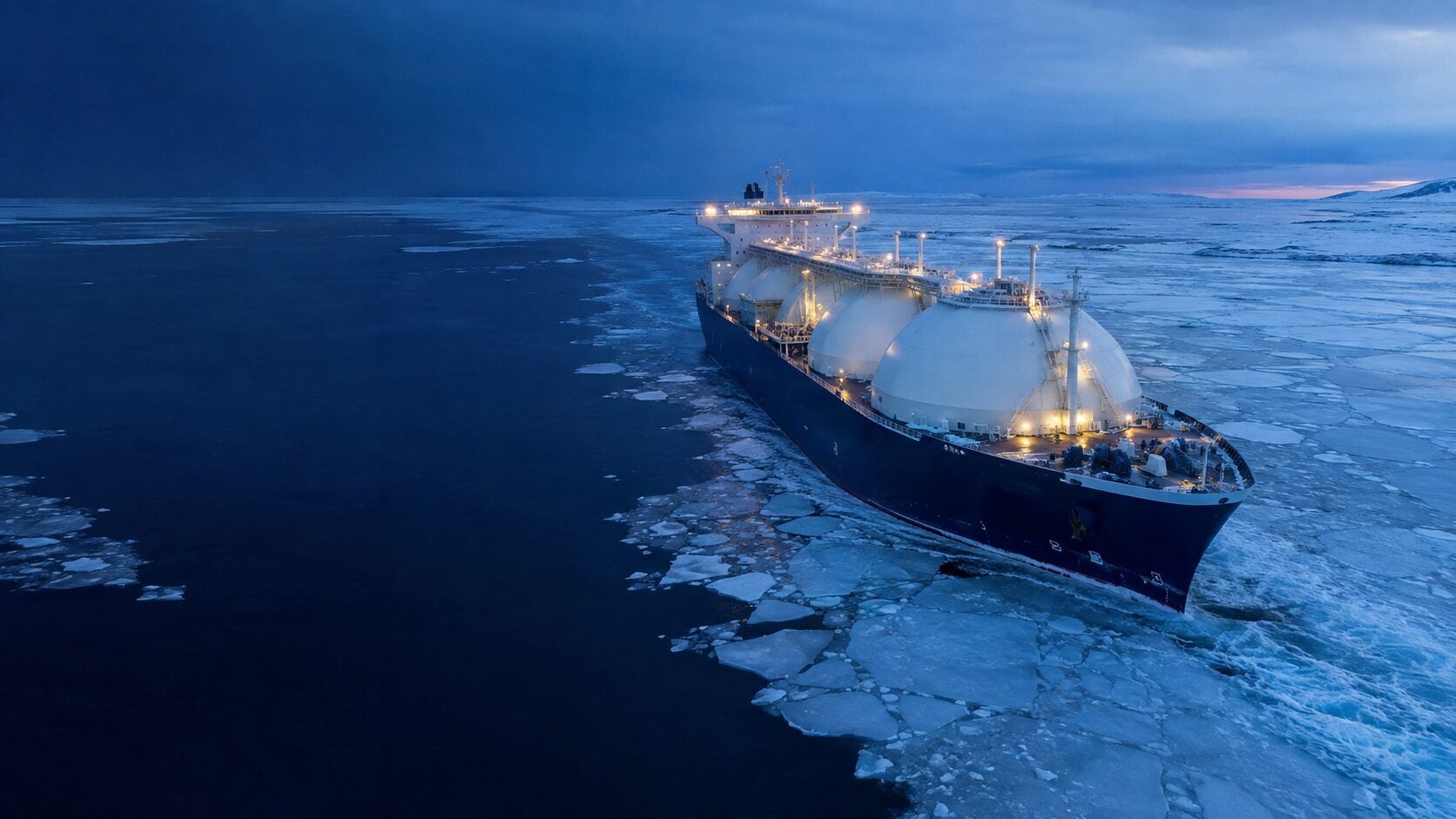
A newly established South Korean ship manager is emerging as a potential new player in Arctic LNG shipping, taking control of four ice-class LNG carriers while planning a rapid expansion into the specialized fleet needed to transport gas along Russia’s Northern Sea Route.
Busan-based IOB Co. Ltd. says it has begun operations with four 174,000-cubic-meter Arc4 LNG carriers and plans to add three to six Arc7 vessels next year, followed by additional Arc7 newbuildings under management from 2028.
The four Arc4 vessels are the North Moon, North Light, North Ocean and North Valley, all built by South Korea’s Hanwha Ocean in 2024 and 2025 for Japan’s Mitsui O.S.K. Lines.
Their ownership and management have recently shifted into a structure linking Russian gas producer Novatek with IOB. Shipping databases show the vessels under new ownership arrangements, while IOB identifies itself as their manager and describes its business as specializing in ice-class LNG carriers operating along the Northern Sea Route.
The development comes after the four ships spent months largely idle following sanctions-related uncertainty.
Three of the vessels – North Moon, North Light and North Ocean – were sanctioned by the European Union in May 2025 over their involvement in Russian LNG trades. The EU removed them from its sanctions list two months later after MOL provided assurances that they would no longer transport Russian energy. It is unclear how these assurances align with the firm seemingly transferring ownership to a Russian-affiliated entity.
The ships nonetheless remained without employment, illustrating the difficulty of finding commercial work for highly specialized Arctic tonnage when Western sanctions constrain access to Russian LNG projects.
IOB’s plans suggest that the company sees that constraint as an opportunity rather than a dead end.
Its website describes the company as an Arctic LNG ship-management specialist, providing technical, marine, quality and safety and crew-management services. It says the company has 13 years of accumulated global LNG fleet-management experience, while its new Busan operation is focused specifically on ice-class vessels.
The planned Arc7 expansion is particularly significant. IOB does not identify the vessels, but its target of three to six ships comes as several Arc7 LNG carriers remain stranded at Hanwha Ocean after sanctions disrupted their original contracts for Novatek’s Arctic LNG 2 project.
Six such vessels – three originally ordered by MOL and three associated with Russia’s Sovcomflot – have been caught up in the sanctions dispute.
The development also adds another piece to South Korea’s increasingly prominent role in Arctic shipping.
South Korean shipyards have built a large share of the specialized LNG carriers serving Russia’s Arctic projects.
At the same time, Busan is positioning itself as a gateway for Arctic trade. In August, PanStar’s 2,758-TEU PanStar Acro departed Busan for Europe via the Northern Sea Route in South Korea’s first commercial container trial on the route. The voyage attracted only 737 TEUs of cargo, highlighting the commercial challenges, but PanStar has said it plans to conduct additional Arctic voyages.
Taken together, the developments point to an emerging Korean strategy that extends beyond shipbuilding.
South Korea is seeking a role in the Arctic maritime economy as a builder of specialized vessels, an operator of them and, increasingly, a potential logistics hub connecting Asian trade with the Northern Sea Route.

 Join The Club