Updated: April 28, 2012 (Originally published April 27, 2012)
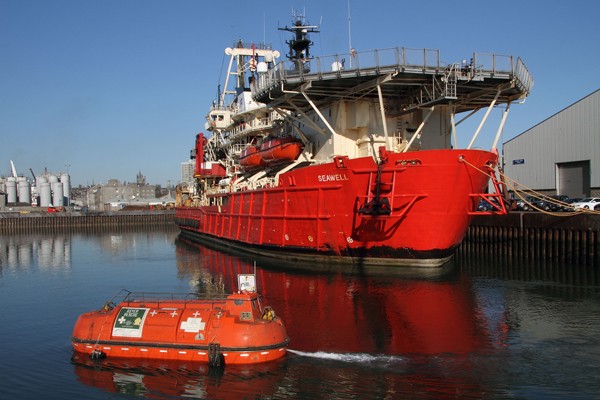
Helix ESG's Seawell, Image: Helix
In a safety first for Aberdeen based diving contractors, Helix Well Ops UK successfully completed a dress-rehearsal of a saturation diver evacuation using a specialized self-propelled hyperbaric lifeboat.
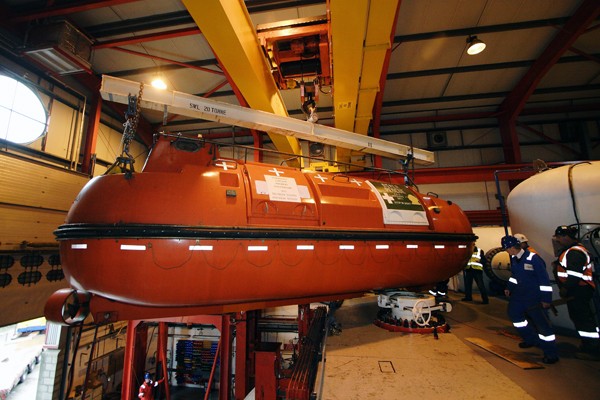
Hyperbaric lifeboats have been required safety equipment on board North Sea vessels for years but Well Ops UK became the first contractor in the region to drop the pressurized vessel in the water, retrieve it and transfer it to a medical facility safely.
“Saturation divers work and live under extreme pressure so you cannot bring them back to surface pressure quickly, in fact sometimes it can take four to five days to decompress safely,” said Steve Sheppard, Well Ops Diving Manager. “And these exercises are invaluable as they allow assumptions to be tested and reveal problems that can now be addressed to ensure a rapid and effective response to a life-threatening situation.”
Well Ops has confirmed the viability of its diver evacuation plan on both its well intervention vessels, the Well Enhancer and the Seawell.
The exercises included the recovery of the lifeboats from Aberdeen Harbour and transporting them by trailer-truck while connected to essential life support controls until they arrived at the National Hyperbaric Centre (NHC) in Scotland.
The centre is equipped with pressure chambers onto which the lifeboat can connect to, enabling the divers to transfer from the lifeboat into the chamber at the NHC for medical attention if required and safe decompression back to surface pressure.
If a diver whose body has been pressurized for work hundreds of feet below the water’s surface is suddenly exposed to a rapid drop in pressure her or she may suffer a life-threatening decompression sickness known as the bends and other serious medical conditions.
The hyperbaric lifeboat is connected to a pressure chamber on board both the Well Enhancer and the Seawell by a tube that divers can travel through in the event of an emergency.
Once through the tube, the divers seal off the hyperbaric lifeboat which has a normal lifeboat’s hull but a specially fitted pressure chamber mounted inside and allows the divers to move the lifeboat out of harm’s way.
Prior to the requirement of self-propelled hyperbaric lifeboats simpler options like floating pressure chambers that fell off the side of a vessel and drifted away unpowered were used and diving bells could be lowered over the side of the vessel which required another vessel to then come by and rescue the stranded divers from the sea.
Updated: November 23, 2023 (Originally published May 31, 2023) Helix Energy Solutions (NYSE: HLX) has been awarded a significant 39-well decommissioning contract in the U.S. Gulf of Mexico. The contract...
By Weixin Zha and Anna Shiryaevskaya (Bloomberg) Hidden by pine forests near the deserted site of what was once East Germany’s biggest nuclear reactor, two shiny pipelines emerge from the...
By Bloomberg News (Bloomberg) — China is speeding up efforts to design and build a manned deep-sea platform to help it hunt for minerals in the South China Sea, one...
June 8, 2016
Total Views: 121
Get The Industry’s Go-To News
Subscribe to gCaptain Daily and stay informed with the latest global maritime and offshore news
— just like 107,230 professionals
Secure Your Spot
on the gCaptain Crew
Stay informed with the latest maritime and offshore news, delivered daily straight to your inbox
— trusted by our 107,230 members
Your Gateway to the Maritime World!
Essential news coupled with the finest maritime content sourced from across the globe.

 Join The Club