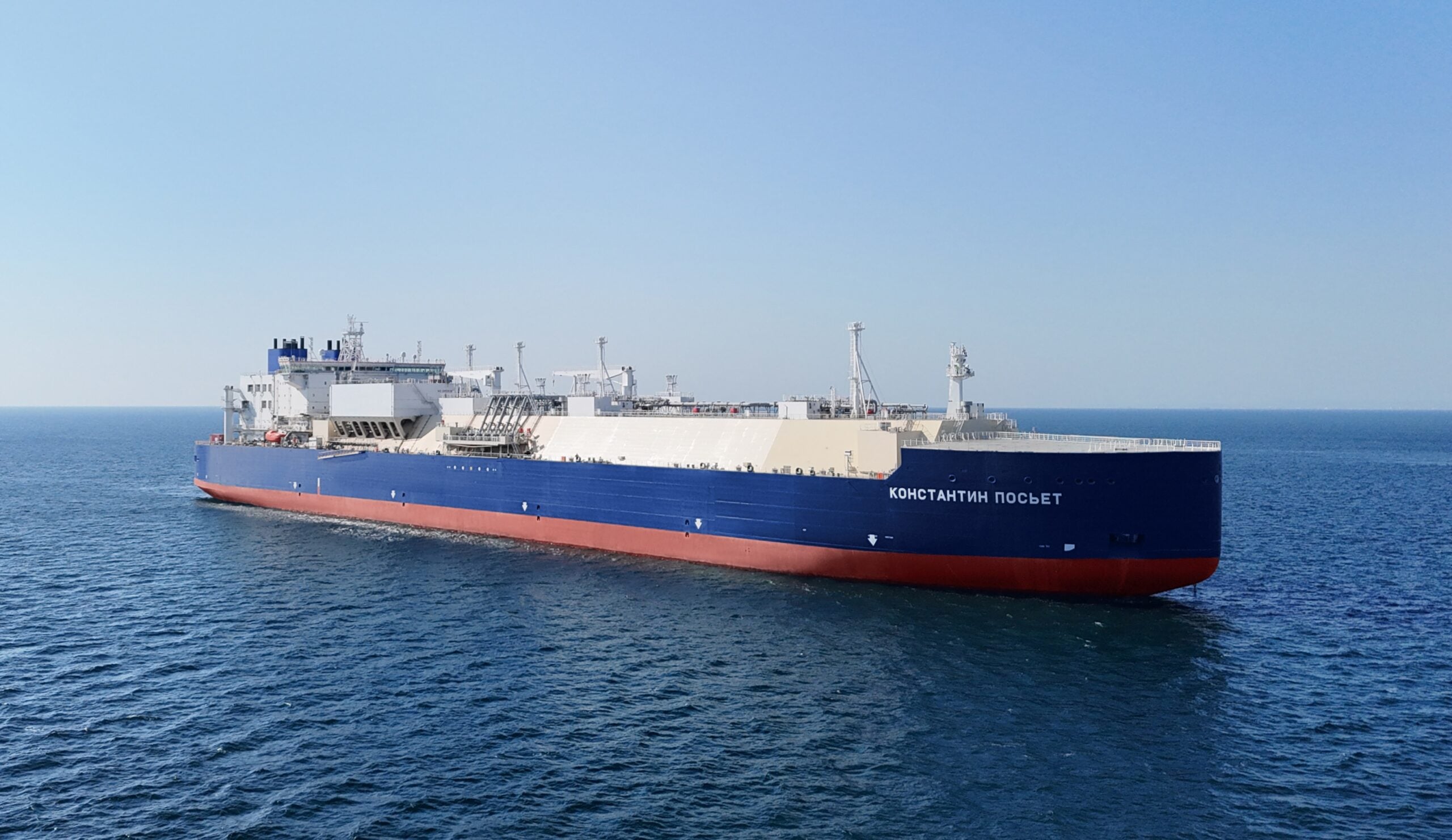
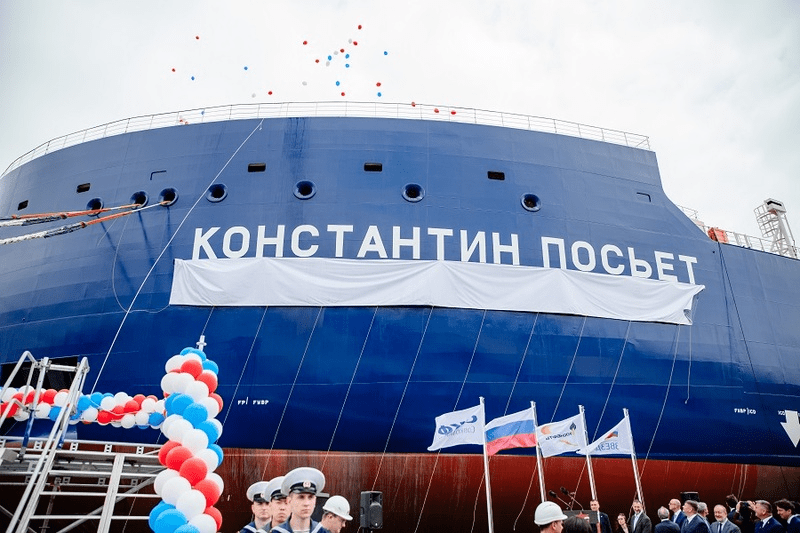
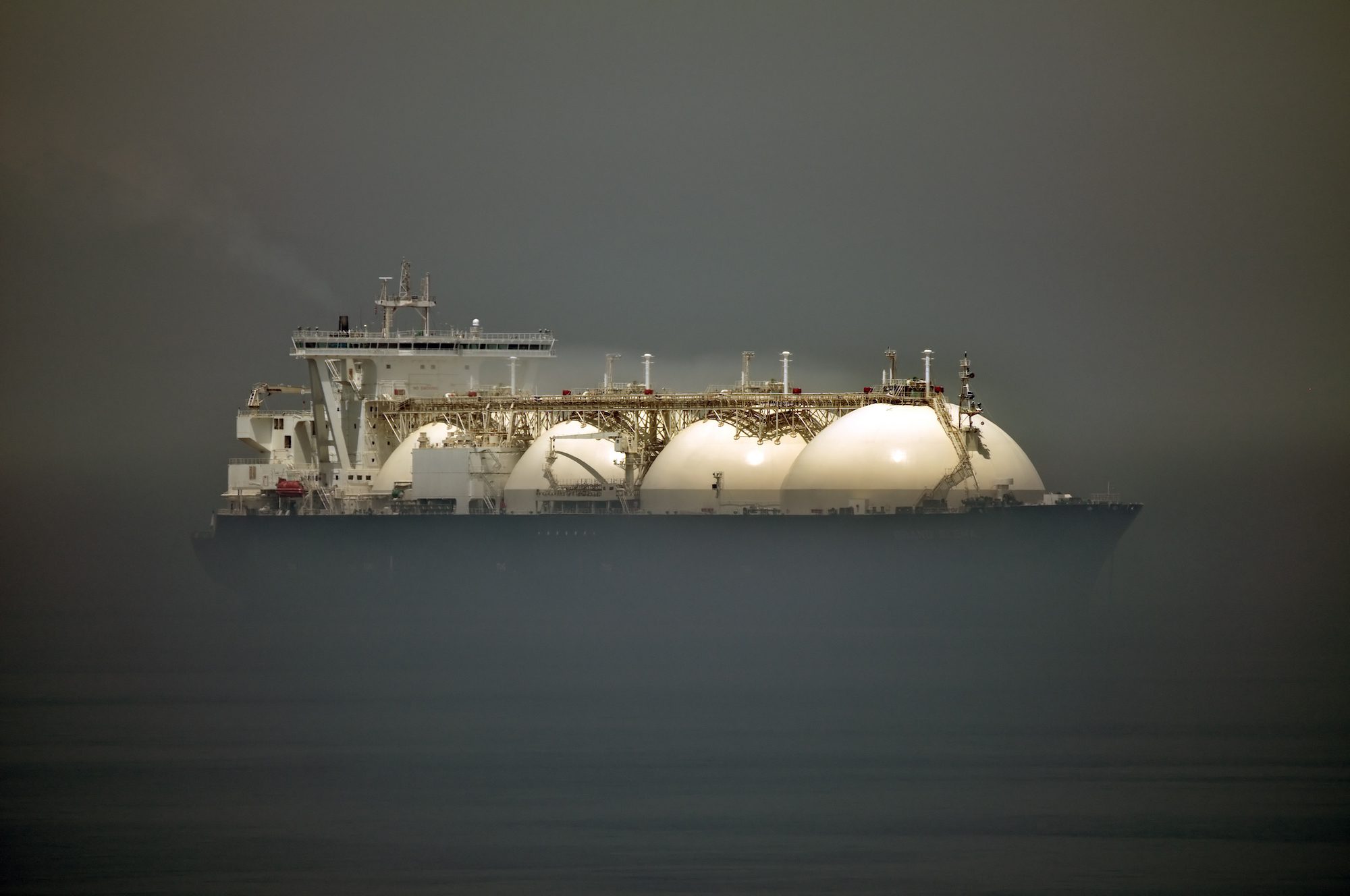
Russia moved closer to deploying its second domestically built Arc7 icebreaking liquefied natural gas (LNG) carrier on Thursday as the Konstantin Posyet was named at a ceremony attended via video link by Prime Minister Mikhail Mishustin, signalling the vessel is nearing commercial service.
The vessel recently completed sea trials and is expected to enter service in the coming months, marking another step in Russia’s efforts to build a domestic fleet of specialized Arctic LNG carriers after Western sanctions disrupted shipbuilding programmes and access to foreign technology.
Its arrival significantly improves the logistics outlook for Arctic LNG 2, which has struggled to establish a stable export fleet after sanctions targeted both the project and many of the vessels originally intended to serve it.
Once Konstantin Posyet enters service, Novatek will effectively have access to three Arc7 LNG carriers for Arctic LNG 2 operations: the two Zvezda-built vessels and one South Korean-built Arc7 tanker, Christophe de Margerie, originally assigned to the Yamal LNG project but subsequently redeployed after sanctions.
Naming ceremony of Arc7 LNG carrier Konstantin Posyet. (Source: Sovcomflot)
Sources familiar with the construction program said a third Zvezda-built Arc7 vessel, likely either the Pyotr Stolypin or Sergei Witte, is expected to be launched before the end of this year. That would give Novatek access to four Arc7 carriers ahead of the 2026-27 winter navigation season.
The new vessels are considered more capable than the first generation of Arc7 LNG carriers built for Yamal LNG. Designed for independent operation in Arctic conditions, they can navigate through ice up to two metres thick.
Speaking at the naming ceremony via video link, Mishustin said the vessel’s completion demonstrated the continuing development of Russia’s Arctic transport infrastructure and domestic shipbuilding capabilities. Large parts of the vessels, however, were constructed by South Korean builder Samsung Heavy Industries (SHI).
The ceremony at Zvezda was attended by executives from Sovcomflot, Rosneft, Novatek and Russia’s shipbuilding sector.
Sovcomflot Chief Executive Igor Tonkovidov described the vessel as another milestone in the development of Russia’s high-tech merchant fleet. In a statement, the company said the tanker combines advanced icebreaking capability with high environmental standards and is designed for year-round operation along the Northern Sea Route.
The vessel is approximately 300 meters long, 48.8 meters wide and capable of transporting 172,600 cubic meters of LNG.
The Arc7 program represents one of the most ambitious projects undertaken by Zvezda, the Kremlin-backed shipyard established at Bolshoy Kamen near Vladivostok to develop Russia’s capacity to build large, technologically sophisticated commercial vessels.
The program has faced repeated delays since 2022 after sanctions disrupted supplies of critical foreign equipment and technology. Several vessels originally planned for completion years earlier were pushed back as Zvezda sought alternative suppliers, especially for the Western-supplied LNG tank membranes. Critically Konstantin Posyet’s tanks had already been installed when sanctions hit.
Installation of the tank membrane and delivery of the remaining three vessels at Zvezda, Pyotr Stolypin, Sergei Witte and Viktor Chernomyrdin, may prove more challenging. Though Russia has reportedly been working on developing its own membrane-type containment.
A nuclear-powered LNG carrier could cost roughly 2.5 times as much to build as a conventional vessel, but lower fuel costs could significantly change the economics over the ship’s operating...
Russia shipped the most crude in a month-and-a-half, while a jump in prices propelled the value of those cargoes close to the highest since the start of the invasion of Ukraine in 2022. But the benefits to the Kremlin are being undermined by its ban on overseas diesel sales.
European imports of liquefied natural gas are rising ahead of the Northern Hemisphere winter, as prolonged disruptions to flows through the Strait of Hormuz threaten to intensify global competition for the fuel.
September 28, 2026
Total Views: 1070
Get The Industry’s Go-To News
Subscribe to gCaptain Daily and stay informed with the latest global maritime and offshore news
— just like 107,107 professionals
Secure Your Spot
on the gCaptain Crew
Stay informed with the latest maritime and offshore news, delivered daily straight to your inbox
— trusted by our 107,107 members
Your Gateway to the Maritime World!
Essential news coupled with the finest maritime content sourced from across the globe.

 Join The Club