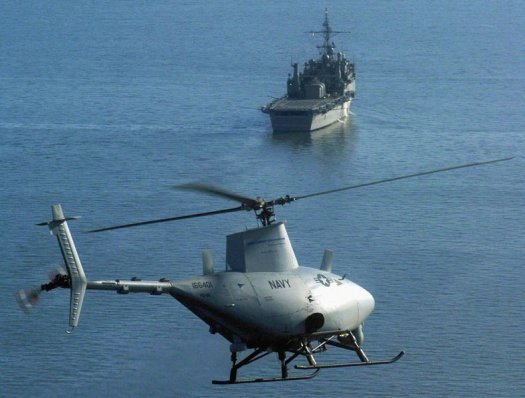
ARLINGTON, Va.— Navy unmanned aircraft will be able to distinguish small pirate boats from other vessels when an Office of Naval Research (ONR)-funded sensor starts airborne tests this summer, officials said last week.
Called the Multi-Mode Sensor Seeker (MMSS), the sensor is a mix of high-definition cameras, mid-wave infrared sensors and laser-radar (LADAR) technology. It will be placed on a robotic helicopter called Fire Scout. Carrying advanced automatic target recognition software, the sensor prototype will allow Fire Scout to autonomously identify small boats on the water, reducing the workload of Sailors operating it from control stations aboard Navy ships.
“Sailors who control robotic systems can become overloaded with data, often sifting through hours of streaming video searching for a single ship,” said Ken Heeke, program officer in ONR’s Naval Air Warfare and Weapons Department. “The automatic target recognition software gives Fire Scout the ability to distinguish target boats in congested coastal waters using LADAR, and it sends that information to human operators, who can then analyze those vessels in a 3-D picture.”
Navy-developed target recognition algorithms aboard Fire Scout will exploit the 3-D data collected by the LADAR, utilizing a long-range, high-res, eye-safe laser. The software compares the 3-D imagery to vessel templates or schematics stored in the system’s memory.
“The 3-D data gives you a leg up on target identification,” said Dean Cook, principal investigator for the MMSS program at Naval Air Warfare Center Weapons Division (NAWCWD). “Infrared and visible cameras produce 2-D pictures, and objects in them can be difficult to automatically identify. With LADAR data, each pixel corresponds to a 3-D point in space, so the automatic target recognition algorithm can calculate the dimensions of an object and compare them to those in a database.”
The algorithms have been successfully tested in shore-based systems against vessels at sea. The software is being integrated into a BRITE Star II turret by a team from NAWCWD, Raytheon, FLIR Systems, BAE Systems and Utah State University for airborne testing aboard a manned test helicopter. The flight assessment will be conducted against groups of approximately seven small boats in a military sea range off the California coast later this summer.
What (Acting) Secretary Hung Cao’s First Five Months Tell Us About the Job Ahead By Bruce Kimbrell (Policy Op-Ed) President Trump has nominated the Honorable Hung Cao to become the...
By Jennifer A. Dlouhy and María Paula Mijares Torres Sep 6, 2026 (Bloomberg) –US Navy escorts that are helping tankers cross the Strait of Hormuz are essential to sustaining crude flows...
Sept 6 (Reuters) – The U.S. aircraft carrier Abraham Lincoln left Thailand on Sunday after a five-day port visit, ending a respite from an extended deployment that included operations in the Middle East, the U.S. Navy said. “We...
September 6, 2026
Total Views: 2014
Get The Industry’s Go-To News
Subscribe to gCaptain Daily and stay informed with the latest global maritime and offshore news
— just like 106,899 professionals
Secure Your Spot
on the gCaptain Crew
Stay informed with the latest maritime and offshore news, delivered daily straight to your inbox
— trusted by our 106,899 members
Your Gateway to the Maritime World!
Essential news coupled with the finest maritime content sourced from across the globe.

 Join The Club