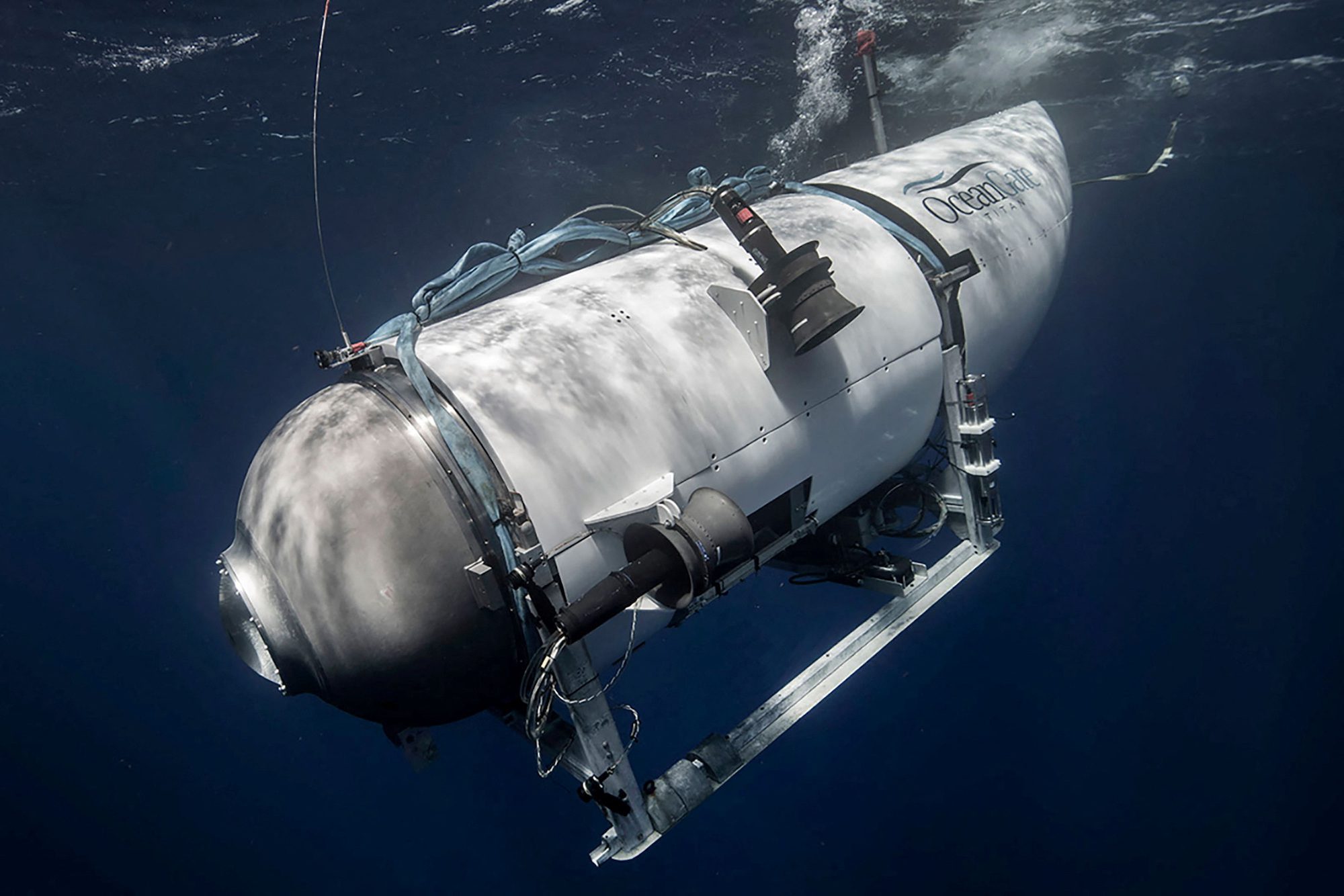
The National Transportation Safety Board has released its investigation report into the June 18, 2023, implosion of the submersible Titan, concluding that OceanGate’s inadequate engineering process and flawed analysis of monitoring data directly caused the catastrophic failure that killed all five persons aboard during a dive to the Titanic wreck site in the North Atlantic Ocean.
The submersible imploded at approximately 10:47 a.m. local time while descending to the Titanic wreckage, located about 372 miles southeast of St. John’s, Newfoundland and Labrador, Canada, at a depth of 3,880 meters. The catastrophic implosion resulted in the immediate death of all five occupants, including OceanGate’s CEO Stockton Rush, who were exposed to approximately 4,930 pounds per square inch of water pressure. The vessel was a total loss, valued at approximately $4.2 million.
Critical Damage Went Undetected After Dive 80
The NTSB found that the Titan’s pressure vessel likely sustained damage after it surfaced at the end of dive 80 in the form of one or more delaminations that weakened the pressure vessel. After dive 82, the submersible sustained additional damage of unknown origin that further deteriorated the pressure vessel’s condition.
According to the report, OceanGate’s analysis of Titan pressure vessel real-time monitoring data was flawed, meaning “the company was unaware that the Titan was damaged and needed to be immediately removed from service after dive 80.”
The existing delaminations and additional damage that deteriorated the condition of the pressure vessel between dive 82 and the casualty dive resulted in a local buckling failure that led to the implosion.
Inadequate Engineering and Testing
The NTSB determined that OceanGate’s engineering process for the Titan was inadequate and resulted in the construction of a carbon fiber composite pressure vessel that contained multiple anomalies and failed to meet necessary strength and durability requirements. Because OceanGate did not adequately test the Titan, the company was unaware of the pressure vessel’s actual strength and durability, which was likely much lower than their target.
The 22-foot-long submersible’s pressure vessel was constructed in 2020 and consisted of a thick-walled, carbon fiber-based composite cylinder fitted at each end with a titanium ring that was capped with a titanium dome. The titanium segments were glued to the cylinder, and the titanium domes were bolted to the segments.
Emergency Response Gaps
The NTSB found that had OceanGate followed Navigation and Vessel Inspection Circular 05-93 guidance for emergency response plans, they likely would have had emergency response assets standing by, and the Titan likely would have been found sooner, saving time and resources even though a rescue was not possible in this case.
Despite OceanGate’s failure to notify search and rescue assets about its planned expedition, as well as the limited resources able to operate at the depth of the Titanic, the US Coast Guard’s search and rescue coordination efforts were effective and resulted in the timely discovery of the Titan wreckage.
Regulatory Shortcomings
The investigation found that voluntary guidance and current US small passenger vessel regulations are not sufficiently tailored to current pressure vessel for human occupancy operations to ensure safety in accordance with established technical and classification society standards.
The NTSB determined that the probable cause of the hull failure and implosion was “OceanGate’s inadequate engineering process, which failed to establish the actual strength and durability of the Titan pressure vessel and resulted in the company operating a carbon fiber composite vessel that sustained delamination damage that was subsequently exacerbated by additional damage of unknown origin, resulting in a damaged internal structure that subsequently led to a local buckling failure of the pressure vessel.”
Contributing factors included US and international voluntary guidance and US small passenger vessel regulations that were insufficient to ensure OceanGate adhered to established industry standards, as well as OceanGate’s flawed analysis of their pressure vessel monitoring system data.
Safety Recommendations
As a result of the investigation, the NTSB recommended that the US Coast Guard commission a panel of experts to study current pressure vessel for human occupancy operations and disseminate findings to industry. The board also recommended implementing US regulations for these vessels informed by the study findings and consistent with international requirements and guidance.
Additional recommendations include updating NVIC 05-93 to include the revised definition of small passenger vessel as reflected in the Passenger Vessel Safety Act of 1993, and proposing that the International Maritime Organization make MSC.1/Circ. 981 mandatory to promote consistent application of pressure vessel for human occupancy rules among member states.
Coast Guard Investigation Findings
The NTSB report follows the US Coast Guard Marine Board of Investigation’s comprehensive 300-page Report of Investigation released in August, which described the loss of the Titan as “preventable” and resulting from multiple systemic failures at OceanGate.
The Coast Guard investigation determined that the primary cause was the loss of structural integrity of the Titan’s carbon fiber hull, with the probable failure point being either the adhesive joint between the forward dome and titanium segment, or the carbon fiber hull near the forward end of the submersible.
According to the Coast Guard report, OceanGate strategically exploited regulatory gaps and confusion to operate the Titan completely outside established deep-sea protocols. The report states: “For several years preceding the incident, OceanGate leveraged intimidation tactics, allowances for scientific operations, and the company’s favorable reputation to evade regulatory scrutiny.”
The Coast Guard investigation also highlighted OceanGate’s toxic workplace environment which used firings of senior staff members and the looming threat of being fired to dissuade employees and contractors from expressing safety concerns.

 Join The Club