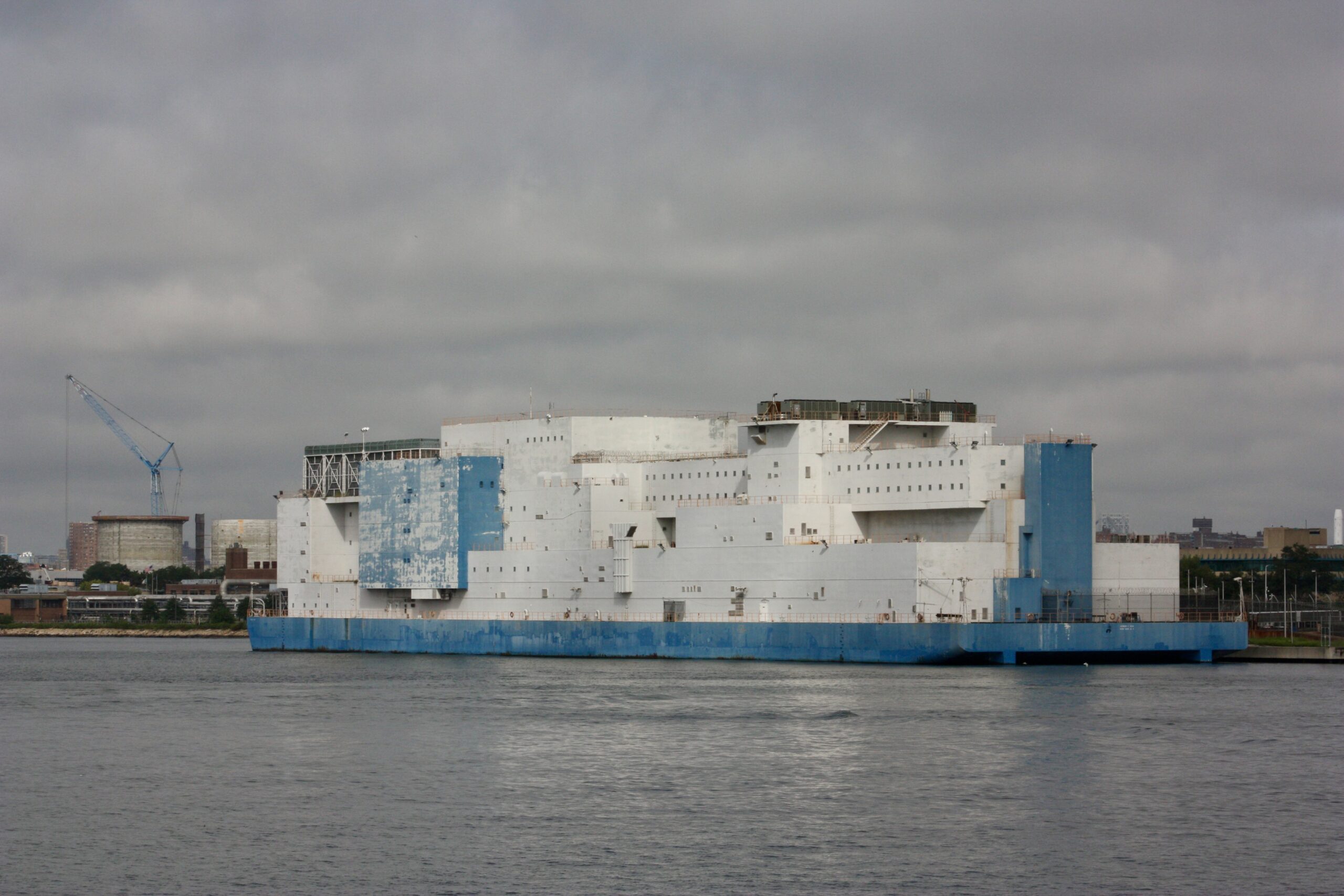
By Daniel Katzive (gCaptain) – A 625-foot New York City jail barge moored on the East River in the South Bronx is finally set to head to the scrappers, two years after its last prisoners disembarked. The removal will open up valuable maritime property adjacent to the city’s wholesale food and beverage distribution centers and allow for construction of a new marine terminal serving those facilities.
The five-story barge, formally known as the Vernon C. Bain Center, will be hauled by tugs to Louisiana Scrap Metal Recycling in Gibson, Louisiana later this fall where it will be dismantled and its metal recycled. New York City will receive $1.5 million for the barge and benefit from not having to pay to have it hauled away, according to the city’s Economic Development Corporation (EDC).
Removing the barge will open up over 600 feet of marginal pier frontage and a 7.4 acre upland site directly adjacent to the Fulton Fish Market and the Hunts Point Food Distribution Center, the city’s main wholesale markets for food and beverage. The EDC says it plans to build a new marine terminal on the site which will accommodate delivery of shipping containers to the market by water and allow for outbound distribution of food products by barge or by “moonlighting” passenger ferries operating after hours to other locations in the city. The new terminal will be a key node in what the city calls its “Blue Highway” plan to increase use of New York’s waterways and reduce reliance on truck transportation. Marine access to the Hunts Point complex, currently served only by truck and rail, has long been a key goal of the program.
As with most elements of the Blue Highway plan, however, the benefits will not be immediate. The EDC estimates that before work can begin, the site will require about two years of environmental remediation to erase legacy contamination from a Con Edison manufactured gas plant which occupied the area until the early 1960s. During this cleanup period, the EDC says it will invest $28.3 million to repair the shoreline and expand local greenways.
The jail barge itself was purpose-built for the city in the late 1980s in Avondale Shipyard in Louisiana, not far from its future destination for scrapping, at a cost of $161 million according to a 1992 article in the New York Times. It was brought to this stretch of shoreline in 1992 as a supposedly temporary facility to house up to 800 inmates and alleviate crowding on nearby Rikers Island. At the time, the city had four other barges holding prisoners according to the Times article—two were repurposed Staten Island ferries and two were former British troop carriers—but the Bain was the only one newly built to hold prisoners.
For the first years of its operation, the Coast Guard required a full-time maritime crew of 3 to be present on the barge and former New York Harbor tugboat captain John Klumpp describes his experiences as one of the barge’s captains in his 2011 memoir An Ordinary Guy. The crew was mainly occupied with maintaining the barge’s complicated fire detection system, according to Klumpp, and the Coast Guard eventually ceased to consider the Bain an active vessel, eliminating the need for a maritime crew.
The Bain Center was decommissioned in October 2023 after years of complaints of bad conditions that were said to be even worse than on Rikers, and the roughly 500 prisoners housed there at the time were transferred to other jails, according to a 2023 article in Gothamist.
The Bain site is adjacent to a smaller waterfront space that is being developed by a private company as a facility for delivery of aggregate and possibly to move food and beverage products as well, as gCaptain reported in April. The first phase of that project, which would involve transloading of aggregate from barges via a crane barge anchored on the shoreline, is expected to go live this month, according to Con Agg Global CEO Paul Granito.
The second phase, which would involve spud barges and a modular pier, is still working through the approval process, but Granito told gCaptain he still sees strong commitment and momentum for the project, and potential interest from food and beverage companies to move their products over the platform. Granito sees the Con Agg project as likely to be complementary to the larger facility handling containers on the former jail property next door that will take shape in coming years if all goes according to the EDC’s plans.
A much larger New York City waterfront project in Brooklyn has also been in the news this month. After months of delay, a special commission has approved a controversial plan for the redevelopment of the Brooklyn Marine Terminal in Red Hook, currently home to a small but active container port and a cruise ship pier. The plan is to sell rights to build housing to help finance restoration and modernization of the maritime facility. Some working waterfront advocates have opposed the plan, concerned about the loss of more industrial maritime space to residential development.
On Thursday, the EDC issued a new Request for Expressions of Interest to solicit proposals from potential port operators, developers, and maritime industrial business on possible maritime operations at the new BMT.
Editorial Standards · Corrections · About gCaptain

 Join The Club