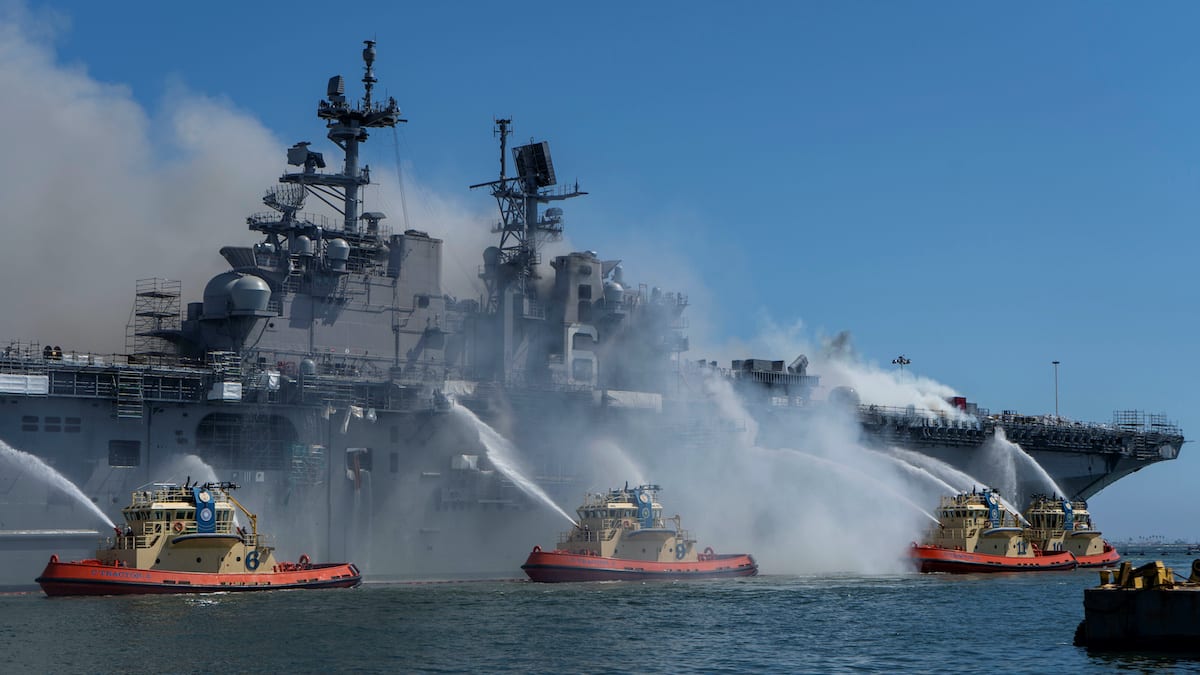
Five years after a catastrophic fire destroyed the USS Bonhomme Richard at a cost exceeding $3 billion, the U.S. Navy’s progress on fire safety during ship maintenance remains threatened by systemic weaknesses in contractor oversight, according to a new Government Accountability Office report.
The GAO found that while the Navy has made improvements since the 2020 Bonhomme Richard incident—with no major fires occurring in the intervening period—critical vulnerabilities persist in how the service monitors contractors performing welding and other “hot work” during maintenance availabilities.
Investigative reports found the USS Bonhomme Richard’s lower vehicle stowage space contained improperly stowed contractor items—forklifts with fuel tanks, cardboard containers of supplies, batteries, and other flammable materials—that fueled the fire.
According to the GAO report, staffing shortages across key fire safety oversight organizations are forcing the Navy to rely increasingly on sailors who are already balancing multiple duties. More concerning, the Navy’s primary tools for ensuring contractor compliance with fire safety standards lack effective enforcement mechanisms.
“The Navy uses these requests to bring contractors into compliance with contract requirements. But this process does not incorporate monetary penalties to address persistent issues,” the GAO stated regarding Corrective Action Requests, one of the Navy’s main oversight tools. The report noted that the Navy issued many such requests related to fire safety, including a severe warning prior to the Bonhomme Richard fire, yet safety issues continued.
The GAO identified four areas where the Navy’s contractor oversight falls short. Quality Assurance Surveillance Plans, which are supposed to assess monetary penalties, currently do not penalize noncompliance with contractual safety standards. Progress payment retention rates remain at reduced pandemic-era levels, diminishing their effectiveness as a compliance tool.Perhaps most significantly, the Navy has not adjusted its limitation on ship repair contractor liability for major losses since 2003, meaning inflation and increased ship complexity have substantially reduced the proportional financial risk contractors face.
The findings echo conclusions from the Navy’s own Major Fires Review, which examined 15 major shipboard fires over a 12-year period and revealed “ineffective learning” and “the persistence of underlying weaknesses in shipboard watchstanding standards, hazardous and combustible material stowage, and training” as primary contributors to recurring incidents.
“The loss of this ship was completely preventable,” Vice Chief of Naval Operations Adm. Bill Lescher said following the Bonhomme Richard investigation. That investigation yielded more than 1,000 findings of fact, 242 opinions, 139 recommendations for corrective action, and accountability recommendations for 36 individuals.
The Navy established a Learning to Action Board in October 2021 to implement recommendations and assess their ongoing effectiveness.However, the GAO found that this board does not consistently take contractor compliance with fire safety standards into account when developing responses to future incidents.
The GAO has issued six recommendations to the Secretary of the Navy, including developing mechanisms to maximize resources across fire safety oversight organizations, improving the Corrective Action Request process to increase contractor accountability, ensuring Quality Assurance Surveillance Plans include safety performance standards, reassessing progress payment retention rates, and updating the limitation of liability clause for ship repair contractors.The Navy has concurred with all six recommendations.
The report underscores an ongoing challenge for the Navy as it manages an aging fleet requiring extensive maintenance while simultaneously attempting to strengthen fire prevention protocols in an environment where contractor oversight tools remain inadequate to ensure compliance.

 Join The Club