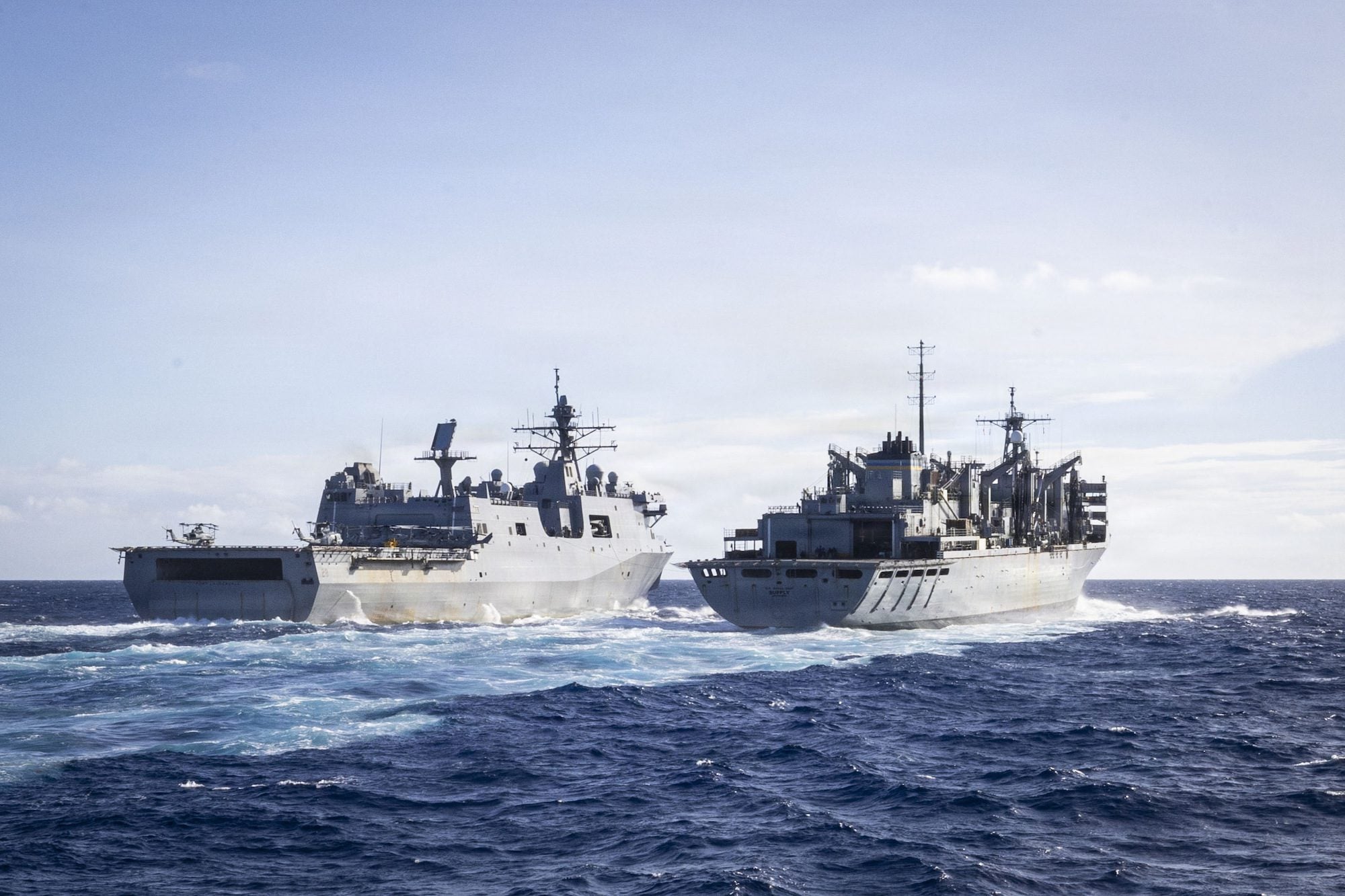
The Arleigh Burke-class guided missile destroyer USS Truxtun (DDG-103) and the fast combat support ship USNS Supply (T-AOE-6) collided during a replenishment-at-sea operation in the Caribbean on Tuesday afternoon, according to U.S. Southern Command.
Two personnel sustained minor injuries and are reported to be in stable condition. Both vessels were able to continue sailing following the incident, which remains under investigation.
The collision occurred just over a week after Truxtun departed Naval Station Norfolk on February 3 for a scheduled deployment. The destroyer carries a crew of roughly 300 sailors, along with 26 embarked air wing personnel assigned to Helicopter Maritime Strike Squadron 50, known as the “Valkyries.”
Ahead of the deployment, Truxtun’s commanding officer, James Koffi, highlighted the ship’s recent operational experience in the 5th and 6th Fleet areas of responsibility, describing the deployment as a continuation of “proven operational readiness”.
USNS Supply was observed departing Ponce, Puerto Rico on February 11, the day of the collision, after arriving there two days earlier. The vessel had previously conducted a replenishment-at-sea with the Ticonderoga-class cruiser USS Gettysburg on January 29 as part of Southern Command operations focused on counter-narcotics and regional security in the Caribbean.
The collision comes as the Trump administration has deployed approximately 12-15 warships to the Caribbean, including the USS Gerald R. Ford aircraft carrier group, marking the largest U.S. military presence in the region since the 1962 Cuban Missile Crisis. While the stated purpose is combating drug trafficking, the deployment has been widely seen as putting pressure on the Venezuelan government, particularly following the recent capture of Nicolás Maduro.
Video of the collision was shared on social media:
Supply is one of only two remaining fast combat support ships in the U.S. Navy, capable of delivering fuel, ordnance, and supplies while maintaining speeds of up to 25 knots to operate alongside carrier strike groups. The 754-foot vessel can carry more than 177,000 barrels of fuel, over 2,000 tons of ammunition, and substantial quantities of dry and refrigerated stores.
In March 2025, Supply’s crew received Military Sealift Command’s Maritime “E” award for operational readiness and safety. MSC’s annual Maritime “E” Award recognizes ships and Civil Service Mariners who demonstrated exceptional operational readiness, performance, efficiency and safety standards, similar to the Navy’s Battle “E” award.
Underway replenishment is a critical naval capability that allows warships to remain on station for extended periods without returning to port. The operation, however, requires precise ship handling and close coordination, with vessels operating at close quarters while underway.
The incident recalls concerns raised following the 2017 collisions involving USS Fitzgerald and USS John S. McCain, which prompted a sweeping Navy review of navigation practices, training, and watchstanding standards. At the time, then-Chief of Naval Operations John Richardson said the service was committed to ensuring such accidents did not recur.
In February 2025, USS Harry S. Truman (CVN 75) collided with the commercial bulk carrier Besiktas-M near Port Said, Egypt, while operating in the Mediterranean following combat operations in the Red Sea. The incident remains under investigation.
The investigation into Tuesday’s collision is ongoing. Both Truxtun and Supply remain under Southern Command operational control in support of regional security missions in the Caribbean.
Editorial Standards · Corrections · About gCaptain

 Join The Club