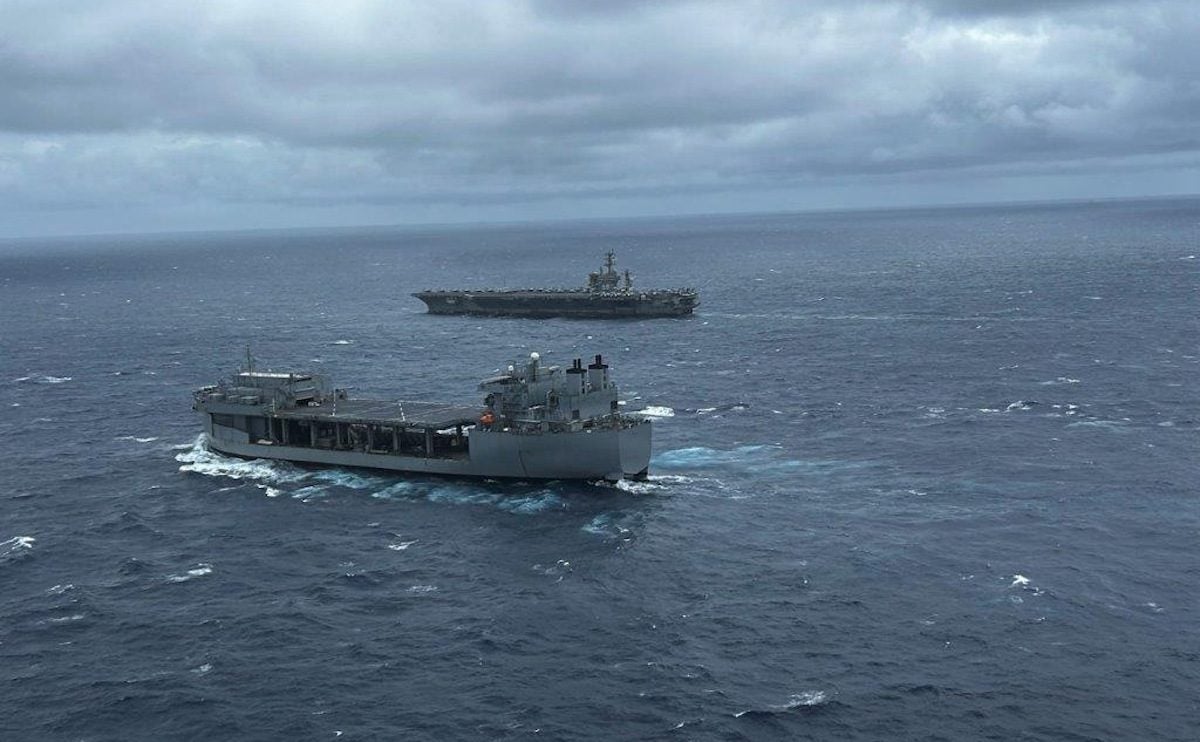
General Dynamics NASSCO has christened USNS Hector A. Cafferata Jr. (ESB 8) in San Diego, marking the sixth and final vessel in the U.S. Navy’s Expeditionary Sea Base (ESB) program and bringing to a close a decade-long effort to field a new class of highly flexible maritime support platforms.
The ceremony honored Private First Class Hector A. Cafferata Jr., a U.S. Marine Corps Medal of Honor recipient recognized for extraordinary bravery during the Battle of Chosin Reservoir in the Korean War. Ship co-sponsors Heather Cafferata, the daughter of the ship’s namesake, and Jessica Cafferata, his granddaughter, performed the traditional champagne bottle break against the hull.
“Ships are not just steel and machinery—they carry legacies, and they connect past generations to future ones,” said David Carver, president of General Dynamics NASSCO, during the ceremony. “The remarkable story of valor and sacrifice of Hector Cafferata Jr. will soon sail across the globe, carried by a ship that embodies his courage and dedication.”
The Expeditionary Sea Base class represents one of the Navy’s most adaptable platforms, designed to support a wide range of maritime-based missions including special operations support, air mine countermeasures, logistics staging, maritime security operations, and humanitarian assistance.
At 784 feet long, the ESB design features a 52,000-square-foot flight deck capable of supporting MH-53 and MH-60 helicopters, MV-22 Osprey tilt-rotor aircraft, and H-1 helicopters, along with extensive facilities for equipment staging, aviation operations, and command-and-control activities. The ships function as mobile sea bases, allowing forces, aircraft, and equipment to operate in regions where shore infrastructure may be limited or unavailable.
The program traces its origins to the Navy’s Mobile Landing Platform (MLP) initiative aimed at strengthening the military’s seabasing concept—moving personnel and equipment from sea to shore without relying on traditional ports. The concept evolved into the Expeditionary Sea Base configuration with the delivery of USNS Lewis B. Puller in 2015, the first ship designed specifically for the role.
Puller itself later became notable as the first ESB to be commissioned as a warship, entering service as USS Lewis B. Puller (ESB 3) in 2017 while deployed in the Middle East. The move gave combatant commanders greater operational flexibility in the U.S. Fifth Fleet region, highlighting the growing strategic role of these platforms.
The ESB fleet now includes Lewis B. Puller (ESB 3), Hershel “Woody” Williams (ESB 4), Miguel Keith (ESB 5), John L. Canley (ESB 6), Robert E. Simanek (ESB 7), and the newly christened Hector A. Cafferata Jr. (ESB 8).
With the final ship now launched, the ESB program closes as one of the Navy’s most successful recent efforts to field multi-mission expeditionary platforms capable of supporting distributed operations, forward staging, and maritime security missions across contested regions.
Editorial Standards · Corrections · About gCaptain

 Join The Club