European law enforcement agencies say they have disrupted a major transatlantic narcotics corridor known as the “Cocaine Highway,” seizing 11 tonnes of cocaine and 8.5 tonnes of hashish during a coordinated maritime operation targeting offshore trafficking networks operating between the Canary Islands and the Azores.
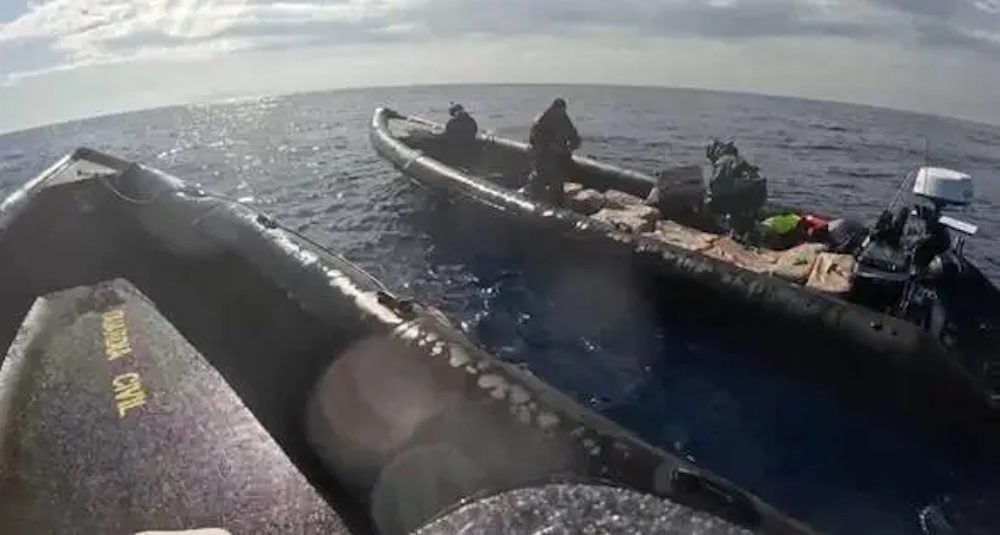
The two-week operation, led by Spain’s Guardia Civil and coordinated through Europol, resulted in 54 arrests and the interception of eight vessels suspected of participating in complex at-sea drug transfers designed to bypass major European ports and evade detection.
The crackdown marks the latest escalation in Europe’s growing maritime battle against increasingly sophisticated offshore trafficking networks that have shifted operations deep into the Atlantic Ocean.
The operation follows Europol warnings earlier this year that cocaine trafficking organizations were increasingly abandoning traditional port-based smuggling routes in favor of fragmented offshore drug smuggling invovling multiple vessels, mid-ocean transfers, and remote coastal landings.
Authorities say the model typically begins with “mother ships” departing Latin America carrying multi-tonne cocaine shipments. The narcotics are then transferred in international waters to high-speed craft — including rigid-hulled inflatable boats and other long-range vessels — before being moved again onto smaller boats for delivery to isolated beaches and marinas in Spain and Portugal.
The waters between the Canary Islands and the Azores have emerged as a key trafficking corridor due to their remoteness and the difficulty of monitoring maritime activity across such a vast area. Europol said the region has become widely known among investigators as the “Cocaine Highway.”
“Our work proves that when law enforcement acts together, even the Atlantic is not big enough for organised crime to hide,” said Jean-Philippe Lecouffe, Europol’s Deputy Executive Director Operations.
The latest operation builds on a series of major maritime drug investigations carried out by Spanish authorities over the past year. In January, Spain announced the dismantling of what it described as the largest cocaine trafficking network operating in the Atlantic during Operation Black Shadow, a sweeping investigation that led to 105 arrests and the seizure of more than 10.4 tonnes of cocaine.
That investigation revealed an industrial-scale maritime logistics network built around high-speed “narcolanchas” capable of exceeding 40 knots, operating from launch points along Spain’s southern coastline and the Canary Islands. Authorities said traffickers relied on encrypted communications, offshore refueling platforms, satellite systems, and floating supply bases that allowed crews to remain at sea for weeks at a time while conducting repeated rendezvous operations with mother ships stationed offshore.
Investigators estimated the Black Shadow network alone smuggled roughly 57 tonnes of cocaine into Europe in a single year.
The latest Atlantic operation involved law enforcement agencies from Spain, Portugal, Italy, the United Kingdom and the United States, including the U.S. Drug Enforcement Administration, UK National Crime Agency, Portugal’s Polícia Judiciária, Guardia di Finanza, the Spanish Navy and Spain’s tax authority.
Europol said intelligence gathered during the operation is now being analyzed to identify additional criminal networks connected to the route, warning that further arrests and seizures are expected as follow-on investigations continue.
The operation was supported through EMPACT, the European Multidisciplinary Platform Against Criminal Threats, the EU’s flagship framework for coordinating action against organized international crime.

 Join The Club