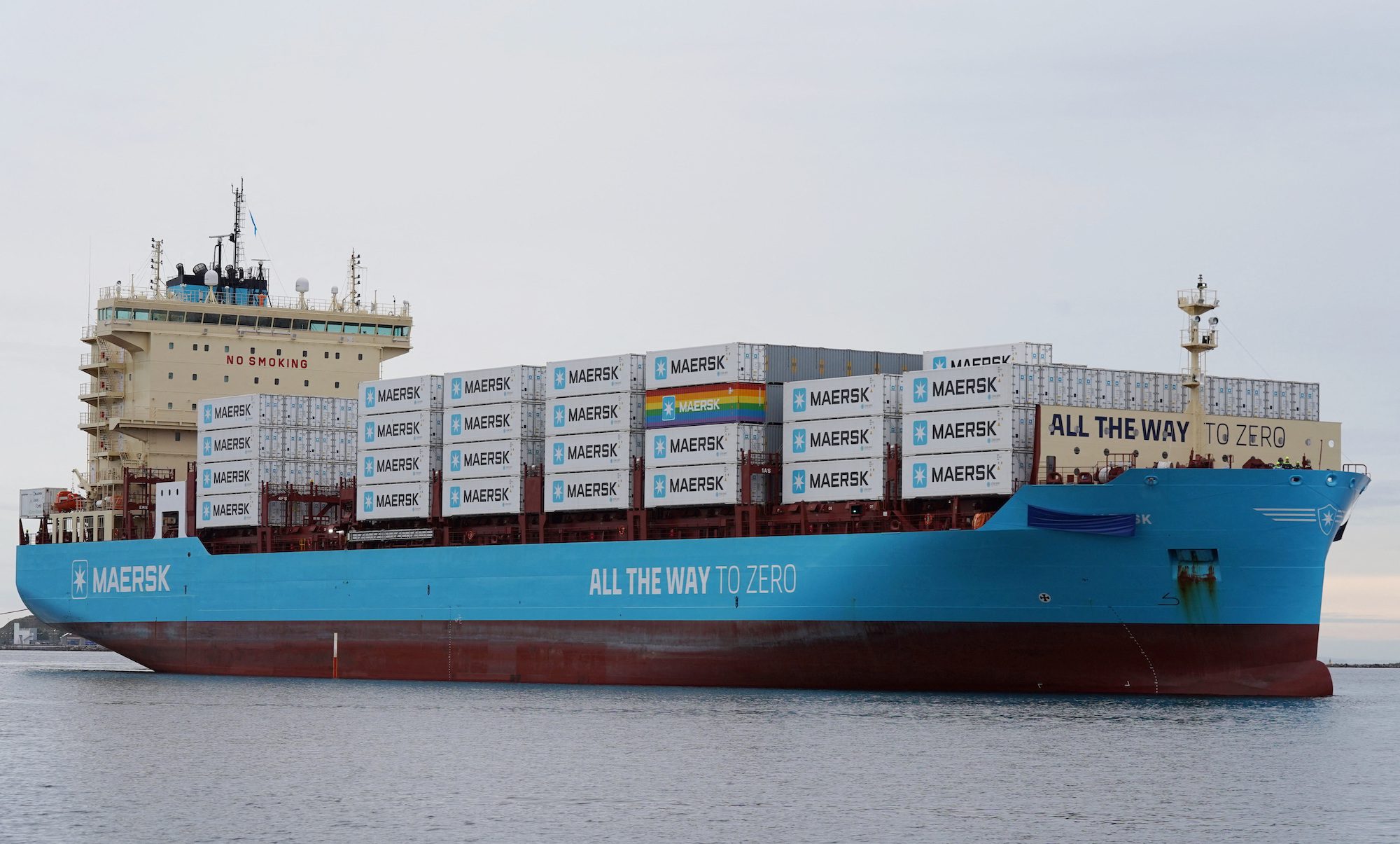
Danish shipping giant Maersk is expanding its low-emission fuel options by testing ethanol as a potential alternative to methanol in its dual-fuel fleet, with trials now underway aboard the pioneering container vessel Laura Mærsk.
The company announced it will conduct a test using a 50/50 ethanol-methanol blend following a successful initial trial in October and November that used a 10% ethanol and 90% e-methanol mixture. The preliminary test confirmed that ethanol can be safely integrated into the fuel system without compromising engine performance, paving the way for higher concentration blends.
“At Maersk, we believe multiple fuel pathways are essential for the shipping industry to meet its climate ambitions. That means consciously exploring different options and technologies,” said Emma Mazhari, Head of Energy Markets at Maersk.
The trials represent a strategic effort to diversify fuel sources for Maersk’s growing fleet of dual-fuel methanol vessels. Laura Mærsk, which entered service in July 2023 as the world’s first dual-fuel containership operating on methanol, was originally designed with methanol as the alternative fuel. However, because ethanol and methanol share similar chemical properties as alcohols, the vessel’s engines can accommodate both fuels with minimal modification.
The initial E10 blend test examined whether the mixture would ignite and burn as efficiently as pure methanol while maintaining comparable lubricity and corrosiveness levels. With those results proving favorable, Maersk plans to proceed with the E50 test and eventually conduct a trial using 100% ethanol.
“Ethanol has a proven track record with an established market and existing infrastructure and offers an additional pathway for decarbonisation. By gradually increasing ethanol content, we gain valuable insights into engine performance and combustion impacts, informing fuel sourcing potential,” Mazhari explained.
The ethanol being tested is anhydrous ethanol, the same type currently blended into gasoline in several countries worldwide. The United States and Brazil are the world’s largest ethanol producers, together comprising 80% of the global market. Ethanol is typically produced from biomass sources such as corn or sugar cane.
Maersk emphasized that sustainability criteria remain paramount in evaluating ethanol’s role in its fuel mix. The company is conducting a comprehensive assessment covering lifecycle greenhouse gas emissions, traceability, certification standards, and responsible sourcing practices to ensure the ethanol used does not contribute to land conversion, deforestation, or competition with food and feed supplies.
The trials are part of Maersk’s broader decarbonization strategy. The company aims to achieve net-zero greenhouse gas emissions by 2040—a full decade ahead of industry standards—and transport at least 25% of ocean cargo using green fuels by 2030. To support these goals, Maersk adopted a policy in 2021 to exclusively order vessels with dual-fuel capabilities.
Maersk planned to have 19 dual-fuel vessels operating in its fleet by 2025. The company also has 24 additional methanol-powered vessels on order for delivery between 2024 and 2027. Its low-emission fuel portfolio includes bio-methanol, e-methanol, and biodiesel, and is expected to expand to include liquefied biomethane and LNG starting in 2027 with the arrival of time-chartered dual-fuel LNG vessels.
Laura Maersk, a 172-meter vessel with 2,100-TEU capacity, was christened by EU Commission President Ursula von der Leyen and is operated on a Baltic shipping route between Northern Europe and the Bay of Bothnia. The vessel’s name honors the first steamship purchased by Captain Peter Maersk Moller in 1886, which also bore Maersk’s iconic white seven-pointed star on a light blue background.
Maersk CEO Vincent Clerc has described Laura Maersk as “a historic milestone for shipping across the globe” and “the breakthrough we needed,” while acknowledging that the industry still has “a long way to go before we make it all the way to zero.”
The success of the ethanol trials could have significant implications for the broader shipping industry as it seeks scalable alternatives to conventional marine fuels. With an established global ethanol market already in place, the fuel offers what Maersk describes as “optionality” in meeting climate targets without requiring entirely new infrastructure.
Editorial Standards · Corrections · About gCaptain

 Join The Club