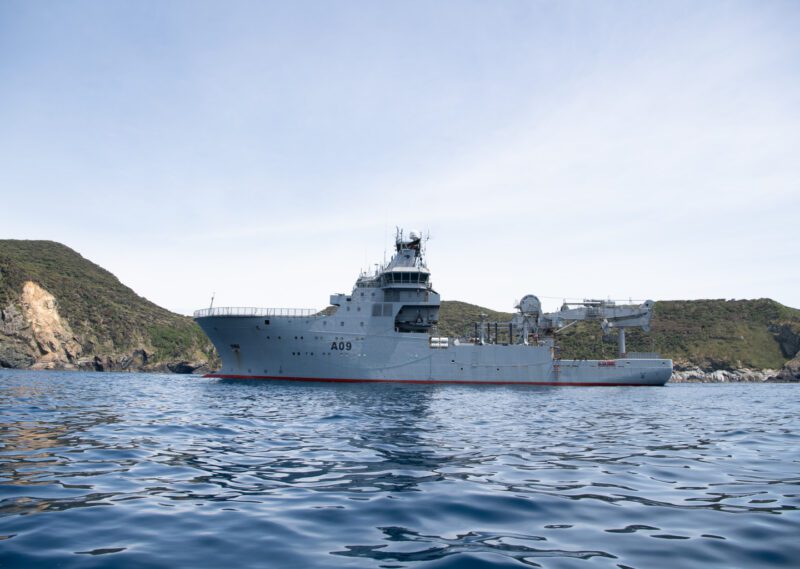
The Royal New Zealand Navy released its final Court of Inquiry report on Friday detailing the circumstances that led to the loss of HMNZS Manawanui, which ran aground and subsequently sank off the coast of Samoa in October 2024.
The vessel, carrying 75 personnel, grounded while conducting a hydrographic survey of a reef on October 5, 2024, and sank the following day.
The Court of Inquiry, presided over by Commodore Melissa Ross, identified direct causes including the ship maintaining a heading toward land and confusion over the vessel’s autopilot status. Critically, the crew attempted to adjust course using azimuth thruster controls while the ship remained in autopilot mode, rendering their actions ineffective.
According to the report, the situation was compounded by a mistaken assessment of thruster control failure and subsequent non-adherence to emergency procedures, which should have included switching from autopilot to manual control.
“The Court found deficiencies in the training and qualifications of key ship’s personnel involved in the incident, risks related to the survey task were not sufficiently identified, discussed and mitigated, and instructions or procedures were lacking,” stated the report.
HMNZS Manawanui. New Zealand Defence Force
Notably, the investigation revealed that the ship’s Commanding Officer was not platform endorsed for the vessel, a requirement specified in the New Zealand Manual of Navigation. Commanding Officer Yvonne Gray has faced harsh criticism over the incident while also being praised for her decision to abandon ship and save lives.
Gray, who is named as “Witness 1” in the report, while not present on the bridge during the early stages of the crisis, arrived on the bridge just moments before the grounding and became central in the immediate response once the situation deteriorated.
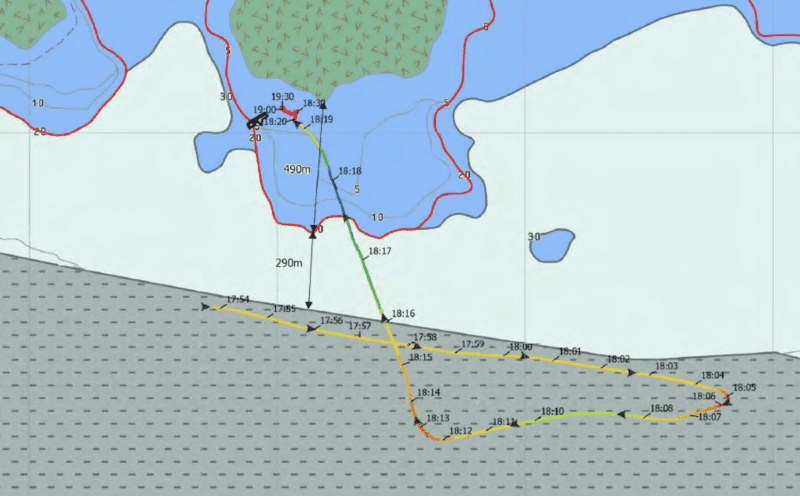
According an analysis of the ship’s VDR (Voyage Data Recorder), Gray arrived on the bridge at 18:17:20, just prior to the initial grounding at 18:17:59 while traveling at a speed of around 10.7 knots. Below is a snippet from the report:
18:17:20 Witness 1 (CO) arrives on the bridge and Witness 2 reports that he has full astern on and the Ship is not stopping. 18:17:21 Witness 16 asks “how many shackles on deck?” 18:17:24 Witness 4 pipes “let go three cables.” 18:17:32 Witness 1 asks “have we got any steerage way?” Witness 2 replies “…haven’t got any steerage way, came full astern on both engines.” 18:17:45 Witness 2 talks about shutting the engines down and asks if they could call the engine room to shut them down. 18:17:53 Witness 1 asks “what speed have we got?” Witness 2 replies “10 kts increasing and I’ve got fucking full astern here and nothing is happening.” 18:17:59 Witness 1 states “turn instead of going astern.” Grinding and shaking noises heard on VDR.
Afterwards, the ship continued moving on heading 340° for about 90 seconds before becoming stranded at 18:19:30.
Reconstruction of the track the HMNZS Manawanui took in the lead up to the grounding. Credit: Royal Navy Defense Force
Chief of the Navy Rear Admiral Garin Golding acknowledged the findings, highlighting a concerning “gap between work as imagined and work as done.”
The Navy has already implemented several corrective measures, including reviews of risk management procedures and training protocols.
“We have updated our critical incident management procedures, made changes to some of our tools that assist with risk, and stood up a project team specifically to ensure quality and consistency of our plans and procedures,” Rear Admiral Golding stated.
The investigation identified twelve contributing factors, including training and experience deficiencies, inadequate military hydrographic planning, procedural issues, supervision gaps, and leadership concerns.
Looking forward, the Navy announced plans for a comprehensive transformation program to address systemic issues, including the lack of standardization across the fleet.
“Fundamentally we need to do things differently. We need to adapt to new technologies, change the way we approach what we do, and find new ways to continue to deliver on what is expected of us,” Rear Admiral Golding explained.
Nine recommendations were outlined in the report, focusing on risk management, procedural improvements, force generation, seaworthiness standards, training protocols, and hydrographic capabilities.
The incident stands as one of the most significant losses in recent Royal New Zealand Navy history, prompting a thorough examination of operational procedures and training standards across the fleet.
The full Court of Inquiry report can be found here.
By Daniel Katzive (gCaptain) – Unapproved use of a propane torch on deck triggered the explosion aboard a New York City municipal sludge tanker Hunts Point last May, according to...
A Houston ship pilot’s extended personal cell phone conversation and multiple failures to maintain a proper lookout led to the fatal 2024 collision between the bulk carrier Yangze 7 and the towing...
A routine maintenance job aboard the fishing vessel Antarctic Discovery turned into a dangerous toxic gas incident after decomposing fish waste was accidentally pumped into a machinery space, sending four workers to...
July 23, 2026
Total Views: 3943
Get The Industry’s Go-To News
Subscribe to gCaptain Daily and stay informed with the latest global maritime and offshore news
— just like 106,954 professionals
Secure Your Spot
on the gCaptain Crew
Stay informed with the latest maritime and offshore news, delivered daily straight to your inbox
— trusted by our 106,954 members
Your Gateway to the Maritime World!
Essential news coupled with the finest maritime content sourced from across the globe.

 Join The Club