Don’t Miss Your Daily Briefing for the Maritime Industry
Join the leading maritime news network
— trusted by our 106,814 members
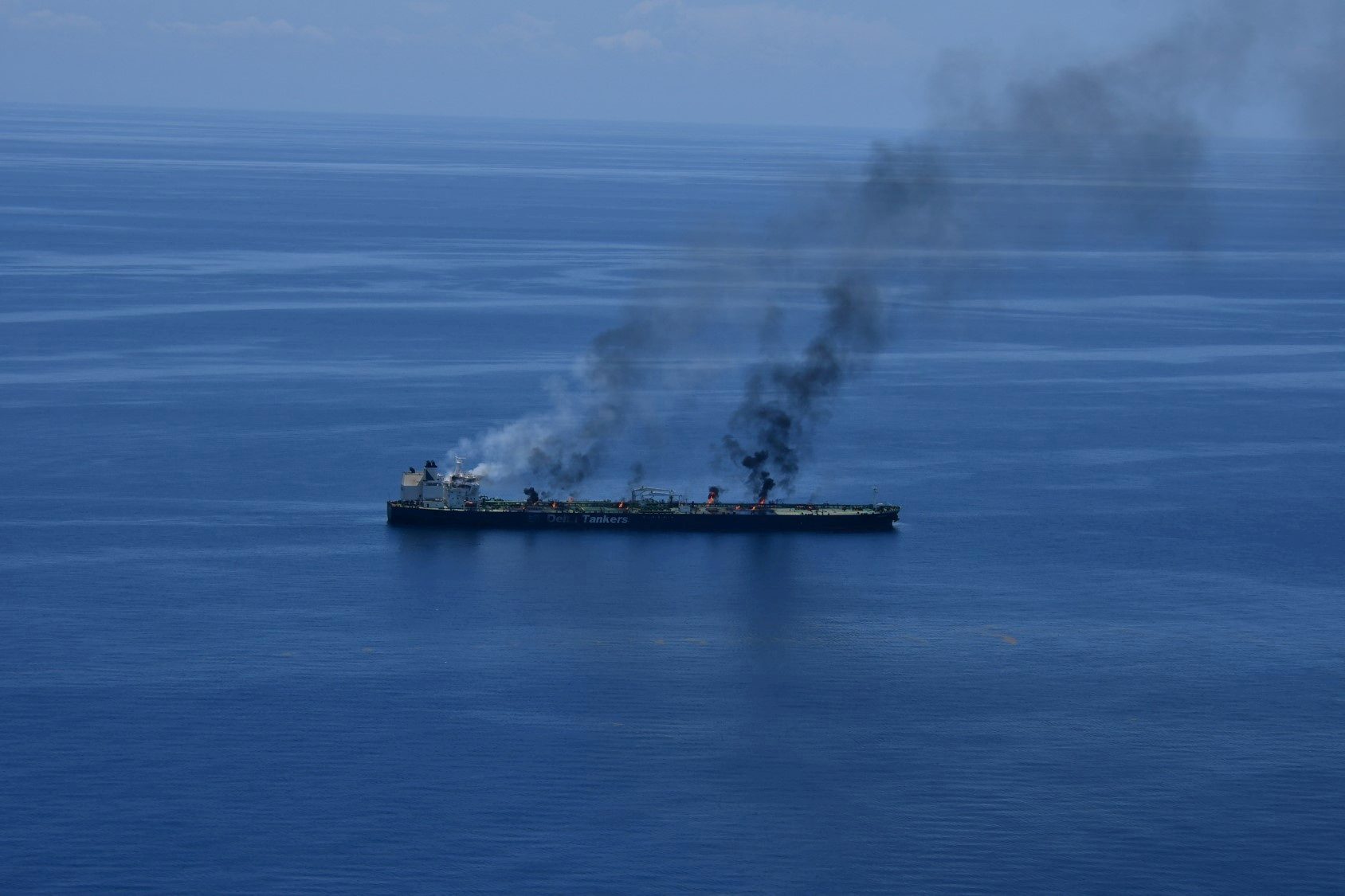
Flames and smoke rise from the Greek-flagged oil tanker Sounion on fire in the Red Sea, August 25, 2024. Yemen's Houthis said they attacked the Sounion in the Red Sea. EUNAVFOR ASPIDES/Handout via REUTERS
Houthi Attacks on Saudi Tankers Constrict Crude Trade
The flow of Middle East energy trade is evolving yet again after attacks on two tankers in the Red Sea by Iran-backed Houthi militants.
In a recent maritime security webinar, Lloyd’s List analysts tracking ship movements and attack patterns in real time warned that the Red Sea has moved from a “gradual normalization” phase back into acute uncertainty.
“I think that the situation in the Red Sea and in the Middle East and the Strait of Hormuz has fundamentally changed, and we’re never going back to what it was before,” said Bridget Diakun, senior risk and compliance analyst at Lloyd’s List. “We’re not going back really to a time where we were before February 28 in the Strait of Hormuz. I don’t think I would describe it as a no-go area.”
Diakun noted that during the peak of the Red Sea crisis, traffic was down about 60%.
“Depending on what the Houthis do right now, perhaps we’ll see transits drop even further than that 60% mark,” said Diakun. “But again, everyone has different risk appetites, and I think people also adjust to the situation.”
Contributing to the decision to transit through a war zone is fatigue. Tanker owners and operators eventually accept the situation as time goes on. War risk becomes the new normal.
“I think the longer this goes, we will definitely watch the space to see how the transits fluctuate,” said Diakun. “I do expect it to move in ebbs and flows depending on what’s happening at a geopolitical level.”
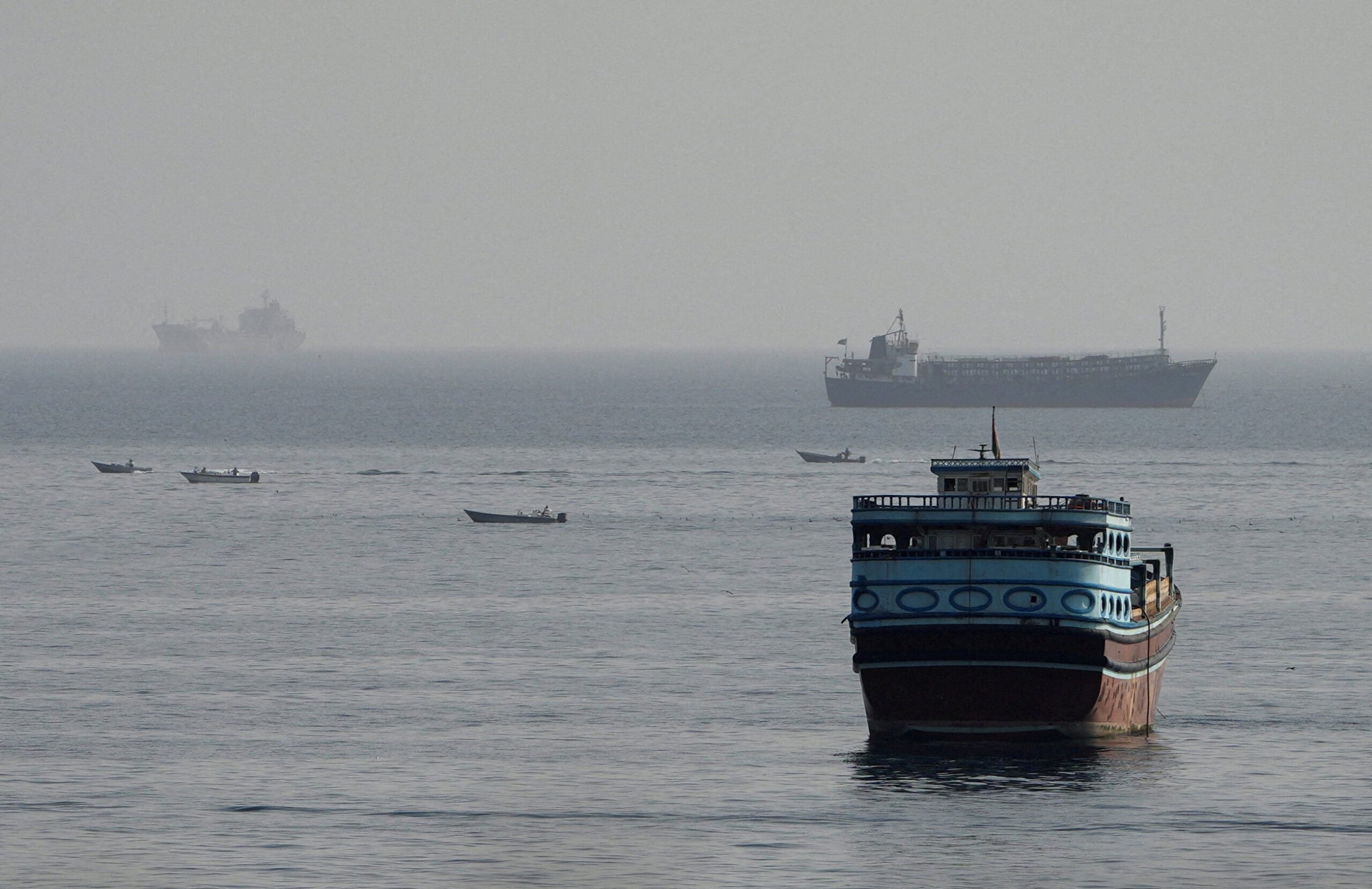
Matthew Rajendra, senior reporter for Lloyd’s List, added that even non-Saudi-linked vessels carrying crude oil from Saudi Arabia could also be targets. To avoid being attacked, some commercial vessels, including tankers, are posting their crew affiliations and nationalities via their public tracking systems.
While there have been tanker diversions away from the Red Sea, some vessels continue to enter the region.
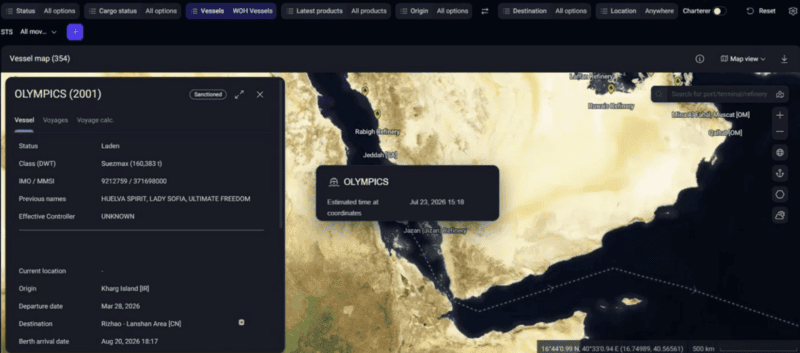
Vortexa tracking shows a sanctioned Iranian tanker carrying crude from Kharg Island transiting the Red Sea.
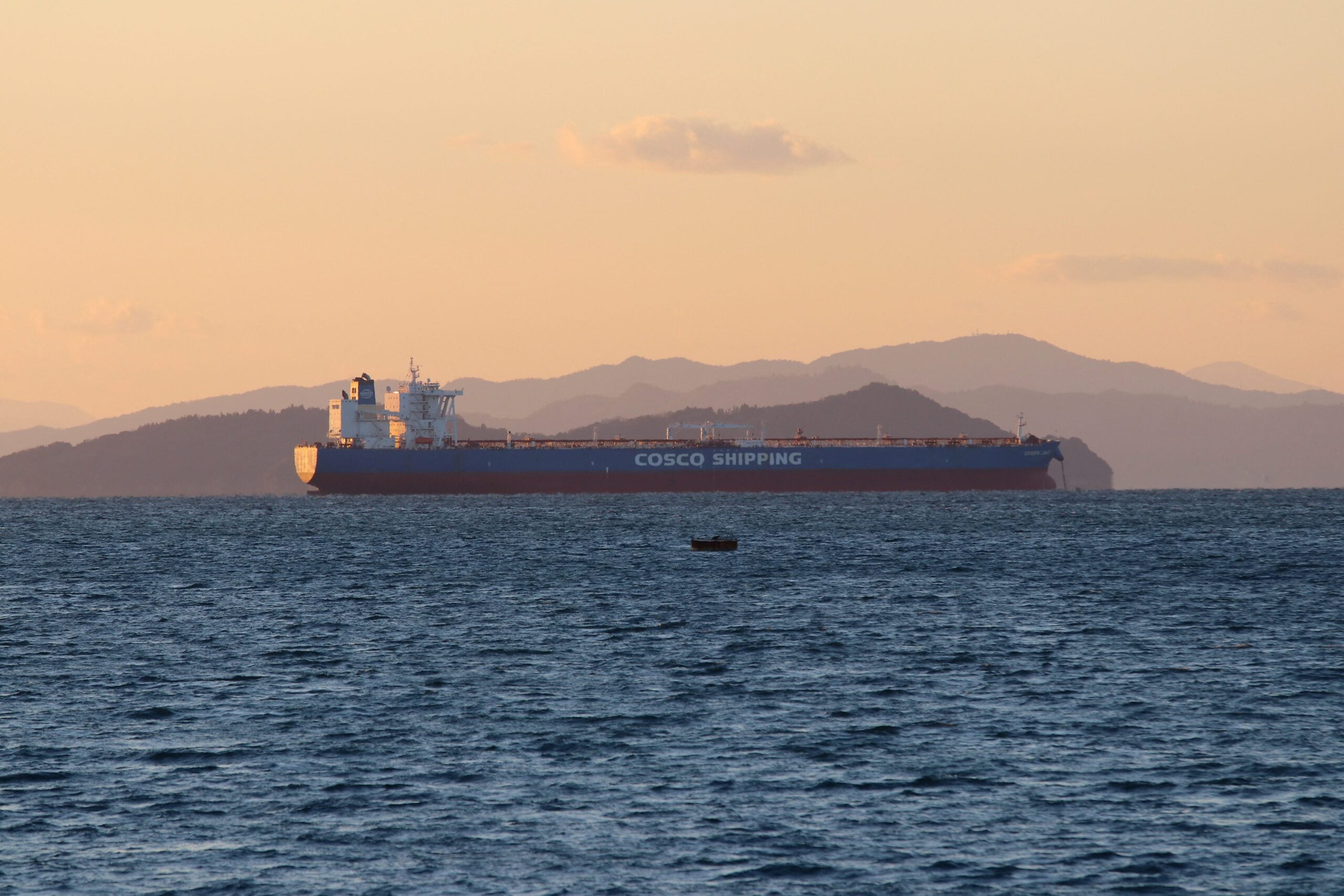
Lloyd’s List has reported that one vessel owned by COSCO has also powered through the blockade.
“Our team was able to get confirmation that COSCO was able to get clearance from the Houthis to get out of the Red Sea,” said Rajendra. “But this raises bigger questions, such as whether any payments may or may not have been made for this passage. It’s still unclear.”
The Houthi militants have claimed responsibility for attacks on at least two Saudi-linked tankers in the Red Sea, including the Ann Ciao, which was verified as the vessel reported hit by UKMTO. A second claimed attack on the tanker Laylaremains uncorroborated by Lloyd’s List. The vessel went dark in mid-July, according to Lloyd’s List, and has not reappeared on AIS. This has complicated efforts to confirm its damage or position.
Vortexa told gCaptain it has observed a couple of vessels transiting the Bab el-Mandeb with AIS turned off, with the common factor being that either the vessel or its cargo is linked to Saudi Arabia.
“Regarding Yanbu, we have observed three liftings in the last two days versus seven over the previous two days. Should attacks in the Bab el-Mandeb continue or become sustained, it’s likely we may see transits via the Cape of Good Hope to load at Yanbu instead of transiting the Suez Canal,” said George Morris, graduate market analyst at Vortexa.
Yanbu on the Red Sea coast has functioned as a key contingency export route for Saudi Arabia during the Strait of Hormuz crisis. If the Red Sea itself becomes severely constrained, Saudi crude exports from Yanbu and other western ports would face a chokepoint from the west, while exports from eastern ports remain constrained by the Strait of Hormuz.
“The impact is even more severe because crude oil and refined products were transiting the Suez Canal from the Mediterranean into the Red Sea on their way to India and Asia,” said Andy Lipow, president of Lipow Oil Associates. “The blockade impacts 3.1 million barrels per day of Saudi crude oil plus another 3.0 million barrels per day of crude oil and refined products that transit the canal in a north-to-south direction. The total impact equals 6.1 million barrels per day, according to ship-tracking services.”
The U.S. Energy Information Administration reported that approximately 4.9 million barrels per day of crude oil and petroleum products transited the Suez Canal and the SUMED pipeline during the first half of 2025.
“If the SUMED pipeline carried 1.0 million barrels per day, that leaves 3.9 million barrels per day on tankers through the canal in both directions—south to north and north to south,” explained Lipow. “It would be the north-to-south direction that would see the additional impact. There are various estimates of how much oil is flowing in the north-to-south direction; it appears that 3.0 million barrels per day is the average. Much of that flow is Russian, North African, and even U.S. crude headed to India and Asia.”
Yemen's Iran-allied Houthis said Saudi Arabia was attacking the Yemeni capital Sanaa on Tuesday after a Saudi-led coalition warned civilians to stay away from an oil depot on the city's outskirts, part of a rapidly escalating war between the sides.
A growing number of empty supertankers have been turning away from the Persian Gulf as escalating Iranian attacks threaten a critical transfer hub for wartime oil shipments.
Six commercial vessels were reported struck in and around the Strait of Hormuz on October 11, including five tankers and a container ship, as attacks on merchant shipping continue to...
October 12, 2026
Total Views: 2207
Get The Industry’s Go-To News
Subscribe to gCaptain Daily and stay informed with the latest global maritime and offshore news
— just like 106,814 professionals
Secure Your Spot
on the gCaptain Crew
Stay informed with the latest maritime and offshore news, delivered daily straight to your inbox
— trusted by our 106,814 members
Your Gateway to the Maritime World!
Essential news coupled with the finest maritime content sourced from across the globe.

 Join The Club