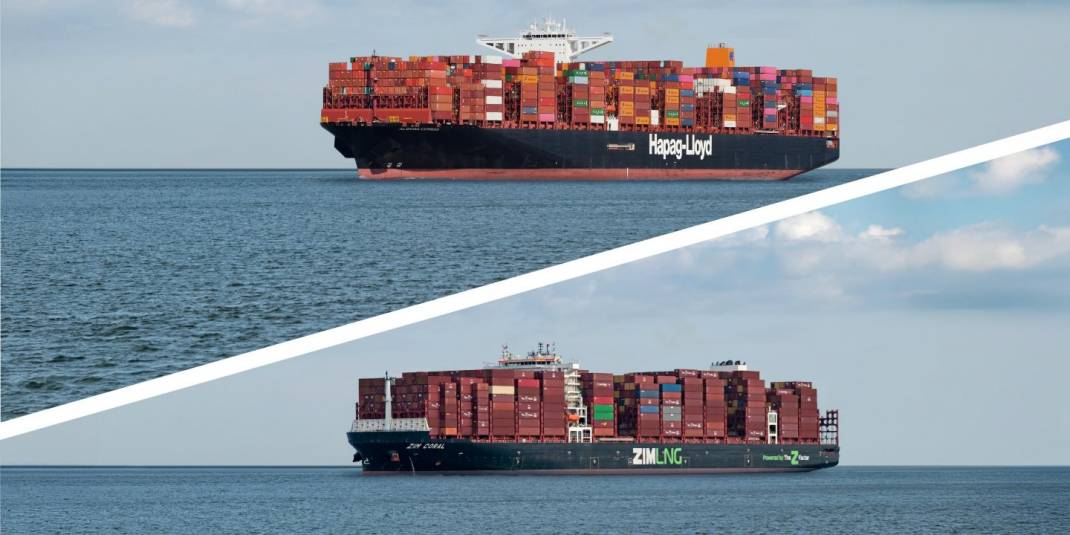
German carrier Hapag-Lloyd has agreed to acquire Israel’s ZIM Integrated Shipping Services for $35 per share in cash, valuing the transaction at roughly $4.2 billion and marking one of the most consequential consolidation moves in container shipping since the pandemic boom.
The offer represents a 58% premium to ZIM’s February 13 closing price and a 126% premium to its unaffected August 2025 share price before takeover speculation emerged. If completed, the deal will lift Hapag-Lloyd’s global market share to approximately 9.2%, reinforcing its position as the world’s fifth-largest liner operator behind MSC, Maersk, CMA CGM, and COSCO, according to Alphaliner rankings data.
The combined company would control more than 4.8 million TEU of fleet capacity including orderbook, transport roughly 17–18 million TEU annually, and operate a fleet exceeding 400 vessels. The move comes as carriers face softer freight rates, elevated operating costs from prolonged Red Sea diversions, and intensifying alliance realignment.
Strategic Network Play
“ZIM is an excellent partner for Hapag-Lloyd,” CEO Rolf Habben Jansen said, citing stronger coverage across the Transpacific, Intra-Asia, Atlantic, Latin America and East Mediterranean trades.
The strategic logic is largely geographic and operational. The merger materially strengthens Hapag-Lloyd’s position on the Transpacific — moving the combined carrier into a top-four slot on the critical trade lane with an estimated three to four percentage point market share gain. The Atlantic trade also sees meaningful expansion, where ZIM’s footprint fills historical gaps in Hapag-Lloyd’s network.
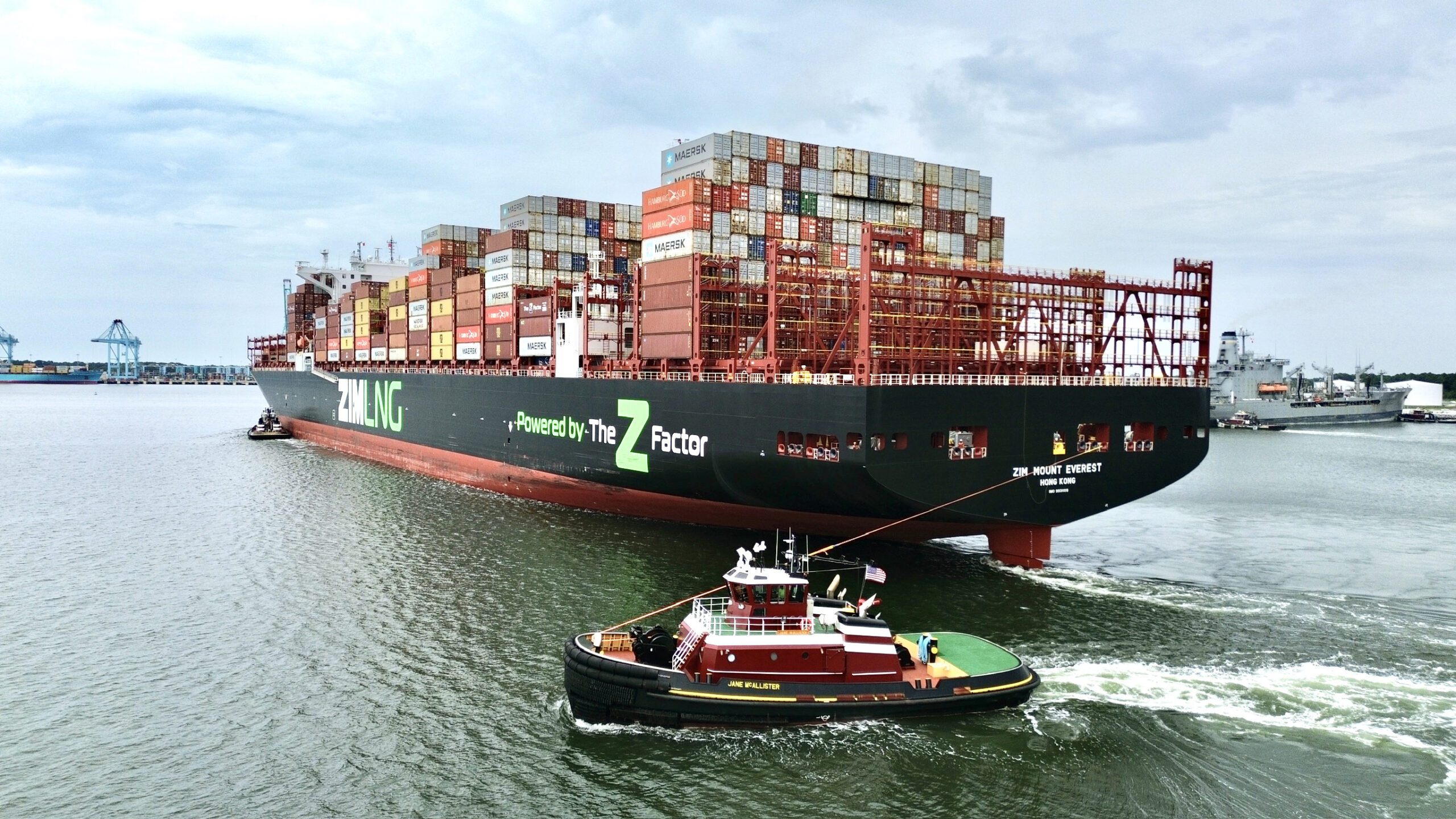
ZIM contributes approximately 713,000 TEU of operated capacity across 117 container vessels plus 14 car carriers, with roughly 60% of the fleet comprised of newer tonnage. About 40 LNG-powered ships are included — positioning the combined carrier as one of the more advanced operators in alternative fuel deployment.
Management projects annual run-rate synergies of $300–$500 million, primarily from network optimization, procurement efficiencies, equipment consolidation, IT integration, and elimination of overlapping infrastructure. Hapag-Lloyd pointed to its prior integrations of UASC, CSAV, and NileDutch as evidence of execution discipline.
The deal also deepens Hapag-Lloyd’s role within the Gemini Cooperation, its strategic alliance with Maersk launched in February 2025, potentially feeding additional volume into the joint network and improving asset utilization.
Israeli Security Safeguards
The transaction includes a carefully structured solution to address Israel’s national security considerations.
ZIM holds a non-transferable “Golden Share” controlled by the State of Israel that provides special protections. Under the agreement, that share will transfer to FIMI Opportunity Funds, Israel’s largest private equity fund with more than $11 billion in assets under management.
FIMI will establish a new Israeli container operator, “New ZIM,” launching with 16 modern vessels serving strategic trade lanes linking Israel with major ports in the EU, U.S., Mediterranean and Black Sea. The new company will operate under the ZIM trademark and receive commercial support from Hapag-Lloyd, including access to the Gemini network, which includes 29 shared mainline services and 29 shuttle services across East–West trade lanes..
“FIMI recognizes and believes in the strategic importance for the State of Israel of a strong independent Israeli shipping company,” said Ishay Davidi, Founder and CEO of FIMI Funds. “We will create a stable Israeli company, the new ZIM, and view Hapag-Lloyd as a significant strategic partner for its ongoing operations.”
A Volatile But Profitable Chapter
For shareholders, the agreement caps one of the most dramatic value cycles in liner history.
Since its January 2021 IPO, ZIM distributed $5.7 billion in dividends. Including the acquisition price, total capital returned approaches $10 billion — roughly five times its initial market value and 45 times the capital raised at IPO.
ZIM became one of the industry’s most closely watched stocks during the pandemic-era freight surge due to its heavy exposure to the transpacific spot market. Under CEO Eli Glickman, the company moved from negative equity in 2017 to record profitability at the peak of the cycle.
“I am incredibly proud of the strategic transformation we have executed at ZIM over recent years, which has generated exceptional value for our shareholders,” said Glickman. “Since I joined the Company in 2017, ZIM has progressed from a position of negative equity to become an industry leader with strong financial and operational performance.”
Deal Lands Amid Earnings Reset
The acquisition comes during a cooling phase for liner profitability.
Hapag-Lloyd reported 2025 revenues of $21.1 billion, with EBITDA of $3.6 billion and EBIT of $1.1 billion — down sharply from $5.0 billion and $2.8 billion, respectively, in 2024. While volumes rose 8% to 13.5 million TEU, average freight rates fell 8% to $1,376 per TEU.
Cape of Good Hope diversions and Gemini start-up costs weighed on margins, though management says alliance synergies began materializing in the second half of 2025 and will be fully realized in 2026.
The transaction has been unanimously approved by ZIM’s board and is expected to close by late 2026, subject to shareholder and regulatory approvals. Until then, both carriers will continue operating independently under “business as usual” conditions.
If completed, the deal signals that post-pandemic consolidation — long anticipated after record windfalls — is no longer theoretical. The next phase of the liner cycle appears to be defined not by emergency profits, but by scale, fuel strategy, and network control.
Editorial Standards · Corrections · About gCaptain

 Join The Club