As positioning capabilities have been improved to the point where a vessel can now sit on a (virtual) dime, the focus now shifts towards refinement. Making vessels more efficient is not only the right thing to do for the environment, it also makes good business sense. As legislation continually moves towards stricter emission controls, companies that are taking the initiative now will remain ahead of the curve, staying competitive in the process.
Lets take a look at some of the improvments that are being made on DP components & technologies, in an effort to make them greener.
Compared to existing DP systems, GreenDP has been designed with the focus of reducing fuel consumption. It accomplishes this with its controller design, which consists of 2 parts:
Environment Compensator
Model Predictive Controller
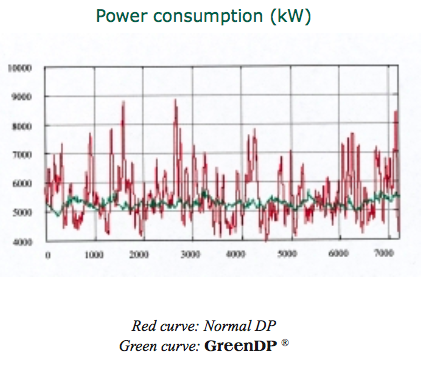
The Environment Compensator is designed to give slowly varying thruster demand, compensating for average environmental forces. This demand will maintain the wanted position under average conditions, but reacts very leisurely to a changing environment. In this way the power consumption is more stable & the usage is reduced.
The Predictive controller uses a forecast of the vessels movements as an input & takes action during larger changes in external forces. The prediction is considered in conjunction with pre-set boundaries. When the prediction indicates that the boundaries will be broken the controller reacts swiftly, thereby insuring that the vessel will stay within the operational area.
Kongsberg indicates that this new control strategy will reduce fuel consumption by approximately 20%. Additionally it will result in reduced wear & tear on mechanical parts of the power & thruster system, thus reducing maintenance costs.
The graph below shows the power consumption of a normal DP system compared to the GreenDP system, with exactly the same wind, waves & current. It is seen that the variation in much lower for the GreenDP. In a real world application this means that the number of generators running may be reduced, resulting in significant fuel savings.
Existing SDP systems can be easily upgraded to GreenDP by replacing the SBC & updating the software.
Hull Design
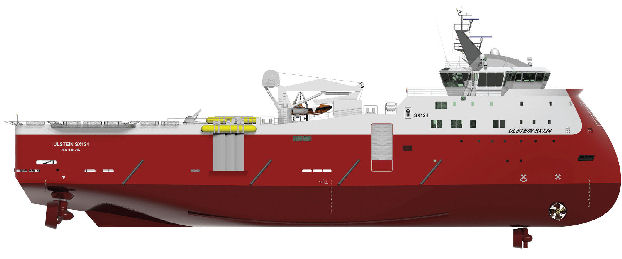
The most significant innovation in hull design this decade is the X-Bow, designed by the Ulstein Group. This inverted bow design improves handling in rough sea conditions & increased fuel efficiency by displacing waves rather than slamming on top of them. This is possible by the increased reserve buoyancy afforded by the large freeboard.
The idea for the X-Bow was conceived in 2003 as a result of a think tank collaboration between a group of industrial designers who knew about industrial design, but didn’t know anything about OSVs and a group of hardcore naval architects and ship designers who had extensive shipbuilding knowledge.
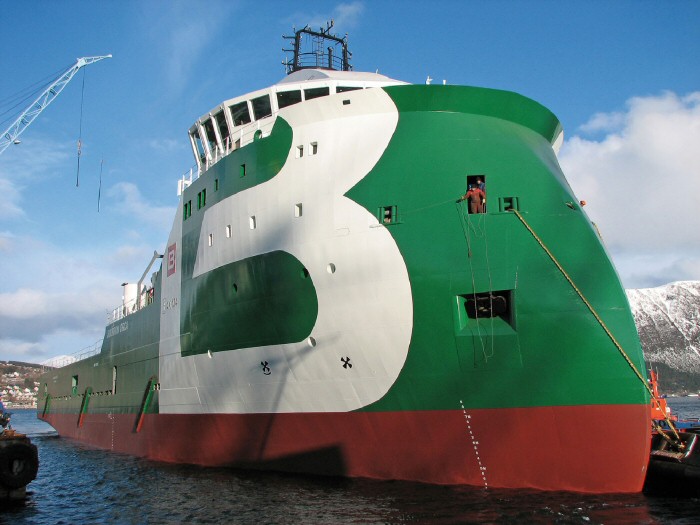
3 years later the first X-Bow AHTS was delivered: The Bourbon Orca.
Propulsion
Although not currently in use in the offshore, CRP Azipod technology will likely make its way there due to the improved hydrodynamic properties of the propulsion system, which lowers fuel consumption & could offer some interesting positioning capabilities.
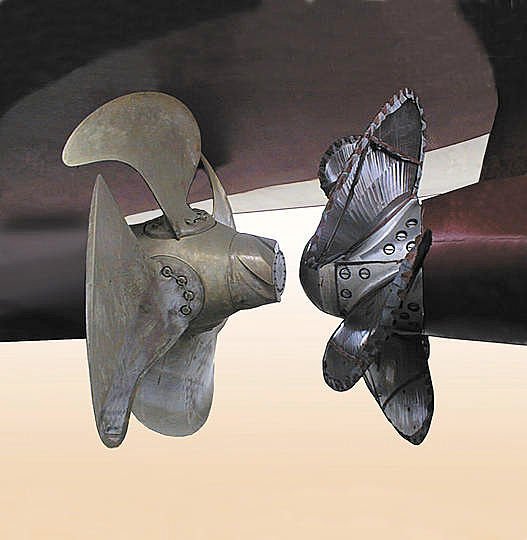
Counter Rotating Propellers work by fitting a steerable azipod thruster inline with the traditional fixed stern propellers. The azipod propeller is smaller than the main prop to avoid cavitation & has a different number of blades, to avoid resonance.
The azipod propeller rotates in a direction opposite to the main propeller, at a slower speed. It acts as the vessels rudder & as it has the ability to rotate through 360 degrees it would be very useful for positioning.
The azipods steering controls meet IMO & Class standards & can be used with DP & Autopilot systems.
Marine BioDiesel is also starting to gain a foothold. Biodiesel is non-toxic, readily biodegradable and essentially free of sulfur and aromatics. Some benefits are:
Non-Toxic
Biodegradable
Cleaner exhaust
Higher flashpoint vs. conventional diesel
Superior lubricity
Because Biodiesel can replace or blend with petroleum diesel with little or no engine modifications, it is a viable alternative to several categories of the marine industry, including: recreational boats, inland commercial and ocean-going commercial ships, research vessels, and the U.S. Coast Guard Fleet.
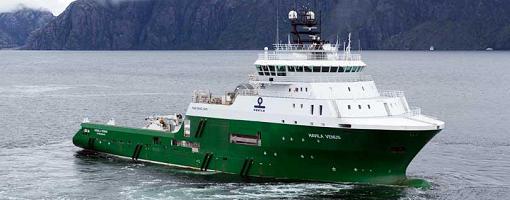
Innovative generator arrangements consisting of various sizes of diesel generators allows optimization of different combinations of diesel mechanic and diesel electric drive. Advanced systems control the generator sets’ operating conditions for minimising fuel consumption and emissions of NOx and CO2. The recently launched Havila Venus is equipped with this system & was named the Greenest AHTS in the World.
By Valerie Volcovici (Reuters) – Joe Biden could erase much of President Donald Trump’s four-year legacy of energy and climate deregulation with the stroke of his pen, according to regulatory...
by Jennifer A. Dlouhy (Bloomberg) — Environmental activists who dangled from bridges and paddled kayaks around an Arctic rig have a new strategy for stopping oil development off U.S. coasts:...
Statoil has published the annual sustainability report and the payments to governments report for 2015. The company delivered annual equity production of 1.971 million barrels of oil equivalents per day...
March 22, 2016
Total Views: 76
Get The Industry’s Go-To News
Subscribe to gCaptain Daily and stay informed with the latest global maritime and offshore news
— just like 107,366 professionals
Secure Your Spot
on the gCaptain Crew
Stay informed with the latest maritime and offshore news, delivered daily straight to your inbox
— trusted by our 107,366 members
Your Gateway to the Maritime World!
Essential news coupled with the finest maritime content sourced from across the globe.

 Join The Club