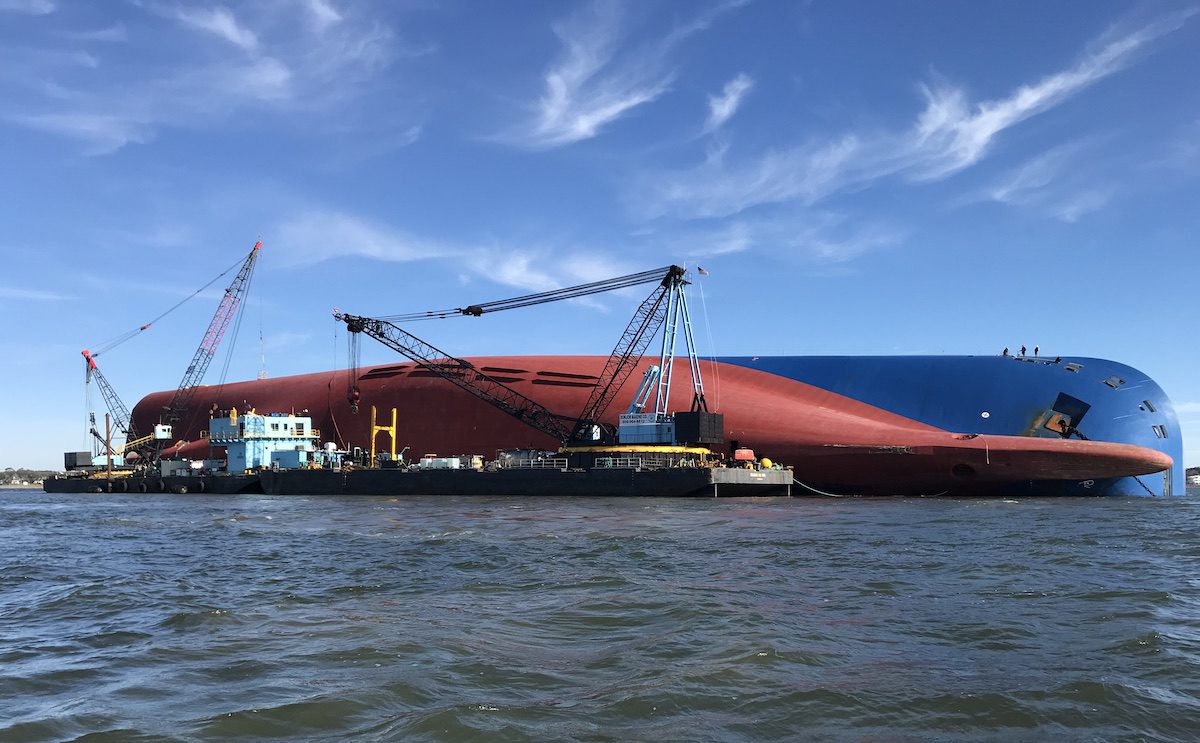
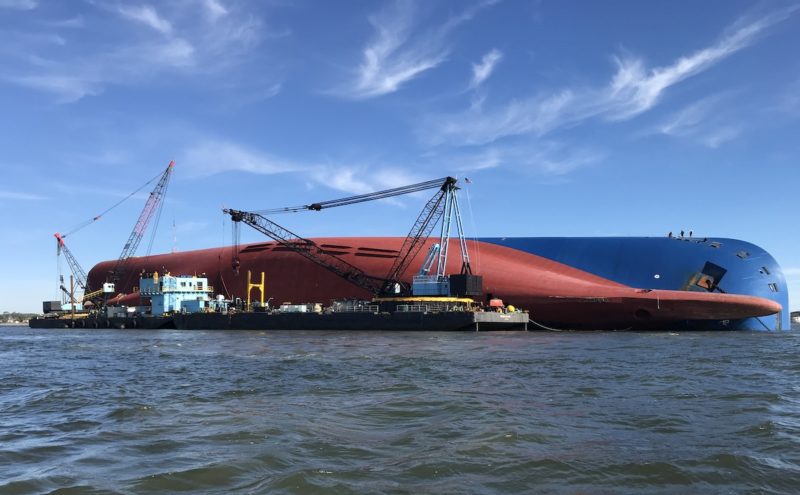
Crews onboard the work barges Farrell [left] and Columbia [right], work to clean residual fuel oil from tanks inside the M/V Golden Ray, St. Simons Sound, Dec. 3, 2019.
The Unified Command overseeing the salvage of the Golden Ray car carrier is getting ready to literally dye the St. Simons Sound.
Crews will introduce the non-toxic, water-soluble dye into the water to determine just how far potential contaminants will travel within the St. Simons Sound waterway, giving experts an idea of how any potential oil discharges will spread when the Golden Ray is cut up.
The dye is the same fluorescein disodium salt commonly used in places like Tampa and Boston when they dye rivers in celebration of St. Patrick’s Day. The natural color is orange-red to dark red, but the color of the dye to be used was not specified.
The dye testing is planned to take place on Tuesday, March 17, during the maximum ebb tide and again at the maximum flood tide the following day.
No significant lasting effects from the dye are anticipated, the Unified Command said.
“The use of this dye is important because it will allow us to see where we need to preposition oil spill response equipment in the most efficient way,” said Jason Maddox, a representative of Gallagher Marine Systems, which is representing the Golden Ray’s responsible party in the Unified Command. “Protection of the environment has always been a priority for the Unified Command, and we take it very seriously.”
The dye test is being conducted as a precaution despite an environmental barrier being built around the Golden Ray wreck to contain pollutants during the salvage.
The 656-foot Golden Ray was carrying about 4,200 vehicles when it lost stability and grounded in St. Simons Bay as it departed Georgia’s Port of Brunswick on 8 September 2019. All the vehicles remain trapped inside the inaccessible cargo holds.
To remove the wreck, salvors have opted to cut up the Golden Ray into eight sections using Versabar’s unique VB-10,000 heavy lifting vessel equipped with a large, diamond cutting chain. Once the cuts are made, each section – weighing 2,700 to 4,100 tons apiece – will be lifted onto a barge for transport to an off-site recycling facility.
The UC for the St. Simons Sound Incident Response is comprised of the Coast Guard as the federal on scene coordinator, the Georgia Department of Natural Resource (DNR) as the state on scene coordinator, and Gallagher Marine Services as the incident commander for the responsible party.
Wreck removal crews have now pulled the grounded containership MSC Baltic III about 53 meters toward shore in Newfoundland and Labrador as salvage teams continue dismantling the vessel and removing steel from...
Tampa-based marine services provider Isla Maritime has expanded into Panama through a strategic partnership with J.A.M. Marine Dockyard, establishing a rapid-response salvage and emergency services capability along one of the...
Nearly a year after running aground on Newfoundland’s west coast, the container ship MSC Baltic III remains at the mercy of North Atlantic winter storms as salvage teams struggle to stabilize the...
January 13, 2026
Total Views: 2478
Get The Industry’s Go-To News
Subscribe to gCaptain Daily and stay informed with the latest global maritime and offshore news
— just like 107,434 professionals
Secure Your Spot
on the gCaptain Crew
Stay informed with the latest maritime and offshore news, delivered daily straight to your inbox
— trusted by our 107,434 members
Your Gateway to the Maritime World!
Essential news coupled with the finest maritime content sourced from across the globe.

 Join The Club