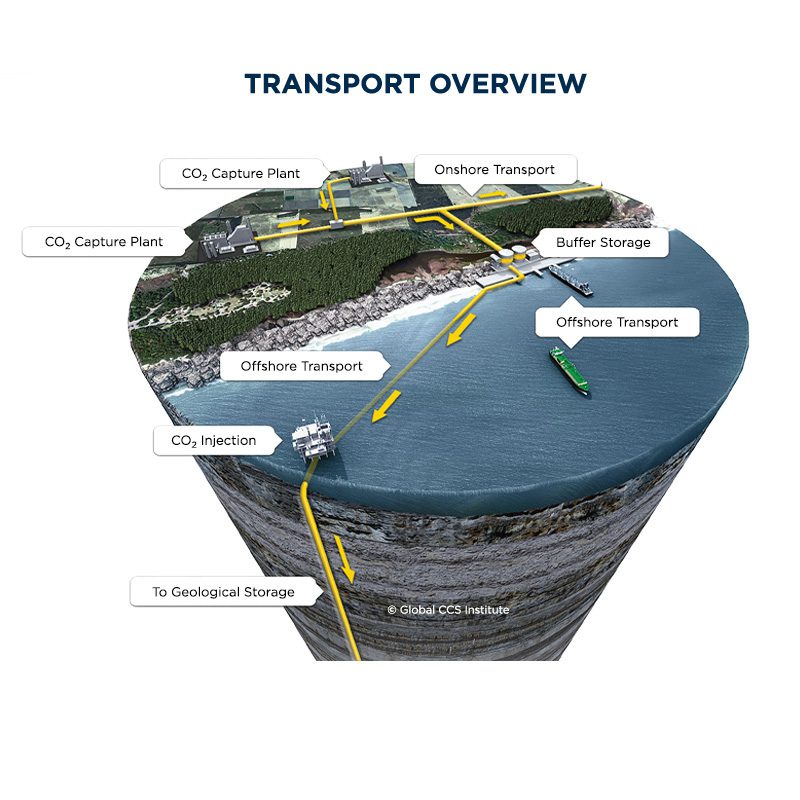
Interest in carbon capture and storage (CCS) is accelerating as industries adapt to evolving regulatory expectations, customer requirements, and competitive pressures. For energy intensive industries such as cement, steel, chemicals, and refining, scalable CO2 management solutions are increasingly viewed as key enablers for continued market access and long-term operational resilience. Offshore storage is emerging as a strategic component of the carbon value chain, and ABS is already working to foster the collaborative networks needed to convert concept into deployment.
Capturing CO2 at land-based facilities and transporting it to offshore locations for permanent geological storage is increasingly viewed as one of the most viable pathways to compliance and risk reduction. While the technology is proven, the diverse stakeholders across this highly integrated ecosystem are still seeking consensus on a workable economic and regulatory model. This is where Floating Storage and Injection Units (FSIUs) could play a pivotal role.
Anatomy of the offshore carbon value chain
There are three main parts to an offshore CCS value chain: the land-based industrial emitter where the CO2 is captured, the CO2 transport provider (typically a specialized liquefied CO2 carrier) and the offshore storage operator. Each faces distinct challenges spanning regulation, technology, financing and risk allocation. Any misalignment, be it incompatible CO2 specifications or transport bottlenecks, can delay or derail projects. Closer collaboration across this chain is essential to ensure compatibility and coordination.
An FSIU – either a newbuild or converted existing offshore asset – receives liquefied CO2 from specialized carriers, stores and conditions it onboard, and ensures continuous injection into subsea wells for permanent storage in depleted oil and gas reservoirs or saline aquifers. Unlike fixed offshore platforms or long subsea pipelines from shore, floating facilities have the flexibility to be deployed incrementally and relocated as early-stage CCS markets continue to evolve.
Northern Lights: A proof point for scale
The Northern Lights project in the Norwegian North Sea illustrates how CCS value chains can mature when commercial alignment, government support and industrial demand converge. Equinor, Shell and TotalEnergies have taken final investment decision on phase two of the project, which has been underpinned by substantial government support – the Norwegian government covered about 80% of the cost for Phase 1 while Phase 2 has received €131 million from the EU funding program, Connecting Europe Facility (CEF).
Other projects are now approaching FID, including APOLLO CO2 , which has been awarded €169.3 million in funding under the EU’s 5th Innovation Fund Large-Scale Projects Call. The project, a collaboration between the Greek natural gas system operator DESFAand ECOLOG, aims to create the first large-scale CCS hub in Greece by 2030, with a first phase capturing 3 to 5 million tons of CO2 from industries in the Attica region, with the possibility of scaling up to 10 million tons. Meanwhile, EnEarth, a subsidiary of UK oil and gas group Energean, is developing the Prinos Carbon Storage Project, also backed by EU funding, while Malaysian energy giant Petronas was recently awarded the first Offshore Assessment Permit for CCS for the Duyong field, located offshore Peninsular Malaysia.
These developments underscore several lessons relevant to floating injection concepts: customer commitment is decisive, public-private partnerships reduce risk and catalyse investment, and scalable infrastructure unlocks further demand. Floating solutions may offer a complementary pathway, particularly where onshore infrastructure faces permitting constraints or where storage sites are remote.
Why offshore, and why floating?
Offshore storage offers several advantages over onshore alternatives. Regulatory and environmental constraints are often less complex, public acceptance risks are reduced, and mature hydrocarbon basins offer significant subsurface capacity and existing skills and knowhow to support the project. Floating injection facilities add another layer of flexibility, acting not only as injection hubs but also as processing and transfer platforms.
FSIUs can support regions where pipeline transport is not feasible or economical, enabling ship-based CCS networks to emerge. Their mobility allows operators to match infrastructure investment with market development, reducing upfront capital risk.
The impurities barrier: why standardization matters
Despite its promise, offshore CCS – floating or otherwise – faces substantial challenges. Regulatory frameworks remain fragmented, long-term liability is not uniformly defined, and economic models are still evolving. Storage operators must identify and mitigate operational risks while assuring regulators and the public of safe, permanent containment.
One of the most pressing technical barriers, however, is the issue of CO2 impurities.
credit ABS
Today’s LCO2 carrier fleet is largely built to customized specifications, which increases costs, limits fleet scalability and creates bottlenecks across the value chain. This customization is driven by uncertainty over impurity compositions and their impacts on materials, safety and operability.
Standardization could be transformative. By defining acceptable impurity “envelopes,” designers and operators could move toward speculative newbuilding of CO2 carriers and associated floating infrastructure. Classification societies such as ABS are actively working with industry and academic partners – including Texas A&M University and Sintef, one of Europe’s largest independent research organisations – to close knowledge gaps around impurity behaviour and materials compatibility. Solving this challenge could unlock significant pent-up demand for offshore storage solutions.
ABS: a catalyst for action
As an independent and trusted third party, ABS is uniquely positioned to help convene stakeholders, educate the market and foster alignment across the offshore CCS ecosystem. While not a solutions provider, ABS plays a critical role in nurturing the conversations and collaborations from which safe, commercially viable and scalable solutions can emerge.
Floating offshore CO2 injection facilities will not solve climate change alone but as part of an integrated carbon value chain, they may prove to be one of the most adaptable tools available. The conversation is moving quickly. The question is whether the industry can move together.
Responding to the surge in global subsea cable investment driven by cloud computing and artificial intelligence, ABS has published its Technical Standard for Subsea Power Cables. Subsea power cable design, installation...
Owners are responding to fleet and market dynamics with efforts to maximise cargo capacity for flexible operations, writes Christoph Rasewsky, Global Container Sector Lead, ABS Europe The containership market is...
Summit Highlights Collaboration, Mentorship, and Opportunity Across the Region’s Maritime Sector ABS hosted the second edition of the Middle East Women in Maritime Summit at the Address Dubai Mall, gathering...
October 24, 2025
Total Views: 281
Get The Industry’s Go-To News
Subscribe to gCaptain Daily and stay informed with the latest global maritime and offshore news
— just like 107,406 professionals
Secure Your Spot
on the gCaptain Crew
Stay informed with the latest maritime and offshore news, delivered daily straight to your inbox
— trusted by our 107,406 members
Your Gateway to the Maritime World!
Essential news coupled with the finest maritime content sourced from across the globe.

 Join The Club