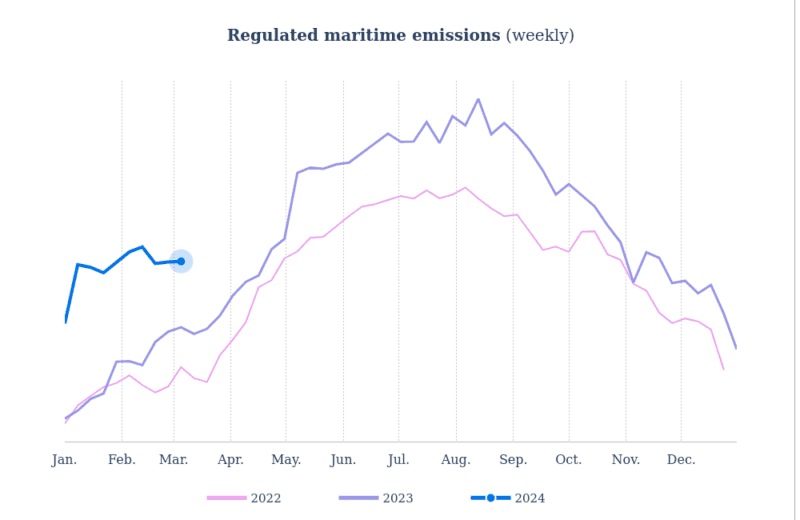
New data has revealed a significant increase in the carbon emissions of the European Union’s (EU) marine shipping sector. According to Kayrros, a global leader in emissions tracking, regulated carbon emissions from the sector have risen by 14% year-on-year in the first two months of this year.
As part of the EU Emissions Trading System (EU ETS), marine shipping emissions now fall under regulatory oversight. The regulations apply to half of the emissions from ships entering and leaving the EU and all emissions for voyages within the Union.
The primary cause of the emissions surge appears to be shipping diversions due to Houthi attacks on vessels in the Red Sea. The targeting of vessels since mid-October has prompted many ships to avoid the Red Sea route between Asia and Europe. Instead, ships are taking a detour around South Africa’s Cape of Good Hope, adding up to 3,000 nautical miles to their journey.
Maritime emissions 2024 vs 2023 vs 2022 in Mt/day
The rerouting has resulted in significant carbon emissions increases. According to Kayrros, an average container ship emits an additional 900 tons of carbon (+30%) when avoiding the Red Sea. Similarly, a Very Large Crude Carrier travelling from the Middle East Gulf to Northwest Europe produces an extra 1,500 tons of carbon emissions.
The EU’s marine shipping emissions were already on the rise before the Houthi attacks, increasing 5.7% in the first nine months of 2023 compared to the same period in 2022. However, the growth rate has accelerated dramatically since the onset of the attacks, despite the implementation of EU ETS regulations.
Antoine Rostand, President and co-founder of Kayrros, said Red Sea diversions present a real challenge for decarbonization efforts.
“With no end in sight for the reroutes, carbon emissions will continue to remain high. In the absence of clean or cleaner fuel for shipping, this would mean a setback for both the maritime industry and the European Commission’s progress towards net zero, all other things being equal.”
Yemen's Iran-allied Houthis said Saudi Arabia was attacking the Yemeni capital Sanaa on Tuesday after a Saudi-led coalition warned civilians to stay away from an oil depot on the city's outskirts, part of a rapidly escalating war between the sides.
The American Bureau of Shipping (ABS) and the U.S. Department of Energy (DOE) have signed an agreement to advance the use of nuclear power in commercial shipping, including nuclear-powered vessels,...
For a decade, LNG has been sold to shipowners as the sensible bridge fuel. Cleaner than heavy fuel oil, widely available and backed by mature engine technology, it has won...
October 12, 2026
Total Views: 2278
Get The Industry’s Go-To News
Subscribe to gCaptain Daily and stay informed with the latest global maritime and offshore news
— just like 106,746 professionals
Secure Your Spot
on the gCaptain Crew
Stay informed with the latest maritime and offshore news, delivered daily straight to your inbox
— trusted by our 106,746 members
Your Gateway to the Maritime World!
Essential news coupled with the finest maritime content sourced from across the globe.

 Join The Club