(Bloomberg) — Reduced congestion in Chinese and Brazilian ports is cutting earnings for ships hauling raw materials, according to RS Platou Economic Research.
About 5.4 percent of dry-bulk carriers are tied up at ports, down from 7.5 percent in May, Herman Hildan, an analyst at RS Platou Markets AS in Oslo, said in an e-mailed note today. Congestion declined in Brazilian ports as exports shifted to Australia, and falling coastal trade helped clear out Chinese harbors, he said. That’s cutting fleet utilization by 1 percent, adding to a 0.5 to 1 percent reduction from lower grain output, Platou estimates.
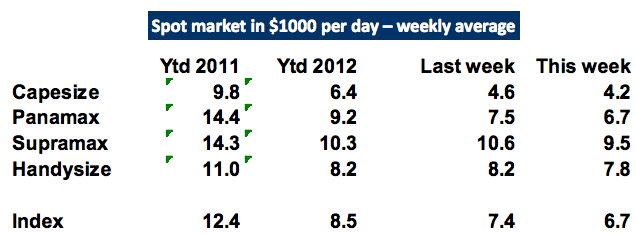
Trip Charter Rates for Bulk Carriers, since March 2012, via RS Platou
Without those two influences, the largest commodity carriers would be earning $14,000 a day, Hildan said in the note. Daily income for Capesizes fell 5.3 percent today to $3,852, according to the Baltic Exchange, the London-based publisher of shipping costs. The Baltic Dry Index, a broader measure of raw-materials shipping costs, declined for a 24th day, falling 2 percent to 774, the lowest since March.
“Lower congestion adds to the dry bulk pain,” Hildan said in the note.
Daily earnings for Panamaxes, which carry about half as much cargo as Capesizes, fell for an 18th day, decreasing 1.2 percent to $6,483, according to the exchange. Supramaxes declined 2.2 percent to $9,264, and Handysizes, the smallest vessels tracked by the gauge, slid less than 1 percent to $7,699, both the lowest since March.
Twenty-two seafarers remain missing after the Panama-flagged bulk carrier Ocean Winner sank in the Bay of Bengal, triggering a major search and rescue operation involving the Indian Coast Guard and passing merchant...
The long-term safety record for bulk carriers continues to improve, but the industry faces an increasingly complex risk environment that extends beyond traditional operational hazards, according to INTERCARGO’s latest casualty...
July 7, 2026
Total Views: 1091
Get The Industry’s Go-To News
Subscribe to gCaptain Daily and stay informed with the latest global maritime and offshore news
— just like 106,328 professionals
Secure Your Spot
on the gCaptain Crew
Stay informed with the latest maritime and offshore news, delivered daily straight to your inbox
— trusted by our 106,328 members
Your Gateway to the Maritime World!
Essential news coupled with the finest maritime content sourced from across the globe.

 Join The Club