The U.S. Coast Guard has announced a record-breaking 510,000 pounds of cocaine seized during fiscal year 2025, marking the largest interdiction haul in the service’s history. Yet this achievement has been eclipsed by mounting international criticism of the Trump Administration over its parallel military campaign that has killed more than five dozen people since early September.
The FY25 seizure represents more than three times the Coast Guard’s annual average of 167,000 pounds and equals approximately 193 million potentially lethal doses.
“The Coast Guard’s top priority is to achieve complete operational control of the U.S. border and maritime approaches,” said Adm. Kevin Lunday, acting commandant of the Coast Guard. “We own the sea, and this historic amount of cocaine seized shows we are defeating narco-terrorist and cartel operations to protect our communities and keep dangerous drugs off our streets.”
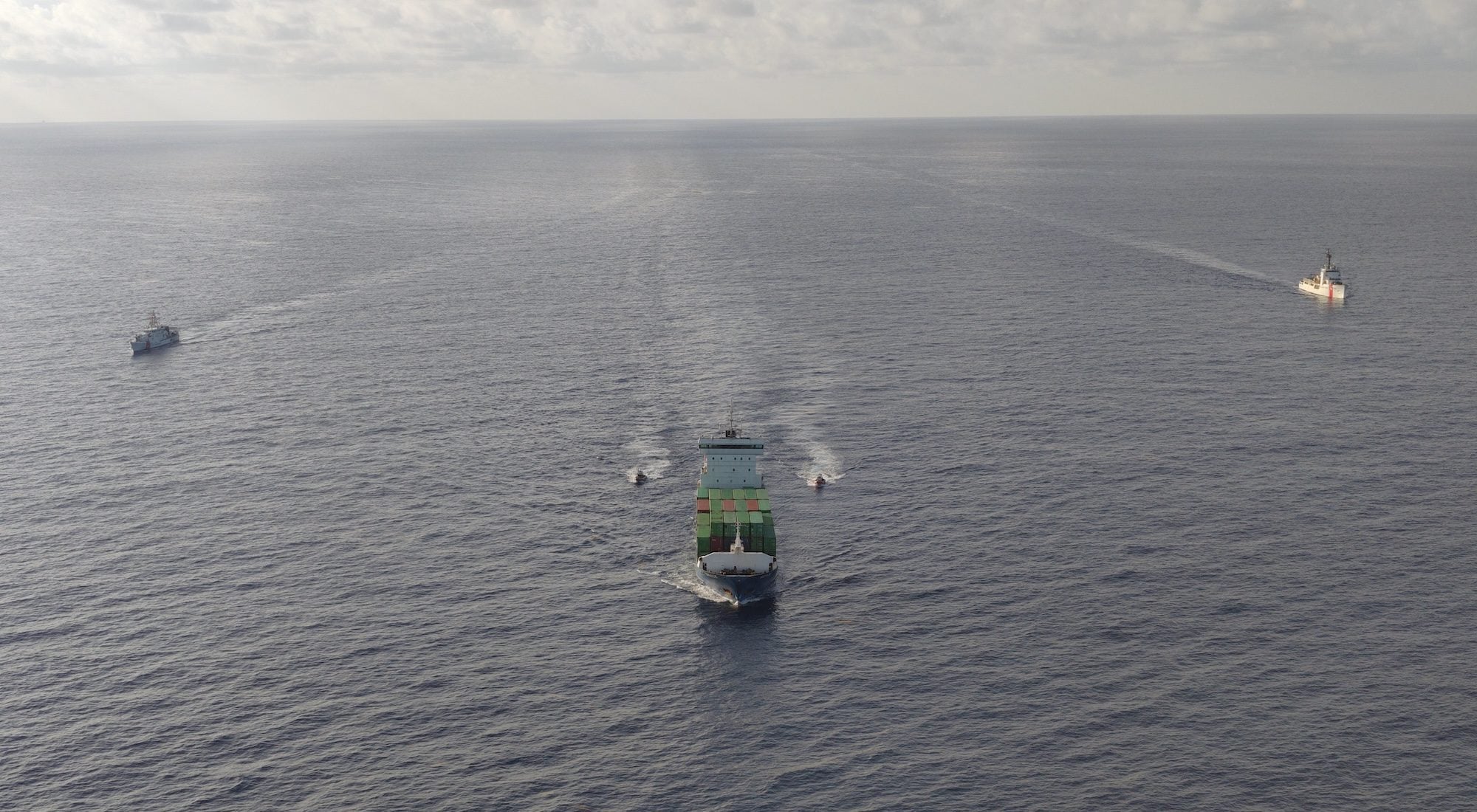
The Coast Guard serves as the United States’ lead federal agency for maritime drug interdiction. Traditional operations involve significant interagency coordination through U.S. Southern Command’s Joint Interagency Task Force-South in Key West, Florida, which detects and monitors drug transit before transferring operational control to the Coast Guard for law enforcement action.
Historically, the Coast Guard interdicted suspected drug vessels while a multi-agency strike force known as “Panama Express” handled investigation and prosecution, which emphasizes lawful interdiction and detention under criminal law.
However, since early September, the U.S. military has conducted at least 15 airstrikes against alleged drug vessels under presidential orders, representing a significant departure from established maritime law enforcement practices. The strikes have killed people from Venezuela, Colombia, and Ecuador.
UN High Commissioner for Human Rights Volker Türk declared last Friday that the strikes “violate international human rights law,” stating: “These attacks – and their mounting human cost – are unacceptable. The US must halt such attacks and take all measures necessary to prevent the extrajudicial killing of people aboard these boats, whatever the criminal conduct alleged against them.”
Türk emphasized that drug interdiction “is a law-enforcement matter, governed by the careful limits on lethal force set out in international human rights law”.
Senate Judiciary Committee Democrats led by Vermont Senator Peter Welch are demanding the Department of Justice provide all legal opinions justifying the strikes. A letter signed by all Democratic committee members, including Ranking Member Dick Durbin, stated that “summarily killing criminal suspects is prohibited under domestic and international law in both peacetime and wartime.”
“If the President does want to start a war, if he wants to put America’s troops in harm’s way, he needs to seek authorization from Congress,” Welch said from the Senate floor.
Amnesty International called the strikes “illegal” and urged Congress to stop further bombings. “In the last two months, the U.S. military’s Southern Command has gone on a murder spree by following the Trump administration’s illegal orders,” said Daphne Eviatar, Amnesty International USA’s Director for Human Rights and Security.
Meanwhile, Secretary of War Pete Hegseth has ordered the Gerald R. Ford Carrier Strike Group to the U.S. Southern Command region to “reinforce operations against transnational criminal organizations,” joining destroyers, a nuclear submarine, and fighter jets already deployed to the Caribbean.
The Justice Department has also shut down the Reagan-era Panama Express task force and transferred remaining cases to a newly created Homeland Security Task Force.

 Join The Club