BEIJING (Dow Jones)–China National Offshore Oil Corp. has begun exploring deepwater oil blocks without the help of foreign partners, partly due to the high risk and cost of exploration and production, which has discouraged foreign investment.
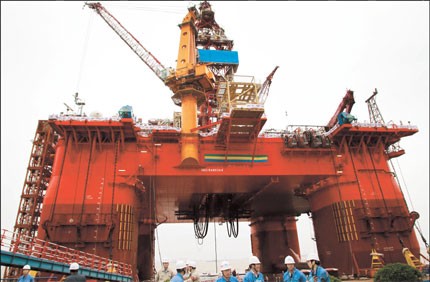
Wednesday marks the official start of Cnooc’s first deepwater semi-submersible drilling rig, the HYSY 981, which is capable of drilling to a depth of 3,000 meters. Cnooc has typically relied on foreign partners such as Canada’s Husky Energy Inc. (HSE.T), U.S.-based Chevron Corp. (CVX) and U.K.-based BG Group (BG.LN) to explore and operate deepwater blocks off China.
Although Husky achieved considerable success finding deepwater gas in the Liwan 3-1 field in 2006, the lack of seismic data, the high cost of drilling exploratory wells and less-than-lucrative contract terms have discouraged foreign companies from partnering to develop China’s deepwater blocks.
Last year, Cnooc publicly offered its first deepwater oil blocks to foreigners, but only Italian oil major Eni SpA (E) made a successful bid, announcing in April that it signed a production-sharing contract with Cnooc for a block located 400 kilometers off Hong Kong.
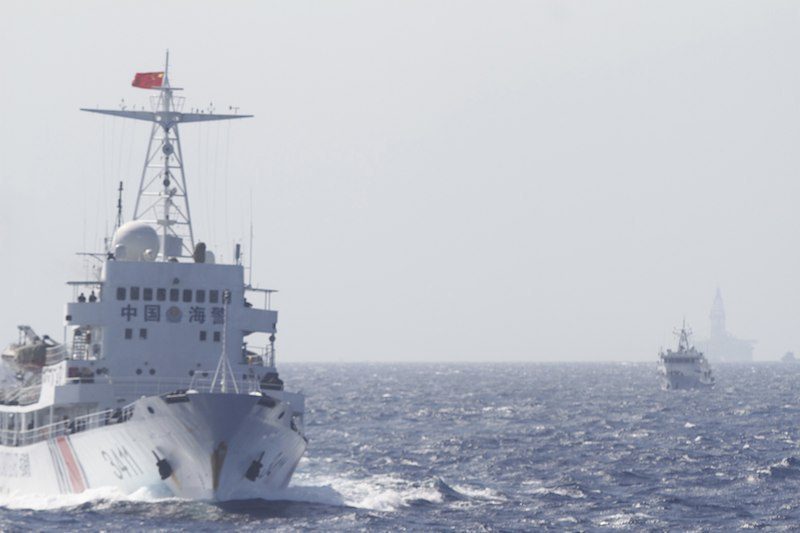
Four other deepwater blocks, two of which may be in disputed Vietnamese waters, are still open to foreign partners.
High international oil prices and the “increasingly severe state” of China’s oil and gas reserves have spurred the search for oil and gas in new areas, Cnooc Chairman Wang Yilin said Wednesday in a statement commemorating the deepwater rig’s formal start of operations.
China’s dependence on foreign oil rose to 56.3% last year, and its dependence on natural gas imports rose to 21.5%, he added.
In addition to building its first deepwater rig, Cnooc has been taking other steps to become independent in deepwater exploration and production.
For instance, it plans to operate its first deepwater field as part of a joint venture with BP PLC (BP.LN) and U.S.-based Anadarko Petroleum Corp. (APC). The company, which usually makes foreign partners assume 100% of the exploration risk, will take a 9.18% stake in the exploration phase for the first time, a sign it’s more comfortable with its capabilities.
Cnooc’s first deepwater rig completed test drilling at the Liuhua 29-2-1 well in early March and formally began drilling the Liwan 6-1-1 well at a depth of 1,500 meters on Wednesday.
A third of China’s oil and gas reserves are located in the South China Sea and 70% of those reserves are located in a 1.537 million square kilometer deepwater area, Wang said.
“Harsh environments, technological difficulties and high costs have prevented much of these resources from being exploited,” he said.
-By Wayne Ma, Dow Jones Newswires
Copyright © 2012 Dow Jones & Company, Inc.

 Join The Club