Don’t Miss Your Daily Briefing for the Maritime Industry
Join the leading maritime news network
— trusted by our 107,340 members
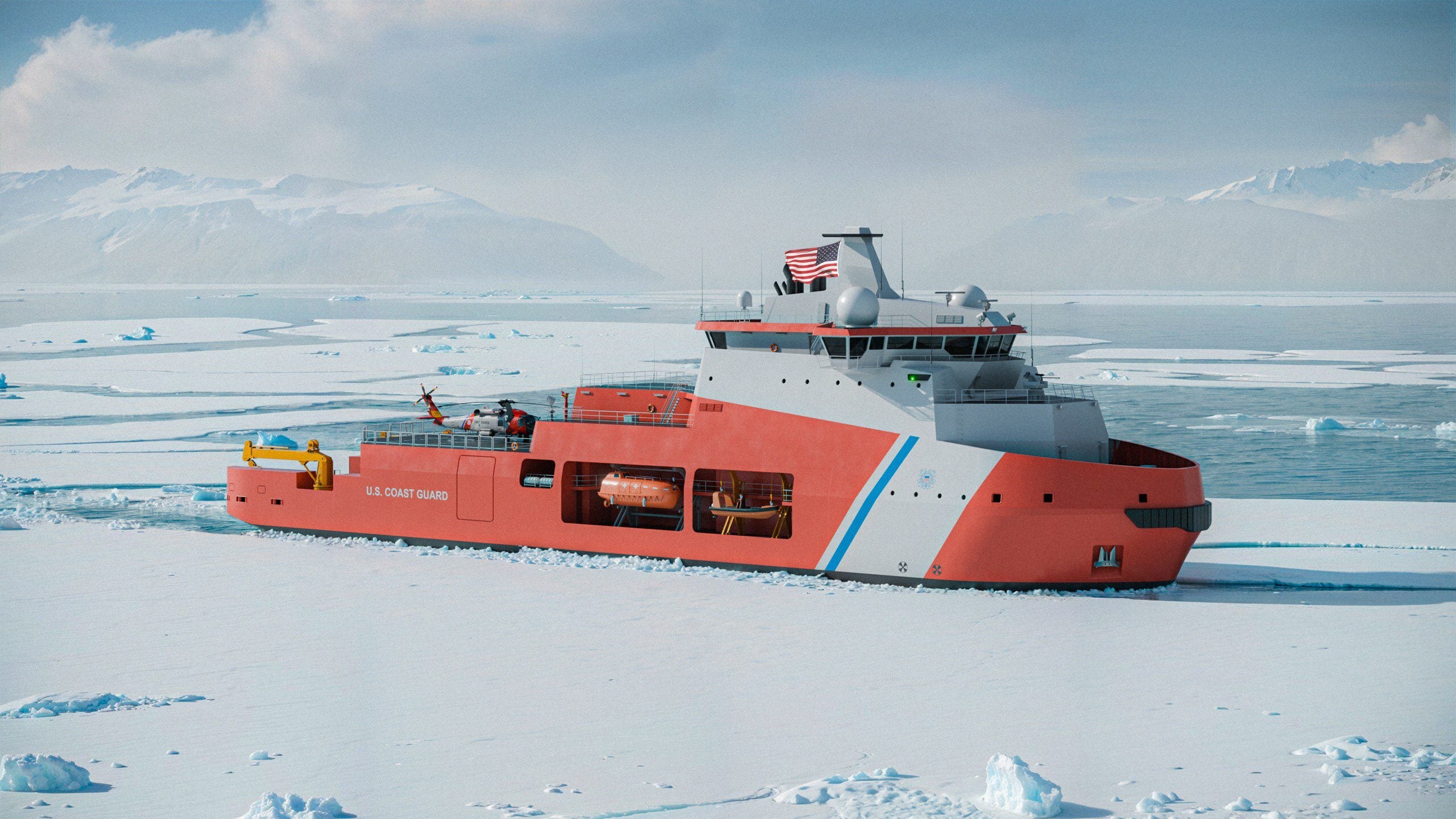
The production-ready Seaspan-Aker Multi-Purpose Icebreaker (MPI) design will meet all U.S. Coast Guard requirements for the Arctic Security Cutters. Illustration courtesy Seaspan
Canadian Icebreaker Design Picked for U.S. Coast Guard Arctic Security Cutters
Seaspan’s production-ready icebreaker design will be built in Finland and Louisiana as Washington races to counter Russian and Chinese activity in the High North.
Canada’s Seaspan Shipyards has signed agreements with Bollinger Shipyards and Finland’s Rauma Marine Constructions to provide its production-ready Multi-Purpose Icebreaker (MPI) design for the U.S. Coast Guard’s Arctic Security Cutter (ASC) program, forming an unprecedented North American–Nordic shipbuilding partnership that aims to deliver up to six cutters by the end of the decade.
Announced today in North Vancouver, the deals make Seaspan’s MPI design — developed in partnership with Finland’s Aker Arctic Technology under Canada’s National Shipbuilding Strategy — the foundation for rapidly expanding the U.S. Coast Guard’s icebreaking fleet as Washington moves to counter growing Russian and Chinese activity in the Arctic.
Under a contract awarded by the U.S. Coast Guard in the final days of 2025, Rauma will build up to two vessels in Finland, with the first expected in 2028, while Bollinger will construct up to four cutters at its Houma, Louisiana yard, with initial U.S. deliveries planned for 2029.
“The MPI design is a true success story of Canada’s National Shipbuilding Strategy,” said Seaspan CEO John McCarthy. “Using a common design and shared supply chain across the Canadian and U.S. Coast Guard fleets will unlock enormous opportunities for cooperation over the vessels’ lifetimes and deliver meaningful cost savings for both countries, fully aligned with the goals of the ICE Pact.”
The project flows directly from the ICE Pact — a trilateral framework signed in July 2024 by the United States, Canada, and Finland to accelerate icebreaker construction. Most of the MPI’s design and engineering was completed in Canada, with Seaspan already selecting many of the systems and equipment suppliers, including a large number of Canadian firms.
Originally developed for the Canadian Coast Guard’s long-range Arctic missions, the Polar Class 4 MPI design is capable of breaking through four feet of ice, sailing more than 12,000 nautical miles, and remaining deployed for over 60 days.
Originally developed for the Canadian Coast Guard’s long-range Arctic missions, the Polar Class 4 MPI design is designed to deliver sustained, year-round presence in some of the world’s harshest waters, combining modern icebreaking performance with long-range, multi-mission capability. Each 328-foot vessel will displace about 9,000 tons, can break through four feet of ice at up to four knots, and is built to sail 12,000 nautical miles while remaining deployed for more than 60 days.
Powered by a diesel-electric plant with variable-speed DC-bus propulsion delivering roughly 7,200 kW, the cutters will carry a crew of about 85 and meet Lloyd’s Polar Class PC4 standards, enabling missions ranging from national defense and maritime sovereignty to scientific research and search and rescue across the Arctic year-round.
“The awarded contract is a historic milestone,” said Rauma Marine Constructions CEO Mika Nieminen. “It is a strong vote of confidence in Finnish shipbuilding and our industrial network. We were selected because of our expertise and ability to deliver these ships within the required timeframe.”
For Bollinger, the ASC program is a major opportunity to showcase Gulf Coast shipbuilding under an accelerated presidential timeline.
“The Arctic Security Cutter is one of the most consequential and time-critical programs in Coast Guard history,” said Bollinger President and CEO Ben Bordelon. “With clear direction from President Trump and an aggressive delivery schedule, our mission is to leverage the full strength of our Gulf Coast facilities and our international partners to deliver these cutters on time and mission-ready.”
The Coast Guard currently operates just three polar-capable vessels: the 1976-built heavy icebreaker Polar Star, the medium icebreaker Healy, and the recently acquired Storis, a former commercial vessel. Internal assessments show the service requires at least nine Arctic Security Cutters to meet year-round mission demands in the high north.
Seaspan’s orderbook already includes 21 icebreaking vessels — the largest portfolio in the world — including a PC2 heavy polar icebreaker and up to 16 MPIs for Canada. The company employs about 5,700 people in North Vancouver and Victoria, including nearly 400 designers and engineers.
Funding for the ASC program comes from President Trump’s “One Big Beautiful Bill Act,” which allocates nearly $9 billion for heavy, medium, and light Arctic Security Cutters as part of the Coast Guard’s Force Design 2028 modernization drive.
In total, the U.S. Coast Guard plans to acquire up to 11 ASCs, with Canada’s Davie Shipyards responsible for the construction of the second tranche of up five vessels through its U.S. subsidiary Davie Defense. The vessels are expected to be based on the company’s fourth-generation Multi-Purpose Polar Support Ship (MPPS) design.
“America has been an Arctic nation for more than 150 years, and we’re finally acting like it,” said Homeland Security Secretary Kristi Noem. “As our adversaries expand their presence in the region, Arctic Security Cutters will be central to restoring U.S. maritime dominance in the far north.”
The contract comes as Bollinger continues to construct the first Polar Security Cutter for the U.S. Coast Guard. Bollinger acquired the troubled three-vessel program from Singapore-based ST Engineering in 2022 through its acquisition of VT Halter Marine. The program has faced substantial challenges, including schedule delays, cost overruns, and an incomplete concept design.
President Trump’s appropriations also bill provides $4.3 billion for the advanced procurement and construction of Polar Security Cutters two and three, fully funding the program through completion. Completion of the first PSC is now anticipated in 2030.
Seaspan Shipyards has awarded a $1.5 million contract to Alberta-based Confined Space Robotics to develop semiautonomous systems for blast and paint operations, marking a significant push toward automation in one of shipbuilding’s most hazardous and labor-intensive processes.
The U.S. Coast Guard has completed contract awards for all 11 Arctic Security Cutters, closing out a major icebreaker expansion aimed at strengthening U.S. presence and operational capability in the Arctic amid rising competition in the High North.
The U.S. Coast Guard has seized more than 200,000 pounds of cocaine in the Eastern Pacific since launching Operation Pacific Viper in August, marking one of the largest maritime counter-drug efforts in recent years as U.S. forces also intensify operations against trafficking routes at sea.
February 6, 2026
Total Views: 1484
Get The Industry’s Go-To News
Subscribe to gCaptain Daily and stay informed with the latest global maritime and offshore news
— just like 107,340 professionals
Secure Your Spot
on the gCaptain Crew
Stay informed with the latest maritime and offshore news, delivered daily straight to your inbox
— trusted by our 107,340 members
Your Gateway to the Maritime World!
Essential news coupled with the finest maritime content sourced from across the globe.

 Join The Club