In February 2014, the dry bulk shipping fleet and orderbook continued to grow. Shipowners and investors continued to order larger vessels more than offsetting newbuilding deliveries. The fleet also grew in each of the larger dry bulk shipping sectors as newbuilding deliveries increased substantially and shipowners withheld ships sent to breakers (i.e., scrapping).
China, the main economic juggernaut for the dry bulk market, is experiencing slower growth. This represents a serious challenge for a dry bulk shipping industry experiencing increased capacity. On March 6th, China’s Finance Minister Lou Jiwei indicated that Chinese GDP in 2014 would be under pressure and that its forecasted GDP target is flexible. The Chinese government has indicated this year it would seek a GDP target of 7.5%; however, the Chinese government may tolerate a lower GDP rate.
Speaking at a new conference on the sidelines of the National People’s Congress on Thursday, Mr. Jiwei stated, “If GDP grows by 7.2% or 7.3%, we can also say the GDP target of “about 7.5% is met”.
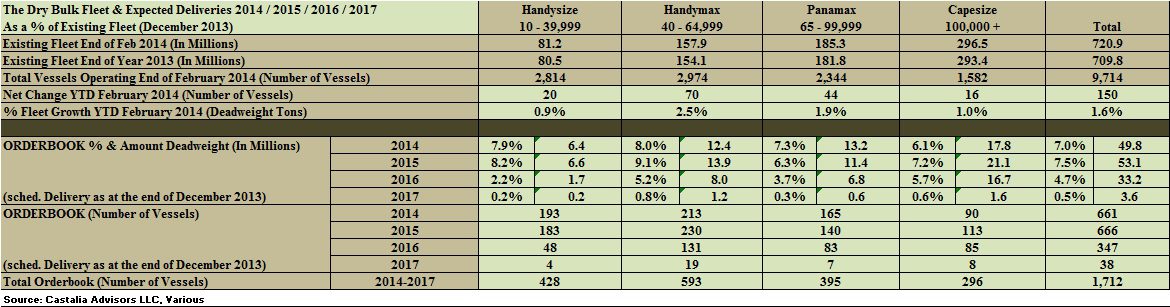
Since the end of 2013, the dry bulk fleet has grown 11.1 million deadweight tons (dwt) or 1.6% (a net increase of 150 vessels). Most of the growth in the fleet has come from larger size vessels, in excess of 40,000 dwt. Substantial growth has occurred in the Ultramax sector. In February 2014, the total dry bulk shipping fleet grew at 3.2 million deadweight or 0.4% (a net increase of 34 vessels). A growing dry bulk fleet in a declining economic environment does not bode well for supporting or increasing shipping rates. The only dry bulk shipping sector that is not experiencing excessive growth is the Handysize sector (10,000 dwt. to 39,999 dwt.); however, the smaller sized Handysize dry bulk shipping sector is a more challenging sector for new/inexperienced operators/investors.
click for larger
The orderbook continues to grow. In February 2014, the orderbook increased another 700,000 dwt. or 0.5% and reached 139.7 million dwt The orderbook has grown 6.4 million dwt or 4.8% since the end of 2013.
While analysts/shipowners/investors expected the orderbook to decline since the end of 2012, it has grown 17.0 million dwt or 13.8%. In the past 14 months, the orderbook has grown in excess of two years worth of depreciation. As economic growth has been on the decline in China and to a lesser extent emerging markets, the main economic driver of shipping requirements, it is expected that dry bulk shipping will be impacted by increased newbuilding deliveries and a more efficient and larger dry bulk fleet.
It should be increasingly obvious that added investment in dry bulk shipping, particularly in larger-sized vessels (i.e., in excess of 40,000 dwt) may generate sub-optimal rates of return for years.
Twenty-two seafarers remain missing after the Panama-flagged bulk carrier Ocean Winner sank in the Bay of Bengal, triggering a major search and rescue operation involving the Indian Coast Guard and passing merchant...
The long-term safety record for bulk carriers continues to improve, but the industry faces an increasingly complex risk environment that extends beyond traditional operational hazards, according to INTERCARGO’s latest casualty...
July 7, 2026
Total Views: 1061
Get The Industry’s Go-To News
Subscribe to gCaptain Daily and stay informed with the latest global maritime and offshore news
— just like 107,257 professionals
Secure Your Spot
on the gCaptain Crew
Stay informed with the latest maritime and offshore news, delivered daily straight to your inbox
— trusted by our 107,257 members
Your Gateway to the Maritime World!
Essential news coupled with the finest maritime content sourced from across the globe.

 Join The Club