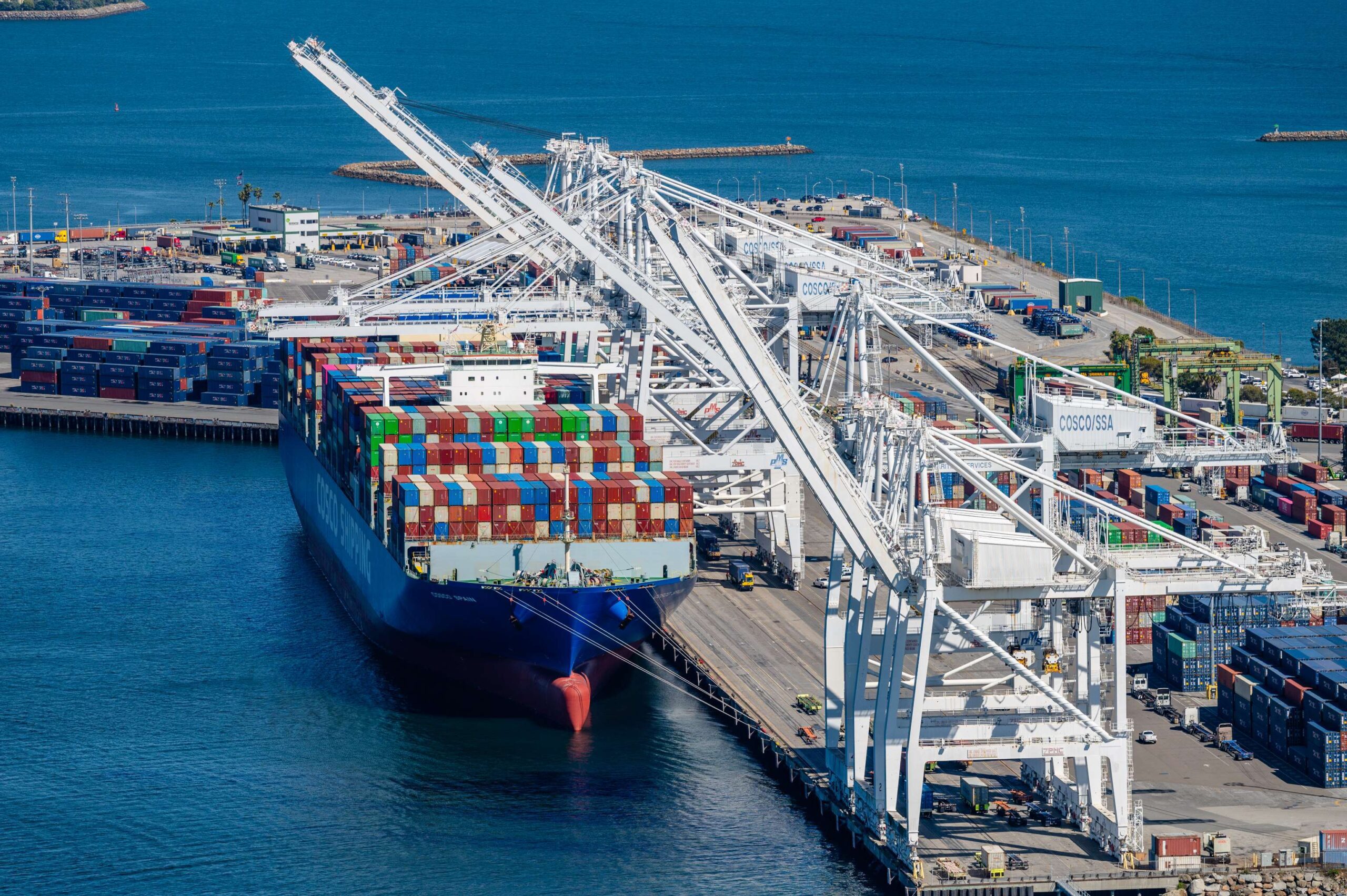
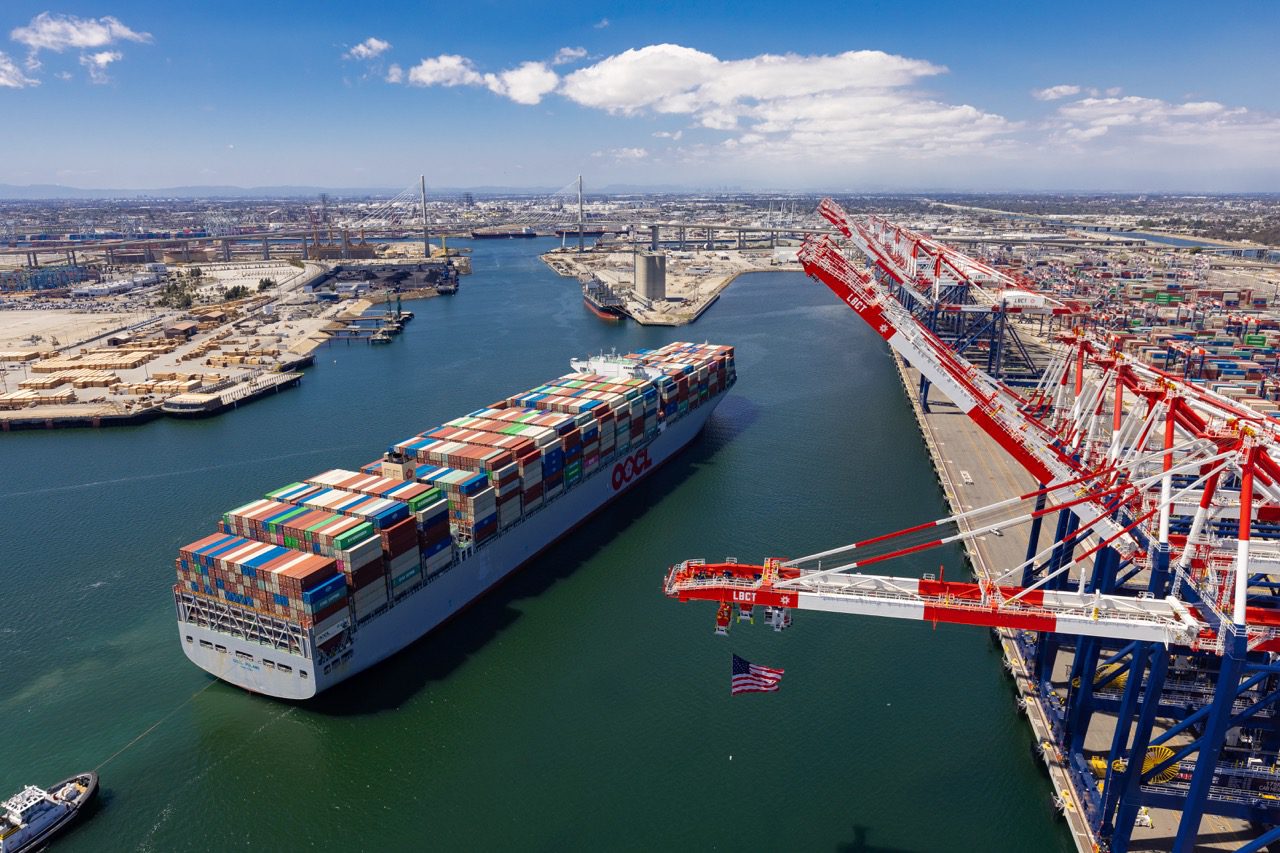
The Biden Administration is set to unveil plans to address bottlenecks at the Ports of Los Angeles and Long Beach.
In a White House “Fact Sheet” published today ahead of a meeting with leadership from the ports of Los Angeles and Long Beach, the International Longshore and Warehouse Union (ILWU), and the business sector, the administration outlined a series of public and private commitments to move more goods from “ship to shelf” ahead of the holiday season.
The commitments include moving to 24/7 operations at the Ports of Los Angeles and Long Beach, which are combined responsible for moving 40 percent of containers entering the United States. The ILWU has committed its members to work those extra shifts, providing the capacity needed to clear the existing backlogs.
Large businesses and retailers, including Walmart, UPS, FedEx, Samsung, The Home Depot, and Target, are also announcing commitments to use expanded hours to move more cargo off the docks.
After meeting with President, Port of Los Angeles Executive Director Gene Seroka issued the following statement:
“Operational details are being discussed and worked out with the supply chain stakeholders. The significance of today’s announcement is the commitment from industry leaders responsible for moving goods on behalf of American consumers and businesses to open up the capacity needed to deliver. It’s a call to action for others to follow.
“We have heard directly from the President, the Vice President, Secretary Buttigieg, National Economic Council Director Deese, and Port Envoy Porcari. We have a lot of work ahead. The Port of LA is called America’s Port because cargo we handle reaches every corner of the country. In the days ahead, we are committed to continuing to be the convener to ensure the supply chain delivers for the American people.”
Long Beach officials have also applauded the White House’s involvement.
“Whenever we are faced with a crisis here, it’s our philosophy to channel it into something positive,” said Port of Long Beach Executive Director Mario Cordero. “Before this unprecedented cargo surge began, we believed 24/7 operations were the future. After all, consumers can shop online at any time, whether it’s at 4 p.m. or 4 a.m., and 24/7 is already the standard at our partner ports in Asia. The supply chain truly never stops now, and we’re thankful to the Biden administration for using its influence to ensure cargo is always moving.”
“Our ports at the harbors of Long Beach and Los Angeles are responsible for 40% of the nation’s cargo. Their hard work over these last 19 months have kept our economy running throughout this pandemic. But now we must take bolder actions to make sure we keep cargo and our economy moving,” said Mayor Robert Garcia. “The Biden administration is committed to moving cargo faster and fixing our supply change challenges. We are very grateful for their work and leadership.”
“Increasing communication and facilitating more cooperation in the nation’s supply chain is exactly what we need at this moment,” said Long Beach Harbor Commission President Steven Neal. “We thank President Biden for doing all that he can to get cargo moving and ensure store shelves are stocked for the holidays.”
The White House Fact Sheet, Biden Administration Efforts to Address Bottlenecks at Ports of Los Angeles and Long Beach, Moving Goods from Ship to Shelf, is posted in full below:
—
October 13, 2021 – President Biden knew that there would be massive economic challenges emerging from the pandemic. The Biden Administration acted quickly to get the economy moving again – passing and implementing the American Rescue Plan to get checks in bank accounts and get Americans vaccinated.
But as the country recovers from a once in a century pandemic and economic crisis, the private businesses that make up our supply chains, which get goods to businesses and the American people, have struggled to keep up. The pandemic has led to a surge in e-commerce, with sales increasing 39 percent in the first quarter of 2021 compared to the first quarter of 2020. At the same time, COVID has disrupted workers in key transportation and logistics nodes – the jobs of 1,800 Southern California port workers were disrupted because of COVID earlier this year.
These disruptions are not just happening here at home, but all around the world as COVID has led to global shut downs and disruptions. The Chinese ports of Yantian (Shenzhen) and Ningbo-Zhoushan—two of the top 5 largest ports in the world—each experienced multi-week partial-terminal closures aimed at curbing COVID outbreaks, slowing global supply chains due to increased dwell times and cancelled sailings. In September, hundreds of factories closed under lockdown restrictionsin Vietnam, halting production that supports thousands of retailers worldwide. They have been slowly reopening in early October but must still contend with mounting supply chain issues. These disruptions have made the transportation supply chain more unstable and difficult to predict.
The President launched the Supply Chain Disruptions Task Force in June, which included a focus on transportation and logistics bottlenecks to the U.S. economic recovery. After meeting with local government leaders and companies to diagnose the problems and identify solutions, Port Envoy John Porcari was appointed in August to help drive coordination between the many private firms who control the transportation and logistics supply chain.
Today, the Administration is convening business leaders, port leaders, and union leaders to discuss the challenges at ports across the country and actions each partner can take to address the delays and congestion across the transportation supply chain. And the President will meet with the leadership from the Ports of Los Angeles and Long Beach and the International Longshore and Warehouse Union (ILWU) to discuss the actions they are each taking to address these challenges in Southern California.
These leaders are announcing a series of public and private commitments to move more goods faster, and strengthen the resiliency of our supply chains, by moving towards 24/7 operations at the Ports of Los Angeles and Long Beach. These two ports are the point of entry for 40 percent of containers to the U.S., and are on track to reach new highs in container traffic this year. Through August, Los Angeles has moved 30% more and Long Beach over 20% more containers to help U.S. exporters reach customers around the world and U.S families and factories get the goods they need.
These commitments will speed up shipments of goods throughout the country and include:
The Port of Los Angeles is expanding to 24/7 operation. The Port of Long Beach expanded operations in mid-September. The Port of Los Angeles is now joining them by adding new off-peak night time shifts and weekend hours. This expansion means the Port of Los Angeles has nearly doubled the hours that cargo will be able to move out of its docks and on highways.
The International Longshore and Warehouse Union (ILWU) has announced its members are willing to work those extra shifts. This will add needed capacity to put towards clearing existing backlogs. This is an important first step, now the private businesses along the supply chain need to move their operations to 24/7.
Large companies are announcing they will use expanded hours to move more cargo off the docks, so ships can come to shore faster.Unlike leading ports around the world, U.S. ports have failed to realize the full possibility offered by operation on nights and weekends. Moving goods during off-peak hours can help move goods out of ports faster. For example, at the Port of LA, goods move 25 percent faster at night than during the day. These commitments will help unlock capacity in the rest of the system—including highways, railroads and warehouses—by reducing congestion during the day.
The commitments being announced today include:
The nation’s largest retailer, Walmart, is committing to increase its use of night-time hours significantly and projects they could increase throughput by as much as 50% over the next several weeks.
UPS is committing to an increased use of 24/7 operations and enhanced data sharing with the ports, which could allow it to move up to 20 percent more containers from the ports.
FedEx is committing to work to combine an increase in night time hours with changes to trucking and rail use to increase the volume of containers it will move from the ports. Once these changes are in place, they could double the volume of cargo they can move out of the ports at night.
Samsung is committing to move nearly 60% more containers out of these ports by operating 24/7 through the next 90 days. 72% of U.S. homes have at least one Samsung product, from appliances to consumer electronics.
The Home Depot is committing to move up to 10% additional containers per week during the newly available off-peak port hours at the Ports of L.A. and Long Beach.
Target, which is currently moving about 50 percent of its containers at night, has committed to increasing that amount by 10 percent during the next 90 days to help ease congestion at the ports.
Across these six companies over 3,500 additional containers per week will move at night through the end of the year.
Those boxes contain toys, appliances, bicycles, and furniture that Americans purchased online or at their local small business, and pieces and parts that are sent to U.S. factories for our workers to assemble into products. And this is just a start—these commitments provide a clear market signal to the other businesses along the transportation supply chain—rails, trucks, and warehouses—that there is demand to move additional cargo at off-peak hours.
Secretary Buttigieg and Port Envoy Porcari will continue to work with all stakeholders to help more businesses access these expanded hours, and move the rest of the supply chain towards 24/7 operations.
The Port of Long Beach handled its busiest August on record as U.S. container imports remained stronger than expected through the late summer peak season. The port moved 919,992 twenty-foot...
The peak shipping season at major U.S. container ports is proving longer than expected, with September now forecast to become the busiest month of the year for imports, according to...
The Port of Los Angeles handled nearly 1 million containers in July, extending a run of historically strong cargo volumes even as an early peak shipping season begins to wind...
August 18, 2026
Total Views: 1160
Get The Industry’s Go-To News
Subscribe to gCaptain Daily and stay informed with the latest global maritime and offshore news
— just like 107,172 professionals
Secure Your Spot
on the gCaptain Crew
Stay informed with the latest maritime and offshore news, delivered daily straight to your inbox
— trusted by our 107,172 members
Your Gateway to the Maritime World!
Essential news coupled with the finest maritime content sourced from across the globe.

 Join The Club