Don’t Miss Your Daily Briefing for the Maritime Industry
Join the leading maritime news network
— trusted by our 106,657 members
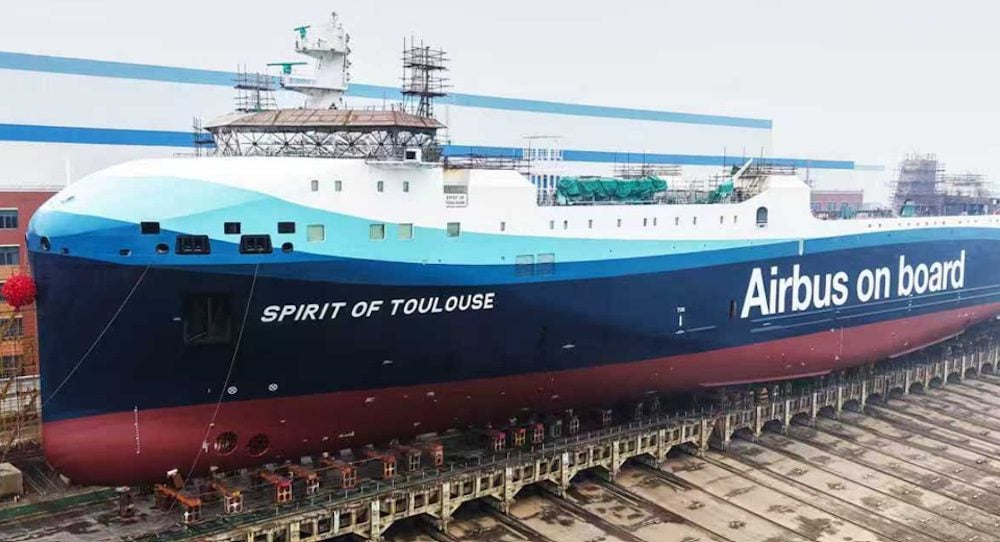
The LNG-powered roll-on/roll-off vessel Spirit of Toulouse, built to transport major aircraft components for Airbus, sits in dry dock during construction at a shipyard in China.
Airbus Goes to Sea: How a French Shipowner and Chinese Shipyard Are Reinventing the Atlantic Supply Chain
Last weekend’s launch of a ro-ro cargo vessel at a riverside shipyard in Wuhan may not have commanded the same attention as an Airbus A320 rolling off the production line in Toulouse or Mobile, but the two events are more closely connected than they might appear.
The vessel that entered the water at the Wuchang Shipbuilding Industry Group facility on the Yangtze that Friday morning, named Spirit of Mobile, is one of three purpose-built ships that will carry the wings, fuselage sections, engine pylons, and tail assemblies of single-aisle Airbus jets across the Atlantic, and in doing so test whether a combination of century-old wind technology, alternative fuels, and artificial intelligence routing software can genuinely halve the maritime carbon footprint of one of the world’s largest aerospace programs.
Spirit of Mobile is the second of three vessels ordered by French shipowner Louis Dreyfus Armateurs from Wuchang, a subsidiary of China State Shipbuilding Corporation. The first, Spirit of Toulouse, was launched in early February 2026 and is now undergoing pre-delivery trials. The third, Spirit of Mirabel, remains on the slipway. All three are scheduled for delivery in 2026, entering service on the route between Saint-Nazaire in France, where Airbus manufactures major A320 Family subassemblies, and Mobile, Alabama, where the final assembly line completes the aircraft before handover to customers. The ship names are themselves a statement of intent, referencing the three cities that anchor the production system the vessels will serve.
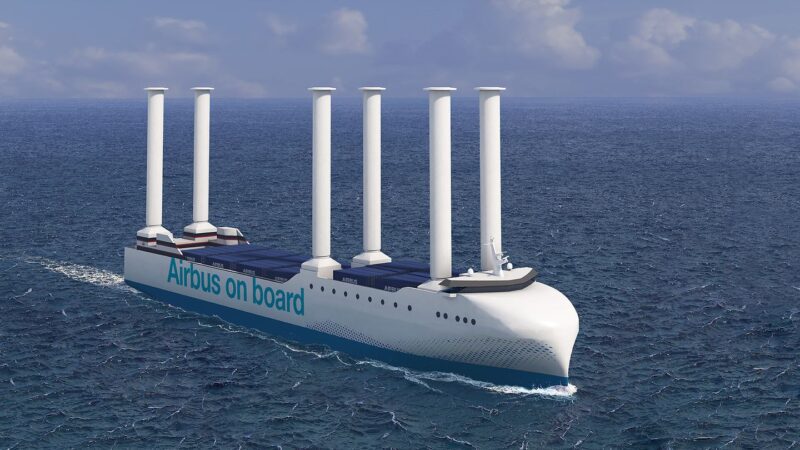
An illustration of Airbus’ future low-emission roll-on/roll-off ships featuring wind-assisted propulsion. Image courtesy Airbus
The commercial background to the programme is significant. In October 2023, Airbus selected LDA to renew the entire chartered fleet serving its Atlantic logistics chain, a decision that committed the shipowner to a major capital programme at a moment of considerable strategic change. In 2025, LDA entered a new ownership structure following the acquisition of an 80 per cent majority stake by InfraVia Capital Partners, which brought with it a stated €1 billion investment plan to double fleet size and accelerate technology deployment. The three Airbus vessels sit at the heart of that ambition.
The vessels themselves represent a marked increase in capacity over the ships they replace. LDA currently operates two vessels on the transatlantic route for Airbus, of which the largest, the Ville de Bordeaux, can carry the equivalent of six complete aircraft subassembly sets per voyage. The new vessels will match that capacity in terms of aircraft units while simultaneously carrying around 70 forty-foot containers per voyage, making more efficient use of available deck and hold space on both legs of the crossing.
At fleet level, replacing the existing tonnage with three new vessels is projected to reduce average annual transatlantic CO2 emissions from approximately 68,000 tonnes in 2023 to 33,000 tonnes by 2030, a fleet-level reduction of around 50 per cent. Per vessel, the projected CO2 reduction against the previous generation is 70 per cent annually, a figure that, even with appropriate caution about the assumptions embedded in lifecycle modelling, represents a step change in the emissions profile of what is ultimately an industrial logistics operation.
The technical means by which those reductions are intended to be achieved are more complex and more carefully engineered than much of the initial reporting has suggested. Wind-assisted propulsion is central to the design, and the six rotor sails fitted to each vessel, each standing 35 metres tall, are supplied by Norsepower of Finland, the company that has done more than any other to commercialise the modern Flettner rotor. The technology operates on the Magnus effect: powered rotation of the cylindrical rotors, combined with beam or quartering winds, generates lateral aerodynamic lift that is converted into forward propulsive thrust, allowing the main engines to be throttled back without loss of vessel speed.
Norsepower estimates the contribution of its rotor sails at between 15 and 20 per cent of propulsive energy on a transatlantic route with typical North Atlantic wind conditions, a figure that is route-specific and weather-dependent but credible given the operating profile. The rotors are fabricated from carbon and glass fibre composites and incorporate recycled materials in their construction. Six rotors on a single vessel of this size is, as of the time of writing, without precedent in commercial shipping.
The dual-fuel propulsion system comprises two methanol-capable main engines and two methanol-capable auxiliary engines, all four able to operate on either marine diesel oil or methanol. The principal environmental advantage of methanol over conventional marine fuels is the absence of sulphur in the fuel, which eliminates sulphur oxide emissions entirely when operating on methanol. The NOx picture is more nuanced. Methanol combustion inherently produces lower NOx than heavy fuel oil or marine diesel, with published test data from engine manufacturers suggesting reductions in the range of 30 to 60 per cent compared to conventional fuels depending on engine type and operating conditions.
Meeting International Maritime Organization Tier III NOx limits in full, however, typically requires aftertreatment technology such as selective catalytic reduction in addition to fuel-switching. Claims of more than 80 per cent NOx reduction attributable solely to methanol combustion are not supported by published engine test data and should be treated cautiously.
The vessels are intended initially to operate on marine diesel oil while the methanol supply infrastructure develops, transitioning progressively to e-methanol, which is methanol produced using renewable electricity and carbon captured from industrial sources or the atmosphere. The distinction matters considerably for lifecycle emissions: methanol from natural gas, sometimes described as grey methanol, carries greenhouse gas emissions roughly comparable to conventional marine fuels on a well-to-wake basis, while e-methanol or bio-methanol can reduce lifecycle CO2 emissions by 70 per cent or more depending on the energy source and production pathway.
The long-term emissions case for this programme therefore depends substantially on the rate at which a credible e-methanol supply chain materialises for transatlantic maritime operations.
The design package was produced by Deltamarin, the Finnish naval architecture firm, which carried out concept development, contract design, and model testing. Classification is by Bureau Veritas. Power management and propulsion integration is provided by BERG. The vessels incorporate an Organic Rankine Cycle waste heat recovery system to convert exhaust thermal energy into additional electrical power, along with high-efficiency propeller and shaft lines manufactured from recycled steel, ultra-low-friction antifouling coatings, and an AI-powered routing and control system that adapts vessel speed, heading, and rotor sail operation in real time to the prevailing weather and sea state, maximising the contribution of wind propulsion and minimising resistance throughout each voyage.
Spirit of Mobile was launched using the inclined slipway method, in keeping with standard practice at the Wuchang yard, and will now undergo dockside commissioning of its propulsion and electrical systems before sea trials and handover to LDA in November 2026. Spirit of Toulouse is expected to enter service on the Airbus route before the end of this year, Spirit of Mirabel to follow in 2027.
The program is not, in the final analysis, a story about Chinese shipbuilding, though Wuchang’s role is substantial. It is a story about whether the maritime sector can build a credible industrial case for wind-assisted propulsion and alternative fuels in combination, at a scale and specification demanding enough to matter to a blue-chip charterer with tight supply chain requirements and a legally binding emissions reduction commitment. The early results of that test will be read closely across the shipping and aerospace industries alike.
For more than a century, commercial shipping steadily moved away from sails. Now they are coming back. Across the global fleet, shipowners are installing towering rotor sails, rigid wings and...
Swiss engine designer WinGD has secured the maritime industry’s first confirmed order for ethanol-fuelled two-stroke engines powering ocean-going bulk carriers, marking another major milestone in shipping’s race toward alternative fuels. The company...
China and Denmark have renewed an agreement on cooperating in green maritime technology and shipbuilding, China's industry ministry said on Tuesday, reaffirming a long-term partnership in the sector.
January 27, 2026
Total Views: 1115
Get The Industry’s Go-To News
Subscribe to gCaptain Daily and stay informed with the latest global maritime and offshore news
— just like 106,657 professionals
Secure Your Spot
on the gCaptain Crew
Stay informed with the latest maritime and offshore news, delivered daily straight to your inbox
— trusted by our 106,657 members
Your Gateway to the Maritime World!
Essential news coupled with the finest maritime content sourced from across the globe.

 Join The Club