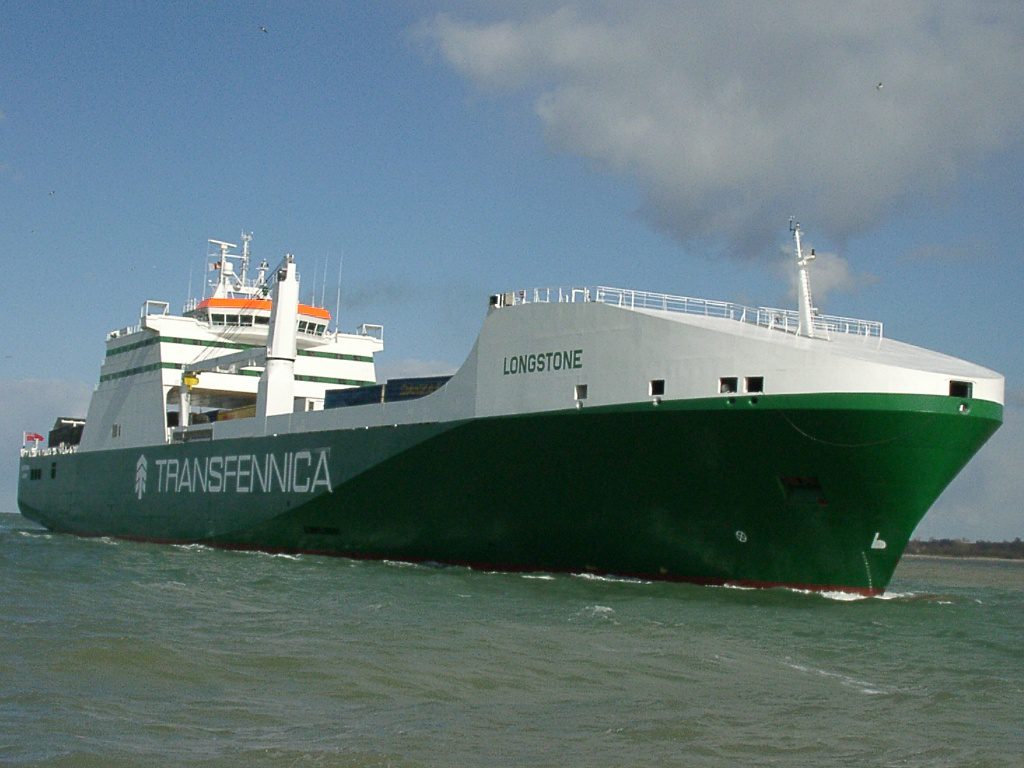
Photo of the M/V Longstone, a Point-class roll-on/roll-off sealift ship originally procured under a Private Finance Initiative to be available for use as naval auxiliaries to the British armed forces. Photo by Wolfgang Hägele, Wikipedia
by Salvatore R. Mercogliano, Ph.D – There are many issues that impact the American maritime industry and the merchant marine, and trying to develop a comprehensive strategy is a daunting challenge. When one tries to get all the pieces to work together into one synergetic being, the littlest issue can sometimes take down the whole structure, á la Jenga. However, this should not stop anyone from proposing solutions to the problem, because just like a long journey, it all starts with the first step.
Two issues that have been in the news is the shortage of mariners in case of a full mobilization of the Military Sealift Command and Maritime Administration reserve strategic sealift fleet. These ships are essential for the military to deploy surge forces from the continental United States overseas and require mariners from the commercial fleet to supplement the cadre crews on board the reserve vessels.
The other issue is the recapitalization of the aging reserve fleet, with some ships in the MARAD fleet dating from the 1960s. These issues were the subject of a recent panel discussion in Washington DC. How does the United States make sure that it has an adequate pool of merchant mariners, and at the same time replace and modernize its reserve fleet? One solution is the Mariner program of the early 1950s.
After World War Two, the new Maritime Administration faced a glut of war-built ships and the fear that the commercial industry would face a severe recession as nations of the world grabbed up surplus Liberty freighters and T-2 tankers, thanks to the Ship Sales Act of 1946 – a maritime version of the Marshall Plan.
MARAD proposed the construction of fifty, later scaled down to thirty-five C-4 freighters. These seven hold vessels, would be the next generation of the C-2, C-3, and Victory ships built by the Maritime Commission. Their construction was spread across five shipyards and the ships were built under Title VII of the Merchant Marine Act of 1936.
The ships, the Mariner-class, were owned by the government, but available for lease to companies, with the provisions that the ships could be withdrawn for emergency situations. When the first ones entered service in 1952, they were utilized to replace ships drawn from the National Defense Reserve Fleet supporting United Nation operations in Korea. When the Korean Conflict subsided, the commercial agencies leasing the vessels, put them to use on their commercial routes.
Over time, other companies – Pacific Far East Lines and American President Lines – not only bought the ships, but also built ships to similar designs using Constructional Differential Subsidies provided under Title V of the MMA 1936.
So why not build a 2020 version of the Mariners. MARAD could construct a mid-sized containership, roll-on/roll-off, or tanker. They have already proposed some initial designs via their American Marine Highway Project. Ships could also be acquired on the open market and reflagged into the US fleet to jump start the initiative. The ships would be owned by the government, but leased to commercial firms for use in trade, either international or Jones Act (this would require legislation to allow non-American ships to enter the trade, but there are ships in the Ready Reserve Fleet right now that are foreign-built).
In essence, the concept is that of Maritime Administration U-Haul, where companies can lease ships for services and it allows them to avoid the huge upfront costs of construction and uncertainty when the market slows down. When not needed the ships can be returned to the government and maintained in the reserve fleet. We do so right now with 46 ships in the RRF and 15 held by MSC.
An active Ready Reserve Force is already being done in Great Britain. At the turn of the century, the British Ministry of Defense conducted a Strategic Defense Review and identified the need for sealift assets. The British merchant marine had declined since the Falklands War of 1982 when merchant ships had been withdrawn from active service under the Ships Taken Up From Trade (STUFT). The result in 2000 was a 22-year charter with Foreland Shipping for six Flensburger designed Point-class Ro/Ros. They are operated commercially in Europe and available for take up as needed by the government, replacing specific ships acquired by the Royal Fleet Auxiliary – the British version of the Military Sealift Command.
Even the United States has experimented with this. The ex-Hawaii Superferry Alakai was acquired by the Military Sealift Command, along with her sistership. While Huakai became USNS Guam and operates in the western Pacific, Alakai was earmarked to be USNS Puerto Rico, but instead was leased to a commercial firm to operate as a ferry between Portland, Maine and Nova Scotia, Canada. Known as THE CAT, she operates today and could serve as a template for an active Ready Reserve Force.
By providing ships for operational service, this will generate jobs in the maritime sector, both afloat and ashore, thereby helping to alleviate the manpower shortage.
The obvious roadblock to this plan is number one, the will power to do something different and number two, funding. The first can be overcome by new leadership in the Maritime Administration. Recently appointed Administrator Mark Buzby knows the industry and has spoken for reforms. For funding, there are several methods that can be used to generate funds for this initial endeavor.
In 2017, there were 167 million containers imported into the nation. A one-time $10 tax on a container will generate all the funding necessary. If that is seen as too excessive, what about a like cost on barrels of oil imported, or a head-tax on a passenger liner leaving a US port for international waters unless, half of the deck and engine crew are documented and licensed American merchant mariners.
Once the initial funding is netted to acquire and built a set number of vessels, leasing and sale of vessels should generate continuance of the program. None of these concepts are new, but all ideas need to be broached if we hope to save the failing American merchant marine.
Updated: November 18, 2020 (Originally published June 3, 2018)
Editorial Standards · Corrections · About gCaptain

 Join The Club