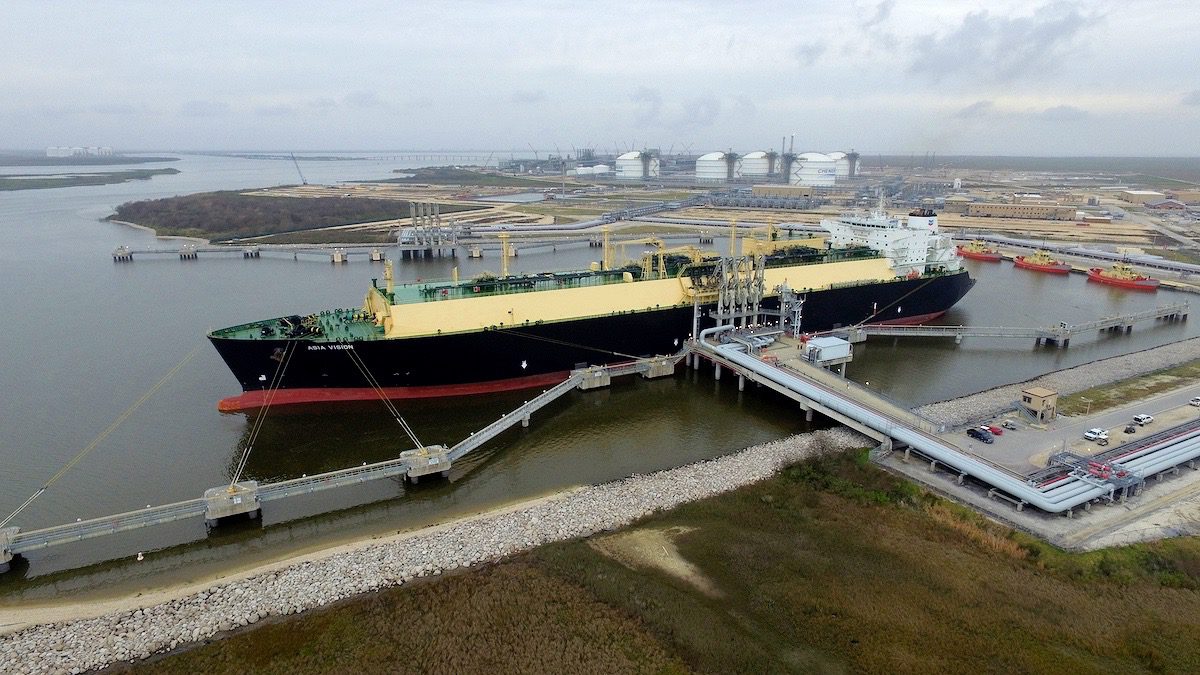
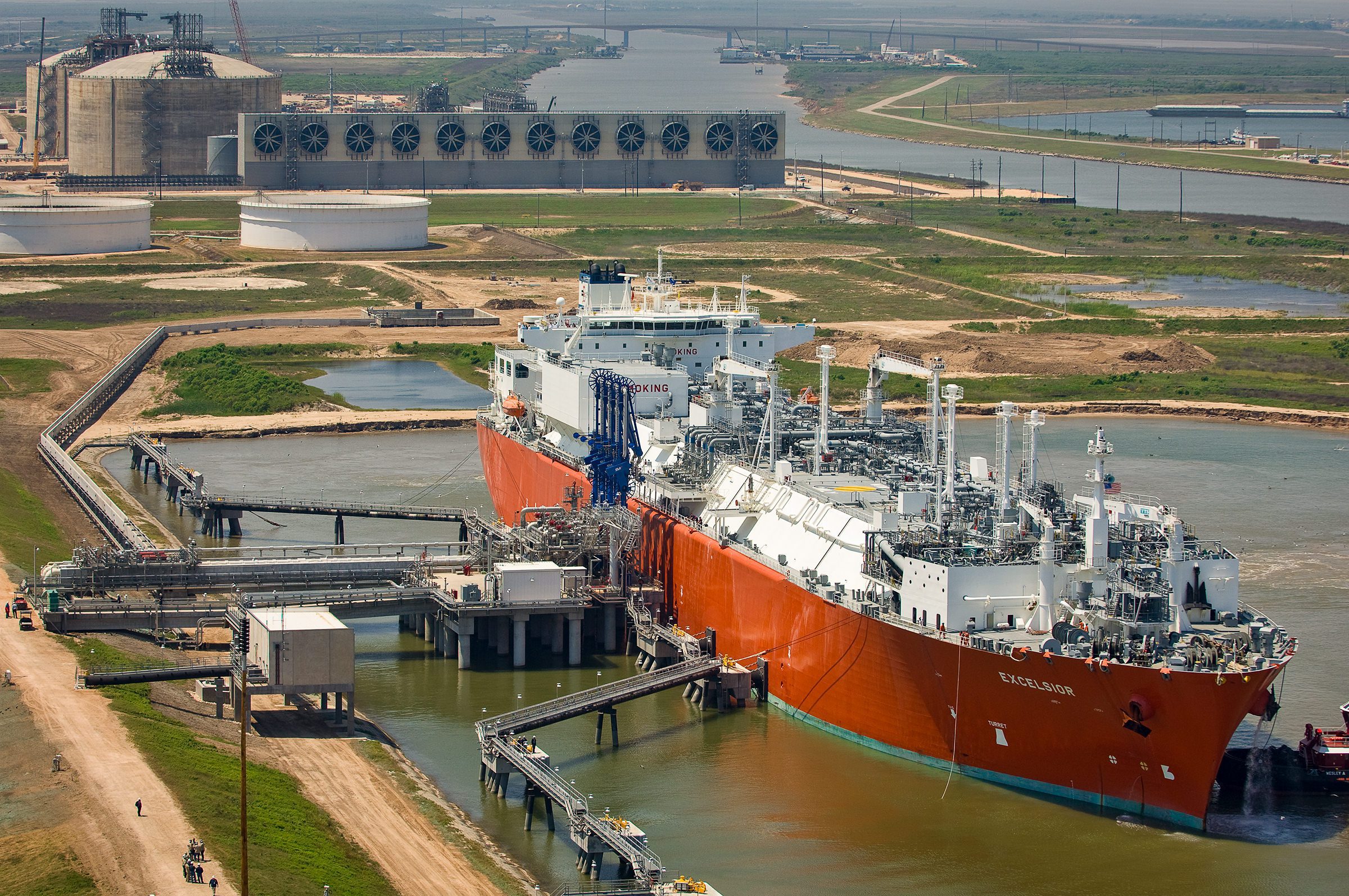
Ten years ago today, the LNG carrier Asia Vision departed Louisiana’s Sabine Pass Terminal carrying 3.3 billion cubic feet of liquefied natural gas bound for Brazil. That single shipment marked the beginning of what would become one of the most dramatic transformations in global energy markets.
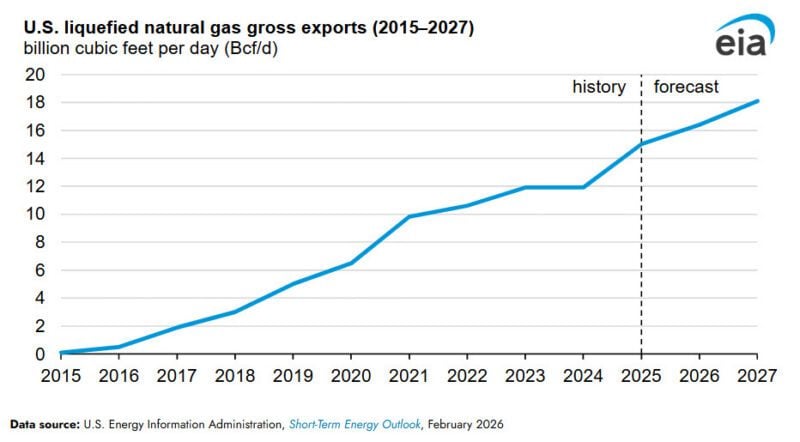
Today, the United States stands as the world’s largest LNG exporter, surpassing both Australia and Qatar. The journey from that first cargo in 2016 to today’s dominance has been nothing short of remarkable. U.S. LNG exports surged from just 0.5 billion cubic feet per day in 2016 to 15.0 billion cubic feet per day in 2025, and the Energy Information Administration forecasts exports will exceed 18.1 billion cubic feet per day by 2027, or approximately 136 million metric tons per year (mtpa).
The milestone took on added significance earlier this year when the U.S. became the first nation to export more than 100 million metric tons of LNG in a single year. According to preliminary data from Reuters’ LSEG, the country sold 111 million metric tons in 2025—almost 20 million metric tons more than Qatar and nearly 23 million metric tons more than the previous year. EIA’s figures peg 2025 exports at 112.4 million metric tons per year.
US LNG Exports chart 2016-2025. Credit: EIA
The transformation was enabled by abundant natural gas supply and reserves, flexible export contracts, and relatively low feedgas costs. But the shale revolution wasn’t always destined to fuel exports. Sabine Pass, operated by Cheniere Energy, actually began operations as an import terminal in 2008. Only when domestic shale production surged did operators pivot to converting import infrastructure for exports.
Since that first cargo departed a decade ago, Sabine Pass has shipped over 3,300 cargoes worldwide—accounting for 39% of all U.S. export cargoes through November 2025.
Europe Emerges as Dominant Market
The destination map for U.S. LNG has shifted dramatically over the past decade. Initially, Asia received the majority of volumes, averaging 46% from 2017 through 2021, according to the EIA. But Russia’s invasion of Ukraine in 2022 fundamentally reshaped trade flows.
In 2022, Europe received 69% of all U.S. LNG exports, up sharply from 34% in 2021, the EIA said. That dominance has continued, with Europe receiving 68% of U.S.-origin volumes from January through November 2025. In December alone, Europe took 9 million metric tons as the Northern Hemisphere winter deepened and the continent reduced purchases of Russian gas.
The American Advantage
What sets U.S. LNG apart in global markets is contract flexibility and pricing structure.
“Many other LNG-exporting nations most often use more rigid, Brent crude oil futures-indexed long-term contracts. In contrast, U.S. contracts generally feature destination flexibility, allowing customers to redirect cargoes or resell access to terminal capacity if they do not want to take receipt of the natural gas. U.S. contracts also often feature lower feedgas costs that are indexed to Henry Hub futures prices,” the EIA stated.
U.S. contracts also often feature lower feedgas costs indexed to Henry Hub futures prices. Under common pricing agreements, LNG from the United States is often less expensive than LNG produced elsewhere.
Expansion on the Horizon
The U.S. currently operates eight LNG export terminals, and by 2031, export capacity is expected to nearly double compared with December 2025 levels. The Plaquemines LNG facility began operations in late December 2024 and delivered 16.4 million metric tons in 2025 after a rapid ramp-up. Corpus Christi LNG shipped its first expansion cargo in March 2025, and Golden Pass LNG—a joint venture between QatarEnergy and Exxon Mobil—is expected to ship its first cargo in early 2026.
Alex Munton, director of global gas and LNG at research firm Rapidan Energy Group, attributed the year-on-year growth in 2025 to “high utilization across onstream terminals and a rapid ramp up at new facilities”.
With continued expansion, industry experts predict the U.S. could increase annual production by another 20 million metric tons this year. As the first cargo from Sabine Pass recedes further into history, the American LNG export boom shows no signs of slowing.
A new policy hands MARAD the lead role in approving offshore ports, a move officials say will streamline environmental reviews and unlock billions in stalled energy export projects. Paul Morgan...
The Trump administration is revamping how offshore oil and gas export terminals are approved, handing control of the deepwater port licensing process from the U.S. Coast Guard to the Maritime...
The U.S. in 2025 became the first country to export more than 100 million metric tons (mmt) of liquefied natural gas in a single year, powered by the startup of production from new plants, preliminary data from LSEG showed.
January 2, 2026
Total Views: 948
Get The Industry’s Go-To News
Subscribe to gCaptain Daily and stay informed with the latest global maritime and offshore news
— just like 107,200 professionals
Secure Your Spot
on the gCaptain Crew
Stay informed with the latest maritime and offshore news, delivered daily straight to your inbox
— trusted by our 107,200 members
Your Gateway to the Maritime World!
Essential news coupled with the finest maritime content sourced from across the globe.

 Join The Club