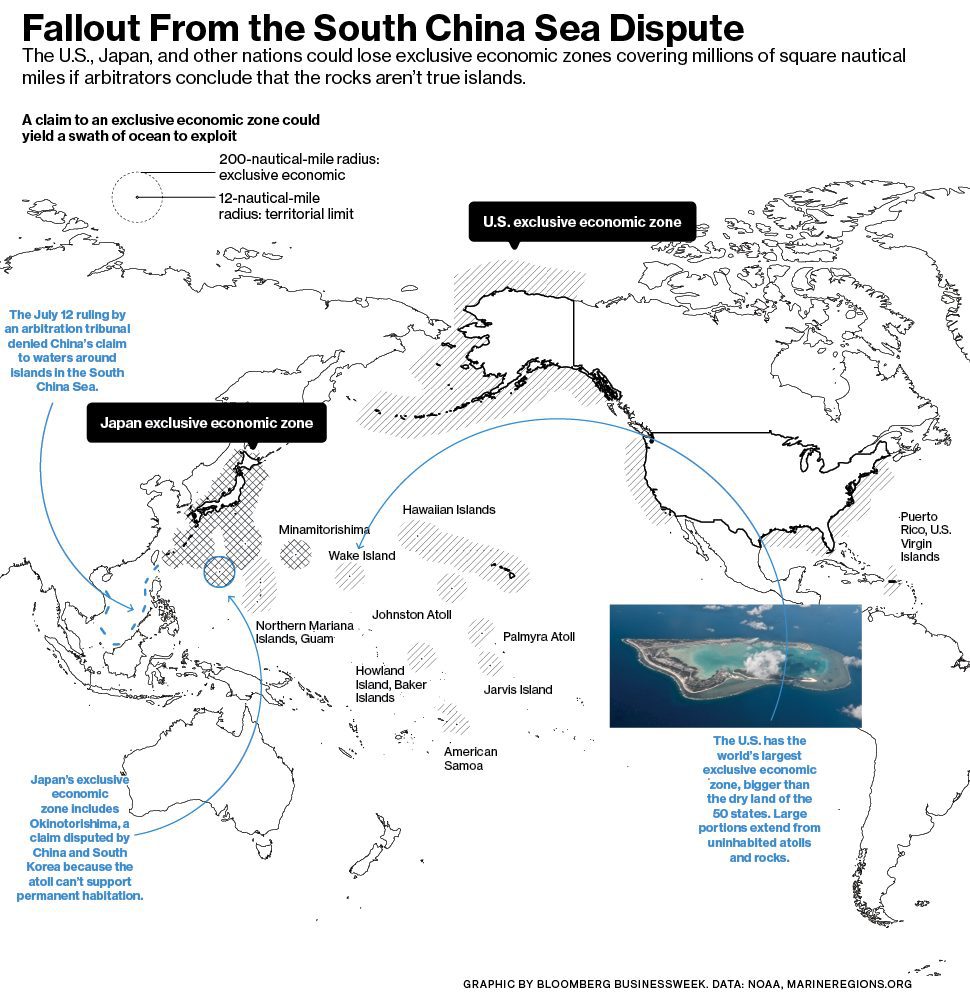
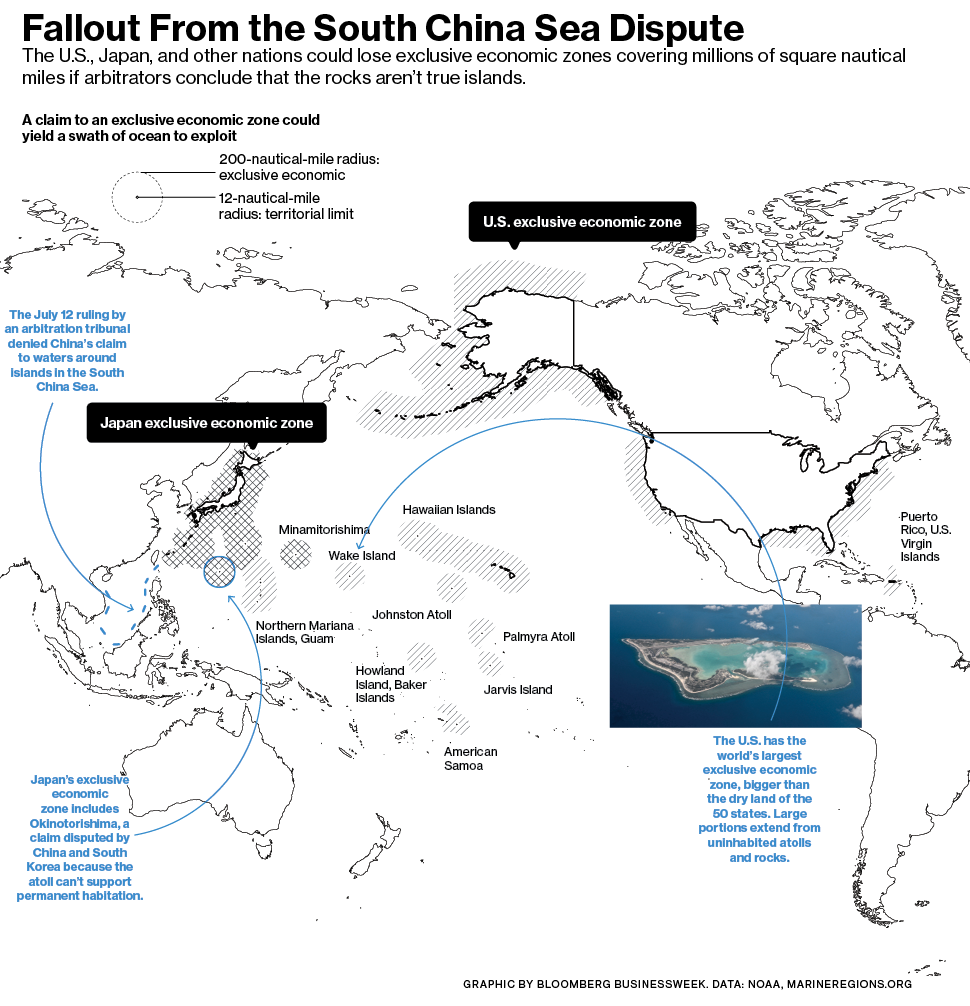
By Peter Coy (Bloomberg) The U.S. and other coastal nations could lose millions of square nautical miles of ocean that are now in their exclusive economic zones. The loss would be an indirect result of an arbitration panel’s ruling on China’s dispute with the Philippines in the South China Sea.
Largely overlooked in the tribunal’s July 12 decision was a strict interpretation of which dry land is entitled to a 200-nautical-mile exclusive economic zone—the surrounding ocean where a nation has sole rights to fish, drill for oil, and search for minerals. While not a legal precedent, the 479-page ruling could influence other judges and arbitrators because of its rigorous argument. “These arbitrators knew that this case was being watched around the world,” says Paul Reichler, a partner in law firm Foley Hoag and lead counsel for the Philippines. “They wanted it to be as close to perfect as possible.”
The United Nations Convention on the Law of the Sea doesn’t allow nations to declare exclusive economic zones around “rocks which cannot sustain human habitation or economic life of their own.” What that’s meant has never been clear. Many countries, including the U.S. and Japan, have claimed exclusive economic zones around tiny atolls and outcroppings of rock. The U.S. hasn’t ratified the treaty because of opposition from congressional Republicans, who fear it would open the U.S. to lawsuits. But the U.S. “scrupulously” follows the treaty’s provisions anyway, says James Kraska, a law professor at the U.S. Naval War College. Push could come to shove if another nation seeks to fish or drill or mine in waters surrounding some dinky U.S. rock.
The tribunal concluded that having people live on an island doesn’t prove habitability if food and water comes from elsewhere. Countries will “now have a greatly reduced incentive” to fight over ownership of rocks if they no longer have exclusive zones, Kraska says. On the minus side, fisheries might be depleted quickly if countries lose the ability to curb fishing in these zones.
The bottom line:An arbitration panel’s definition of what an island is could undermine nations’ claims of economic zones around rock outcroppings.
Taiwan's government condemned planned Chinese navy drills with an Indonesian warship off its east coast, saying they were dangerous and showed Beijing was trying to create a false impression that it controls those waters.
The U.S. Department of the Interior has proposed targeted changes to federal regulations governing exploratory oil and gas drilling in Alaska’s Arctic offshore, arguing the revisions will reduce unnecessary regulatory...
Taiwan sent ships and fighter jets to monitor the second Chinese "joint combat readiness patrol" in a week near the island, in what a senior Taiwanese security official said showed China was the sole source of instability in the region.
May 26, 2026
Total Views: 406
Get The Industry’s Go-To News
Subscribe to gCaptain Daily and stay informed with the latest global maritime and offshore news
— just like 107,339 professionals
Secure Your Spot
on the gCaptain Crew
Stay informed with the latest maritime and offshore news, delivered daily straight to your inbox
— trusted by our 107,339 members
Your Gateway to the Maritime World!
Essential news coupled with the finest maritime content sourced from across the globe.

 Join The Club