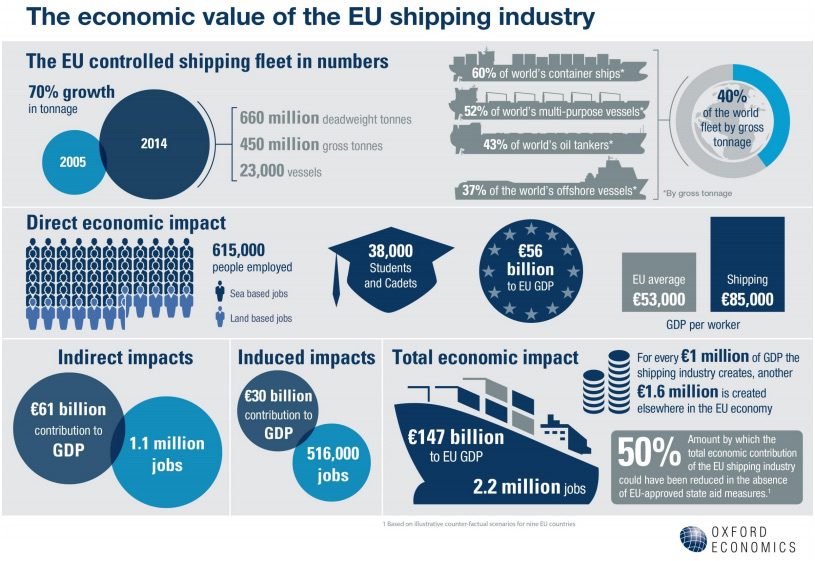
The European shipping industry supports employment of 2.2 million people and overall contributes €147 billion to EU economy, according to the results of a Oxford Economics study released today by the European Community Shipowners’ Associations (ECSA).
The study, titled “The economic value of the EU shipping industry”, looked to estimate the economic impact of the shipping industry across three channels: the direct impact of the shipping industry itself; the indirect impact of shipping firms’ expenditures across the EU supply chain; and the impact of spending by employees in the shipping industry and supply chain.
According to the study, the overall contribution – including all 3 channels – of the European shipping industry to the EU’s GDP in 2013 is estimated to have been €147 billion, including an estimated €56 billion of which that directly contributed to EU GDP. The study notes that for every €1 million the European shipping industry contributes to GDP itself, it creates another €1.6 million elsewhere in the European economy.
In terms of employment, the EU shipping industry directly employs 615,000 people, including 501,000 jobs based at sea, according to the study. The industry directly employs more workers than the aviation sector, while, between 2004 and 2013, direct employment grew by 25%, the ECSA said in a statement announcing the results of the study.
Moreover, EU shipping is far more productive in terms of GDP generated per worker than the EU average. Each worker is estimated to have generated €85,000 of GDP, significantly above the EU average of €53,000, according to the study.
Overall, the study said that the industry supports employment for an estimated 2.2 million people both on board vessels and ashore in the wider maritime cluster.
The study also showed that ultimate ownership or control of 40% of the world’s gross tonnage lies in an EU countries, and growing strongly. Between the start of 2005 and the start of 2014, the EU-controlled fleet expanded by more than 74% in tonnage, and by 72% in terms of deadweight tonnage, the study said.
“Europe controls the world’s largest and most innovative fleet of ships” remarked Patrick Verhoeven, ECSA Secretary General. “This very important fact is often overlooked despite the fact that it plays a key role in the economic impact of our industry on the European economy.”
The study and its findings were presented by the ECSA during a press conference kicking off European Shipping Week. The theme of this year’s conference is “Charting the route of EU shipping policy: An input to the EU maritime strategy review.”
INFOGRAPHIC
Click image for high-res.
The updated Oxford Economics study on the economic value of the EU shipping industry can be found HERE.
Oil and gas prices surged as Israeli and U.S. strikes on Iran disrupted Middle East facilities and shipping through the Strait of Hormuz. Four tankers damaged, one seafarer killed, and 150 ships stranded as Qatar declares force majeure on LNG shipments.
The Canadian government is looking hard at developing a remote northern port on Hudson Bay as a conduit for exporting natural gas, potash, canola and other commodities as the country tries to reduce its economic dependence on the US.
The United States and the European Union agreed on a framework trade deal, which leaders on both sides of the Atlantic said would end months of uncertainty for industries and consumers.
July 28, 2025
Total Views: 1664
Get The Industry’s Go-To News
Subscribe to gCaptain Daily and stay informed with the latest global maritime and offshore news
— just like 107,414 professionals
Secure Your Spot
on the gCaptain Crew
Stay informed with the latest maritime and offshore news, delivered daily straight to your inbox
— trusted by our 107,414 members
Your Gateway to the Maritime World!
Essential news coupled with the finest maritime content sourced from across the globe.

 Join The Club