gCaptain.com

A Blog About Ships

Fastream Maritime Leaderboard


Life on an Oil Rig - Gulf of Mexico

November 11th, 2008 · Comments

Life on an Oil Rig in the Gulf of Mexico
“Just Another Day at Work”

By Captain Ben Dinsmore

For the last 5 years I have served as Chief Mate (First Mate) on board an oil rig in the Gulf of Mexico. Similar to ocean going merchant ships, the rig that I work on is self propelled (meaning that it can sail under its own power from location to location without being towed) and is required to have Coast Guard licensed Merchant Mariners on board.

During my undergraduate studies at Maine Maritime Academy, I studied for a more traditional career in the marine industry as a ship’s officer on an ocean going cargo ship.

As graduation day approached, I interviewed with several such companies until a recruiter lured me into a position in the offshore oil and gas industry. 10 years later I still have no regrets.

For those of you not familiar with the management organization on a merchant vessel, the chief mate (sometimes referred to as the first mate, or “mate”) is second in command of the vessel under the captain.

The chief mate is responsible for all lifesaving equipment on board the vessel, and is the chief of both the fire and emergency teams.

The chief mate helps ensures that the rig is operated in a safe and controlled condition, and is compliant with all company and governmental rules and regulations.

In regards to the well drilling operation, the chief mate ensures the position of the rig remains precisely over the oil well that is being drilled thousands of feet below on the ocean floor.

Finally, and the responsibility that I take the most pride in, is helping to ensure that the rig’s impact on the environment is as minimal possible. The company, rig, and it’s crew all take great pride in our environmental record.

http://www.vimeo.com/2211561

My day actually begins in the early afternoon when I wake up from my daily slumber. As I mentioned in the first post in this series, I work the night shift, 12 hours straight, from 6:00pm to 6:00am.

By 2:00pm I am usually out of bed and wandering around the accommodations looking for the freshest pot of coffee. Once I get some caffeine I begin checking my email, or catching up on the latest news headlines.

If I am in the mood, this is the time when I do most of my writing for Trees Full of Money. The few hours before work are split between any overtime opportunities, writing for my blog, the occasional trip to the gym, reading, watching TV, and eating dinner. There is only so much you can do for fun when you are isolated in the middle of the ocean!

After dinner (which is actually breakfast for me), I meet up with the captain in his office to go over the events day and plan any tasks that need to be carried out for the night.

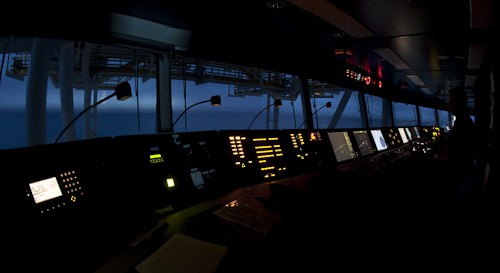
At night the chief mate supervises the night seaman, as well as three to four operators on the vessel’s bridge who control the position of the vessel and monitor the rigs power generation and safety equipment control panels.

My first order of business is a walk around the rig to inspect different areas, double check various pieces of safety equipment, and get an overall sense of what operations are ongoing on the rig. On any given night there is a variety of operations going on including well drilling, machinery maintenance, and the constant movement of deck cranes unloading and repositioning supplies from supply boats.

Between 7:00pm and 9:00pm I either catch up on any maintenance items that may be due or work on any special projects that may have been requested by the captain. There is always work to be done, and each night brings something a little different.

I relieve the control room operators (DPO’s) on the bridge at 9:00pm so that they can get a quick bite to eat or get a fresh cup of coffee. This is the time that I usually call home (yes we have phones out here) and by 10:30 I am heading to the galley for lunch.

After dinner I begin gathering information for the marine report which is review of the day’s activities, operational events, and weather conditions that is then submitted to the corporate computer servers on land.

As part of this report I conduct a survey of all movable equipment on deck which I use to calculate the stability of the rig. If weight is not properly distributed on the rig, there is a chance that it will become unstable and risk capsizing.

Most nights I finish the marine report between 01:00am and 02:00am which allows me an hour or two to catch up on any other paperwork or outstanding projects before I relieve the operators on the bridge for the 3:00 am coffee break.

The final hour of my work day is spent wrapping up any projects or paperwork, and finishes with a morning meeting with the captain to bring him up to speed on the night’s happenings.

By 06:00 am I am ready to call it a day (or night). After a quick shower I am usually fast asleep by 06:30am, resting up for the day that lies ahead. That’s it!

After repeating this schedule 21 times I get to go back home for 21 days of vacation reversing the itinerary outlined in my first post about commuting to the rig!

I hope that you enjoyed a look into the working life of this personal finance blogger, there isn’t much money management insight here, but hopefully I’ve satisfied some of your curiosities on what my day (er..night) job is like!

__________________________

Capt. Ben Dinsmore is an Master Mariner currently sailing as chief mate on an oil exploration vessel in the Gulf of Mexico.  He is also editor of the personal finance/environmental website Trees Full Of Money.

CommentsTags: · , ,

Faststream’s Maritime Employment Review - Autumn 2008

October 22nd, 2008 · Comments

Despite the declining shipping markets, global maritime recruitment firm Faststream says that it is experiencing strong demand from its shipowning, broking and commodity clients for commercial shipping candidates.

Writing in the company’s new quarterly Maritime Employment Review published today (20 October), managing director Mark Charman notes:

“Our clients are telling us that they expect to continue hiring people in the New Year. Driving this is the huge growth of the global merchant fleet which continues to expand at a relentless pace and needs a wide range of skilled professionals to service it.”

Focusing on chartering and shipbroking roles, the Faststream Maritime Employment Review reports that as many companies did not recruit during the poor shipping markets of the 1980s and 1990s, a generation of shipping people have reached the traditional retirement age, but continue to work.

The report notes:

“If in the long term freight markets return to the levels of pre-2003, then we predict a flight of shipbroking and chartering experience.”

Faststream notes that the average length of service within a company is now between three and five years and companies are focusing on offering better packages.

“We are seeing companies offering more flexible hours, improvements in the work environment, free lunches and other initiatives.”

The report also reveals that this year’s changes to the UK’s “non-dom” tax regime whereby UK resident but non-domiciled individuals are taxed on their overseas earnings has not as yet led to a flight of commercial shipping to Athens, Geneva and Monaco.

The full copy of the report can be found HERE.

CommentsTags: · , , ,

Coming Ashore? 10 Things You Should Do When Interviewing

October 7th, 2008 · Comments

10 Things You Should Do When Interviewing

by Matt Furhman - Faststream

Last week we brought you the Top 10 Things You Shouldn’t Do When Interviewing.  Hopefully you did a self evaluation and were able to catch yourself guilty of too many infractions.  This week we right the ship to bring you more helpful tips.

Now let’s take a look at 10 things you SHOULD do in an interview.

  1. Be positive: Everyone likes a positive person around.  So be positive and your confidence in yourself will rub off on your potential employers.
  2. Don’t bring up money: If asked about money, your answer should be “we can get to that, but I am more interested in the opportunity.”
  3. Ask a lot of good questions: Good questions at the end of the interview shows you have done your research about the company and the job.
  4. Good eye contact, firm handshake: Out of the book Never Eat Alone, staring 100% of the time into the eyes is considered peering (and a little creepy). Less than 70% means you are avoiding something. Try to stay in the middle of this range.
  5. Keep your hands in control during an interview: Flailing your hands all over the place will take the attention off of you and your skills.  You don’t want the interviewer to start thinking “what the heck is this guy doing with his hands.”  The interviewer should be concentrating on your answers, not your uncontrollable movements.  Keep your hands on your knees or the table.
  6. Be optimistic: Your glass being half full will increase your probability of getting the job. [Continue Reading →]

CommentsTags: · , , ,

Coming Ashore? 10 Things You Shouldn’t Do When Interviewing

October 2nd, 2008 · Comments

10 Things You Shouldn’t Do When Interviewing

By Matt Fuhrman - Faststream

For most, coming ashore may be easy but nailing that perfect job is tough.  Here are ten things you should shy away from when interviewing for that new position.

  1. Don’t be negative about a previous employer: If you go into a company and trash a previous employer for any reason the first thought through the hiring manager’s mind is ‘how long it will take for this person to start bad mouthing our company’.  Secondly if you trash someone specific, there is a chance the hiring manager knows that person or knows someone who knows that person, and you don’t want to burn any bridges… Bottom line; don’t do it.
  2. Don’t bring money up as a candidate: Ok, money is definitely a motivator, but if it is the key motivator, no one will want to work with you.  It is all about perception; if your greed is perceived in an interview your stock will drop dramatically.
  3. Don’t fail the drug test: Don’t do drugs.
  4. Don’t tell the interviewer you are smarter than they are: You are at an interview to sell how you will add value to the company, not how you will take the hiring managers job.
  5. Don’t bring a resume of another friend who is also interested in the job: “Oh yea by the way I have a friend that is looking too.” The job is for you and no one else, if you don’t get the job then tell your friend about it. [Continue Reading →]

CommentsTags: · , , ,

Are You Missing The Drillship Goldrush?

June 21st, 2008 · Comments

ABEAC111-1946-4DBF-831B-E1A0B21D8A49.jpg

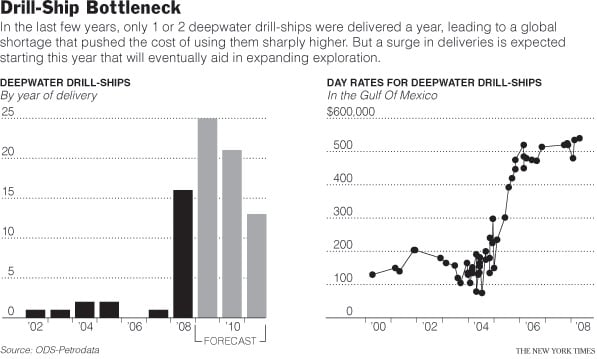
The shipping industry is currently the most profitable segment of the market with exploratory driling heading the way. The woldfleet of drillships alone will double in the next four years and this does not including countries with much larger plans. From seaman to CEO, if you are not connected to the offshore industry is some way you are missing out on the gold rush. Just make sure you call us before showing up late ;)

CommentsTags: · , , , ,

New Tools Section

November 6th, 2007 · Comments

gcaptain tools logo

The good news;

We have competently overhauled the tools landing page to provide direct links to our most popular features.

We have launched a new feature that you may find very useful… gCaptain’s news and jobs mashup. Ok, we know the average mariner has no idea what a mashup or its underlaying technology (RSS feed scrapers) is but we hope you can figure it all out. Basically we take headlines from the leading maritime news organizations (and job boards!) around the web and display them on a single easy to navigate and searchable page.

You can find the mashups via our new tools landing page (click on “tools” in the upper right corner of the site) but here are the direct links;

News

Jobs

Bad News,

We are working out a bug in our Maritime News Discoverer page and expect that area of the site to be down for a few days(our database team was able to get it back up and running… many thanks Mark).

CommentsTags: · , , , , , ,


Comments

Popular Topics


Sponsors


Maritime and Offshore Recruitment


Spurs

Mariner Taxes Logo

Mariner Taxes


The Maritime Executive Magazine


Your Ad Here


Authors


Follow Us


Categories


Recent Posts


Popular

Shipping Archives

Read A Random Story