The U.K.’s Daily Mail has the story of Second Mate David Blair, the lucky Merchant Mariner who was pulled off the Titanic just prior to her infamous voyage.
(Note: We are republishing this post on Today, the 96th Anniversary of the tragedy.)
Blair was replaced with the more experienced officer Charles Lightroller, Chief Mate of the Olympic, by White Star just four days prior to the tragic events and hours before departure. In the rushed turnover he made a seemly small but potentially critical mistake.
For those readers not familiar with the duties of a merchant officer, turnover is a critical time aboard ship. Today most mariners work an equal time-on time-off scheduled. For example, you may work 3 months aboard a ship then have the next 3 months off meaning there are two officers assigned to the ship in each position. The turnover between the two, however, is often a hurried process. The industry has built in many ways to avoid problems but the fact is you have one person excited to go home and another just starting a long hitch and sometimes “things” are missed.
So the day Blair signed-off he likely briefed Lightroller on his duties and operational specifics then gave him written notes and any items needed for the job. The mistake? Blair accidentally took the key to the binocular locker home with him.
The Daily Mail tells us;
Blair’s rush to leave Titanic he carried this key off with him in his pocket and forgot to hand it to his replacement, Charles Lightoller.
“Had Lightoller had the key then there probably would have been a pair of binoculars in the crows nest.
“It is supposition but, in lookout Fleet’s own words, they would have seen the iceberg sooner with the binoculars.
“It is the key that had the potential to save the Titanic.”
Senator Smith, chair of the inquiry, asked Fleet: “Suppose you had glasses … could you have seen this black object [the iceberg] at a greater distance?”
Fleet replied: “We could have seen it a bit sooner.”
Asked “How much sooner?”, he said: “Well, enough to get out of the way.”
I must stop the story and make it clear this mistake was just that ….a small error… therefore should Blair be blamed for the accident? Of course not. While some point to the ship’s excessive speed, the vessel’s design or the positioning of the ship’s compass as the cause of the incident the facts clearly show the titanic sunk as a direct result of the accident chain. In other words the titanic sunk, not due to one large error but a combination of small errors that linked together caused the tragic circumstances. Remove one small link in the chain and the incident is avoided.
It is interesting to note that a string of small errors caused by human error is the cause of most large maritime incidents. The lesson to be learned….. next time you make a mistake aboard ship listen for the voice in the back of your mind and quickly ask yourself; is this an isolated incident or indication of larger problems?
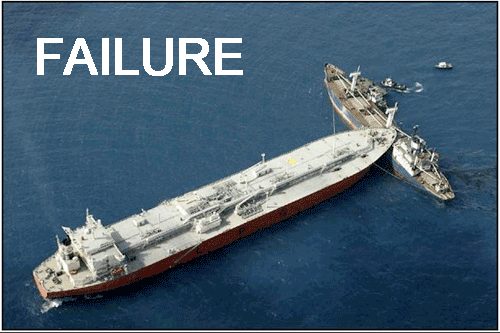
Ship incidents caused by Error Chains;
(This article was originally posted Oct 2007)
Tags: · binoculars, chief_mate, critical_mistake, crows_nest, daily_mail, History, Incidents, key, management, Maritime, merchant_mariner, sea, second_mate, Ships, sinking, titanic, white_star
In “Refrences to Joseph Keefe”>another excellent article, Maritime Executive’s managing editor Joseph Keefe is dead on with his assessment of salary (find the article HERE) and working condition improvements in this tight labor market. The following comment in response to a discussion with one Captain sums up the discord between shore side managers and shipboard personnel perfectly;
Gathering that he was earning well in excess of $100,000 per year with about six months vacation, I chided him for complaining about a job situation that a lot of people would kill to obtain. My comments were NOT well received.
Well had Keefe called any member of gCaptain’s staff we could have gently clued him in on the likely response. The reason? Well he lays out all the major points but let us add a few minor ones. Mariners currently in top positions aboard ship are loyal to their profession. We have seen tough times and stayed at sea to the protest of loved ones and in doing so have payed the price. From high points to low a mariners life is one of hard misses. Personally I’ve sacrificed being with my family on the day of my father’s death and missed the birth of his namesake, my first child, Jack. Mine is one of the least troubling stories but the hardships are not the primary reason for the discord; it’s the rewards, or lack there of. To show my point I offer some examples;
- Mariners in the first Gulf War bravely supplied the troops in countless runs to the war zone and in return received “all you can eat” overtime pay and handsome bonuses. For my wife’s 30 days in the war zone she received little more than a medal.
- Mariner’s salaries are just recently breaking above the levels (not adjusted for inflation) of those in the same position 30 years ago.
- Sailing 30 years ago was an enjoyable experience that did not entail constant communication with management. Email and “real” phone service didn’t exist.
- Port time is currently non-existent.
- The U.S. mariner has historically come at a premium to their foreign conterparts but the gap is closing fast.
- With the decline in the dollar we are suddenly being recruited be European companies that are offering considerable bonuses. U.S. companies are not following suit.
- Specialists in support roles, mostly from Europe, freely share their salaries which can be considerable higher than an American Captain’s.
- The majority of mariners live in areas (New England, Florida, California) of skyrocketing housing expenses.
- Mariners are now getting arrested for incidents that, as CAMM (The Council of American Master Mariners) put it, “were at one point considered mistakes”.
- Today civilians are more likely to ask you how you can work for an Oil Company than reply with a statement once heard often; “Wow, what an interesting job”.
In addition to these points the personnel shortage in our industry is not only a concern of company, it’s a concern for the shipboard management. The simple fact is positions are being filled by people who five years ago would not be considered ready for the job. In the past twenty years crew levels have been brought down to record low levels but overqualified crews “stuck” in positions they long ago mastered have kept the ships running smooth. Today an alarmingly high number of vessels list 100% of their officers as short-service employees (in the position for less than a year). This is not only a problem for officers but also for those on shore. Ships rely on a foundation of support from town that increasingly comes from managers lacking experience due to the same stratospheric rise in the number of promotions. These two factors equate to rising difficulties for Captains, Chief Mates and their counterparts in the engine room.
A manager recently asked a good friend of mine if he was ready for the big promotion to Captain, his response angered the boss. I can only assume the anger derived from the fact his statement was both accurate and troubling. He replied, “Hell no, I have no business being Captain. Professionally I’m not close to being ready but if I’m not promoted in the next few rounds you’re making a big mistake because I can run circles around my competition!” Not a good sign for those who need to trust the next man in charge of a 500 million dollar asset.
What he did not tell the manager is also reveling, “Why take a promotion for a few extra dollars and have to sit at a desk filling out paperwork, answering phone calls from town and dealing with petty squables. The captain use to have a stateroom twice the size of a seaman’s and fly to work in first class, now he just gets paid more.”
While the article was impressively accurate the following comments are not entirely correct;
His pay had been augmented three or four times in the past 18 months and his employers had confirmed that pay scales had at least doubled during that period.
While it’s conceivable that the payroll has double I’ve witnessed between 10 and 40% increases in senior mariner pay.
Gathering that he was earning well in excess of $100,000 per year with about six months vacation
“But you get Six Months vacation” is the first thing mariners hear during salary negotiations but it’s a misnomer. I don’t personally know a mariner who took less than 4 weeks of training classes last year and know many Chief Mate candidates who took between 12 and 16 weeks of class… that brings us down to 5 months “Vacation”. Subtract travel days, visits to the Coast Guard and days spent at the union hall and your down to less than 4.5 months (139 days).
The average American takes 15 days vacation, 8 personal days and 10 holidays. Add this to the number of weekends and (if my math is correct) shore side personel have 137 days off or only 3 days less than the mariner. Ever leave the office early on Friday or take a long lunch to visit the dentist? Mariners work 12 hours a day, every day which equates to nearly double the number of hours a “40-hour per week” American works during the year. Now I can begin to understand why gCaptain’s email box gets flooded with shore-side job related questions.
The number one reason for the discord is rooted by Keefe’s statement;
It is tempting to dismiss this as seafarer whining, but maritime executives everywhere had better strap on their hearing aids and listen to what their employees have to say. To do otherwise will only exacerbate the current crisis.
On the return trip for a promising shore-side job a prominent divorce attorney joined the discussion on NPR’s Fresh Air and said he often sits at the arbitration table looking at two people in love who share a life others only dream about and asks himself why. The reason is not that argued by either party, the reason is that neither listens to what the other is saying.
Mariners are being marginalized and management isn’t listening. Captains no longer have the power to solve problems aboard ship without approval from managers who frequently ask “Who died and left him in charge?”. This response filters down to the crew who justly assume their boss can not communicate their problems to distant offices ashore. This problem is exacerbated by the increased regulatory pressures, technological requirements, and industry opposition not to mention burdensome levels of training, paperwork and hands-on management from shore.
So while the “24/7 satellite television, e-mail, voice comms, excellent (but SSDD) food and media room” are nice do something that compensates me for the extra work I’ve taken on lately or double salaries instead of payroll.
What are management’s concerns? Not sure, I’m knocking on the divorce attorney’s door and just not listening!
-JD
This post is in response to Maritime Executive’s article:
Tags: · captain, chief_engineer, chief_mate, complaints, editorial, jobs, joseph_keefe, management, marex, mariner, maritime_employment, maritime_executive, maritime_jobs, maritime_unions, merchant_marine, Offshore, oil_patch, shipping, shipping_jobs
On a recent story I confused the Norwegian Dawn with the Norwegian Dream. The error itself is small but the implications are large and the reason for the error gives me the opportunity to shed light on the cause of so many maritime incidents. A short explanation might give you a look into the mind of a ship’s captain, so here it is;
Some articles are the result of hours spent researching, writing and editing while other posts are simply excerpts of stories found elsewhere on the web. My Norwegian Dream post was part of a general interest series we run called “Incident Photo of the Week“. These posts are designed to be short, interesting and easy to write and only require one line of explanation but, sufficient to say, I did not put much time into the “easy” job of posting the article.
Aboard ship 90% of the navigational jobs are easy. Some jobs, like departing Valdez Alaska, seem difficult to an outsider but are simple tasks for an experienced mate. This is the very reason Capt. Hazelwood of the Exxon Valdez left the 3rd mate in charge of the watch. These simple tasks, however, can result in tragedy caused by an even simpler mistake.
Moving large ships is not the only profession requiring complicated mathematical calculations, little room for error and disastrous consequences but marine navigation differs from professions like structural engineering because we have no brakes. The time is ticking on a large ship and errors are often not seen until after the danger has passed. During the incident you can not stop the job and spend hours reassessing the hazards, Newton’s law of motion doesn’t allow it. This is why my error in reporting the story is significant and had it been made aboard ship would be cause for alarm.
So how does a captain prevent the simplest mistakes from becoming catastrophic incidents?
The first is training. While a brilliant structural engineer could be given the top spot at a young age this is not the case with ship captains. At the minimum regulations require 10 years of sea time in addition to hundreds of hours of course work and multiple levels of testing prior to being allowed by the Coast Guard to sit for the Master Unlimited exam. This method of advancement prevents a shining star from rising quickly but not for his lack of knowledge, rather from his lack of experience. This is required to give an officer the time not only to learn the theory and application of job specific tasks or even to give the time required to actually witness the full gamut of possible situations, although both are important. The primary reason is to a mate the time needed to feel the ship and understand/compensate for his limitations. The ability to master this is the mark of good captain and one reason companies prefer promoting older chief mates and rarely hire someone based solely on his qualifications (note: this is changing).
The best captains can identify instability by the feeling the roll of a ship, correlate the simplest annoyance with a larger problem (e.g. a sticky door caused by hogging) or recognize the tone of an officers voice that masks concern. They not only can identify but also have developed processes for solving problems. Last they know their own shortcomings and have built a system to identify and manage them.
In my case I have the occasional tenancy to correlate similar information so in this case my mind failed to separate the Norwegian Dream from the Norwegian Dawn. Aboard ship I would combat the problem by writing down each name on opposing sides of a yellow note pad and keeping relevant notes separated by space.
Second I am careful to listen for the voice in the back of my head that whispers “Something Is Wrong”. I have found this voice to be present 90% of the time prior to identifying a problem. It is important to note that incidents are not caused by single failures they are always the result of what our industry refers to as an error chain. The clearest example of this chain would be a catastrophic cylinder failure in the main engine. To most this type of failure would be classified as bad luck but mariners are trained to realize this is not the case. I use the following example because I recently read an incident report on a cylinder failure that was ten pages long and took 6 months to complete. The findings were nothing spectacular, rather they described many small problems dating back decades. The findings included an overworked engineering officer in charge of lubrication (days before the incident), the supplier substituting lubricants not ideal for that particular lube oil pump (the previous year) and even the designers failure to relate this seemingly small problem to the manufacturer 15 years prior to the failure. In this case all seemed well but I would bet heavily on the presence of a voice in back of the Chief Engineer’s mind calling out “I can’t identify it but we have a problem” his daily routine simply drowned it out. If he had identified just one of the links (minor causes identified in the report) in the error chain and removed it the incident would not have occurred.
Last I always step back and take a “time out”. This simple and effective technique taught in Major Emergency Management, an optional class in managing nightmare situations, closely resembles something we learn at a young age; step back, take a deep breath and ask yourself “what doesn’t make sense here?”
So putting it all together I could have avoided the mistake by first writing the key points down on a note pad and separating similarities (the ship names). Then I could have actively listened for the voice whispering (or in this case shouting) “something is wrong” and finally, if I had failed to identify the difference in the first step, I should have called a personal time out, stepped back and asked myself “does this make sense.” If I had done this I would have quickly realized the obvious fact that containers do not belong on a cruise ship.
Why didn’t I? …well this is just a blog, right?
Many thanks to our loyal readers for finding the error, especially Perry. Despite my initial annoyance from his repeated corrections a good captain must always smile when a concern is related (even when woken at 0400) and hopes all of his makes are just as diligent and persistent. It’s the “easy” posts, after all, that often results in longest incident reports.
Stay Safe,
John
___________________________________________________

John Konrad is a USCG licensed Master Mariner of Unlimited Tonnage and the editor in chief of gCaptain.com. Since graduating from SUNY Maritime College he has sailed 4 of the world’s oceans and reports from his ship via satellite.
Interested in writing for gCaptain? Contact us today.
Tags: · Communication, gCaptain, management, Master Mariner, tips, Training