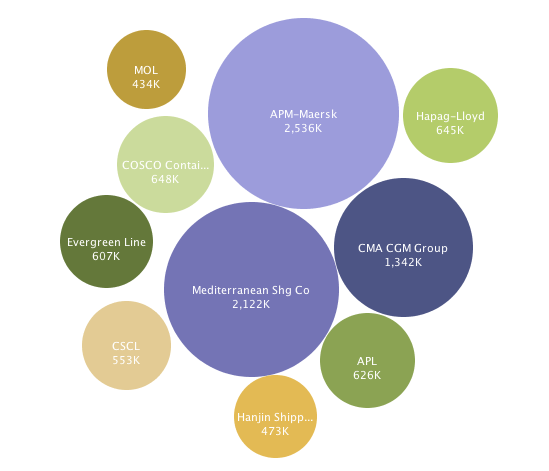
The data visualization above represents the worlds 10 largest container shipping companies by TEU capacity. We created this chart using IBM’s Many Eye’s project which we enjoy using since it gives us a clear, easy to understand and interactive picture of numeric data. Plus it looks pretty cool.
Want to know which company has the largest number of ships or the highest percentage of the overall market? If so then click on the picture above for the interactive version.
For those who prefer more traditional data:
| Company |
TEU capacity |
Market Share |
Number of ships |
| A.P. Moller-Maersk Group |
1,665,272 |
18.2% |
549 |
| Mediterranean Shipping Company S.A. |
865,890 |
8.6% |
299 |
| CMA CGM |
507,954 |
5.6% |
256 |
| Evergreen Marine Corporation |
477,911 |
5.2% |
153 |
| Hapag-Lloyd |
412,344 |
4.5% |
140 |
| China Shipping Container Lines |
346,493 |
3.8% |
111 |
| American President Lines |
331,437 |
3.6% |
99 |
| Hanjin-Senator |
328,794 |
3.6% |
145 |
| COSCO |
322,326 |
3.5% |
118 |
| NYK Line |
302,213 |
3.3% |
105 |
(Source: 2006 BRS Report)
Tags: · apl, ap_moller, china-_shipping, cma_cgm, Container Ship, containers, container_shipping, cosco, Data, data_visualization, evergreen, hanjin, hapag-lloyd, ibm, Interesting, maersk, many_eyes, Maritime, Maritime Expert, nyk_line, senator, shipping, shipping_companies, Ships, teu, Web 2.0
February 24th, 2008 · 2 Comments

We recently ran across some interesting statistics from a 2005 joint study on manpower from BIMCO and the ISF.
Q: How many officers are currently employed aboard ships?
A: Approximately 466,000
Here’s a chart of the numbers;

Regarding this chart the study notes:
An updated estimate of global seafarer supply has been produced based on the most recent national statistics provided by authorities in almost all principal labor supply and other maritime countries. The worldwide supply of seafarers in 2005 is estimated to be 466,000 officers and 721,000 ratings. The OECD countries (North America, Western Europe, Japan etc.) remain an important source of officers, although Eastern Europe has become increasingly significant with a large increase in officer numbers. The Far East and South East Asia (the “Far East”), and the Indian sub-continent remain the largest sources of supply of ratings and are rapidly becoming a key source of officers.
Here is the age structure of officers from OECD countries;

The study tells us:
The world fleet continues to rely heavily on officers from Europe, North America, Japan and other OECD countries However, over 25% of these are over 50 years old, and well over50% are over 40. Most are in senior positions such as Masters or Chief Engineers. The impact of their retirement, without adequate numbers of well trained and experienced replacements, could be severe.
The study itself discus, in depth, manpower issues facing the industry. You can download the report summary, including more information on the above charts HERE or the full report HERE.
Tags: · bimco, Data, Interesting, isf, labour_supply, manpower_issues, Maritime, Maritime Expert, merchant-marine, merchant-navy, oecd_countries, seafarer, seafarers, shipping-industry
December 10th, 2007 · 6 Comments

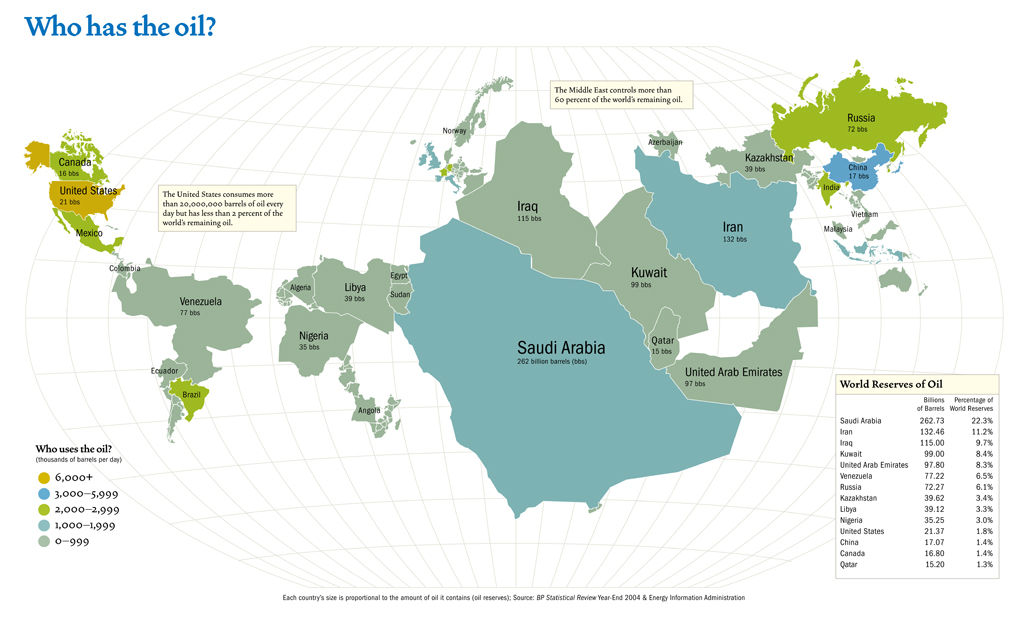
“The United States consumes more than 20,000,000 barrels of oil per day but has less than 2 percent of the world’s remaining oil”
This map, produced by BP’s Statistical Review division, shows countries based on known crude oil reserves. The larger the country, the more reserve capacity. The map also gives mariners working offshore an idea where jobs opportunities may arise in the coming years. Click on the map for the large Hi-Resolution version.
Tags: · bp, crude_oil_reserves, Data, Offshore
December 2nd, 2007 · 2 Comments
While this does not take into account size of respective fleets (click here for that information) the following graph shows the number of detentions recorded by Paris MOU with respect to Flag State.

Tags: · Data, flag_state, fleets, graph, Interesting, paris_mou, ship_detentions
October 30th, 2007 · 6 Comments
The Exploratorium brings us live earthquake mapping links! Normally I wouldn’t cut an paste so much info but in light of messages I’ve received from mariners worried about their families, here it is:
Southern California Integrated GPS Network Mapsurfer
Mapsurferer is an interactive mapping system that allows visitors to overlay different layers of information on a map of California. These layers include seismic stations, highways, geological features, major faults, and more. While information about the Bay Area and northern California is available, this map focuses on southern parts of the state.

Quakes in the last 7 days: USGS Earthquake Hazards Program
The USGS has many maps of live earthquake data. This section lets visitors see quakes that have occurred anywhere in the world in the last week. You can also focus on geographic regions. Zooming in to a specific quake, you reach a page with specific data and links to the area’s seimic and quake damage history

Shake map of California and Nevada showing fault lines
These maps are nice illustrations of the fact that earthquakes occur along faults. You can click the small boxes to zoom in and get more details on specific quakes

Did you feel it?
Seismometers can measure shaking, but how much does that reflect what people actually feel? On this site, people in the area of a quake can report their experiences to the USGS, and the results are made into a map. This can be compared with other shake maps for the same quake that were generated from seismometer data.

IRIS Seismic Monitor
IRIS (Incorporated Research Institutions for Seismology) has developed their Seismic Monitor that offers data about quake in near realtime, lets you search the Web for information about them, and view seismograms.

Real-time seismograms
Recorded by stations in the Northern California Seismic Network, these seismograms update every 5 minutes. The site also includes information on interpreting seismograms and examples of different magnitudes.

USGS Global Positioning System (GPS) monitors
USGS keeps many stations that track movements of the earth’s plates using GPS. Because plate movement is fairly slow, the data are recorded over long periods of time. So the information on this site records events in the last year, or last decade, rather than the last week.

Tags: · Data, earthquake, google_maps, links, maps, real_time, Weather

CLICK FOR INTERACTIVE VISUALIZATION
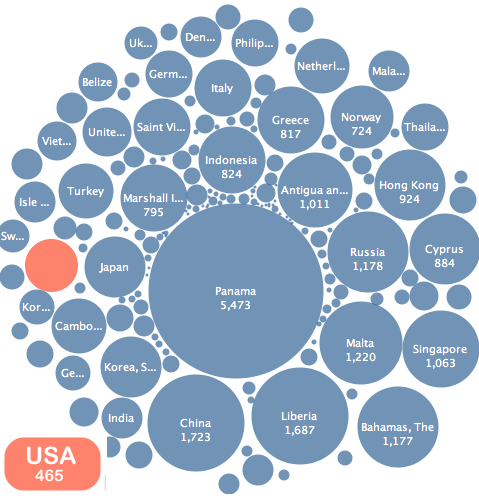
With the recent LNG News I decided to get to work on some maritime visualizations. Above is a bubble graph I created representing the number of ships registered to each flag state.

CLICK FOR INTERACTIVE VISUALIZATION
This graph is even more interesting, it shows the number of ships registered to each country by foreign owners. Notice the Flags of Convenience? Surprising that the U.S. has 51 flagged ships registered by foreigners.
Data is from the May 15th 2007 version of the CIA World Factbook.
Total number of ships registered worldwide: 33,222
Total number of foreign owned ships: 16,717.
More graphs of this data:
Merchant Marine - Rank Order (top chart): [Continue Reading →]
Tags: · Data, Interesting, Maritime Expert, Master Mariner, Ships, Web 2.0
August 15th, 2007 · 1 Comment
Tags: · Data, largest, li, world-record