NASA’s Liberty Star ship departs Port Canaveral in Florida with an Orion flight test capsule secured to its deck. (NASA/T. Jacobs)
Photo courtesy NASA
Note: This week’s interesting ships are reposted and updated from gCaptain’s archives.
When one thinks of a NASA ship, it’s generally not the seagoing type that pops into ones head. However, NASA does in fact have two vessels made for the high seas – MV Liberty Star and the MV Freedom Star – that assist with a shuttle launch. Both vessels are tasked as recovery ships for retrieving spent Solid Rocket Boosters (SRBs) that are used to power the shuttle’s ascent into space. After two minutes of flight, the boosters separate from the orbiter and external tank at an altitude of approximately 24 miles, descend under parachutes and land in the Atlantic Ocean where the MV Liberty Star and the MV Freedom Star are waiting to retrieve the reusable SRB’s.
It all begins about 24 hours before a shuttle launch, when the two ships set out to sea, manned by highly trained crews of professional merchant mariners and divers. During the operation, each ship retrieves one booster. Each ship has a permanently assigned crew of 10: a captain, two mates, four seamen, two marine engineers and a cook. In addition, eight divers accompany each crew to perform the delicate retrieval operation.
Here is an image taken from from the May 2008 STS-124 mission of an SRB splashing down into the ocean.
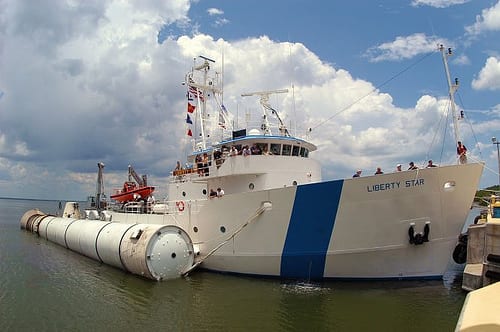
NASA’s solid rocket booster recovery ship Liberty Star closes in on the shore with a spent rocket alongside. (NASA/G. Shelton)
Once the boosters splash down into the ocean, the recovery ships spring into action:
First the pilot chutes and main parachutes are brought aboard. They’re followed by the drogue parachute and the 5,000-pound frustum that houses the chutes at the top of the booster. With those elements secured onboard, attention turns to the booster itself, as a team of eight divers boards two small boats. After installing a 1,500-pound apparatus called an “enhanced diver-operated plug” and air hose, the water is removed from the booster. The booster then rises in the water until it falls horizontally and floats on the surface, enabling the ship to tow it back to port behind the vessel.
Once recovered, the boosters are refurbished and reused in future shuttle launches, and the MV Liberty Star and the MV Freedom Star take on additional duties such as assist with diver training for NOAA and the Navy and additional utility uses. As to where they go now that the last space shuttle has launched? We’re not sure.
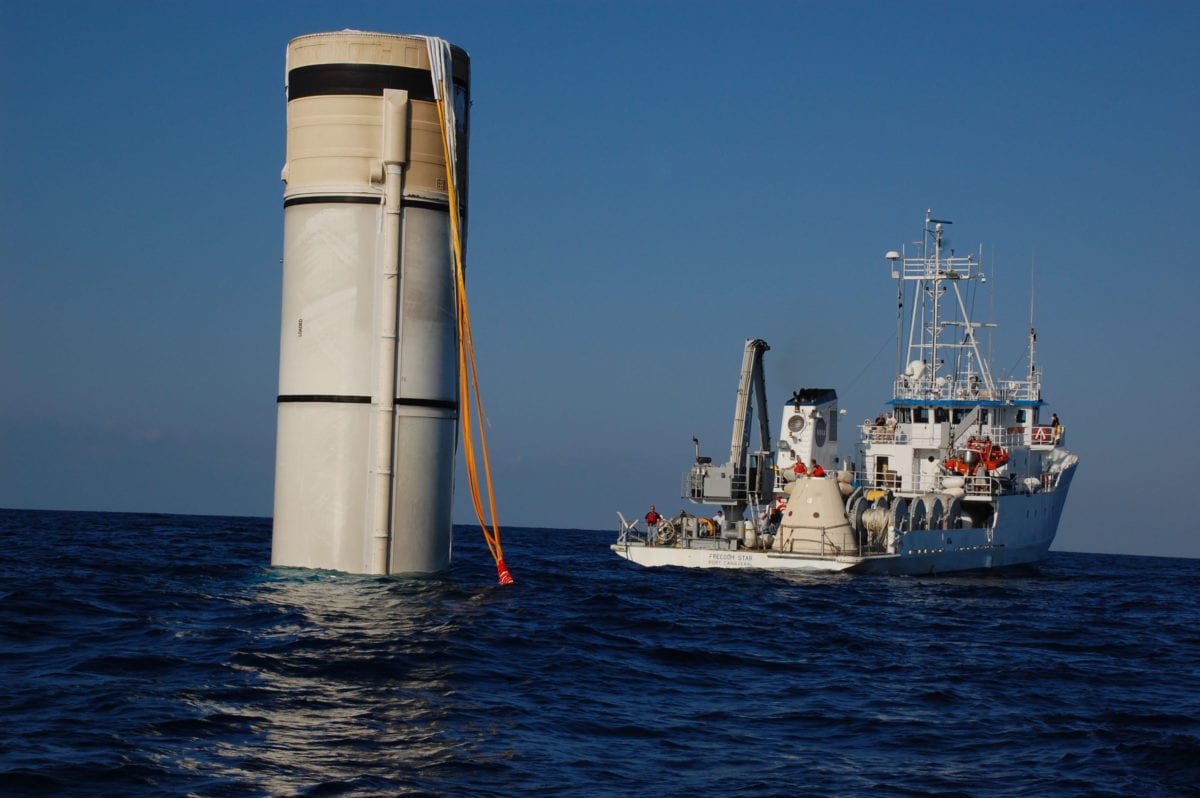
Image above: The left spent booster from space shuttle Discovery’s final launch bobs in the Atlantic Ocean near the Freedom Star. Image credit: NASA/Ben Smegelsky
The Liberty Star and Freedom Star were specifically designed and constructed for this task. Built at Atlantic Marine Shipyard, Fort George Island, near Jacksonville, Fla., in 1980 and 1981, the ships are 53.6 meters (176 feet) in length, 14.3 meters (37 feet) in width and draw 3-4 meters (10-12 feet) of water.
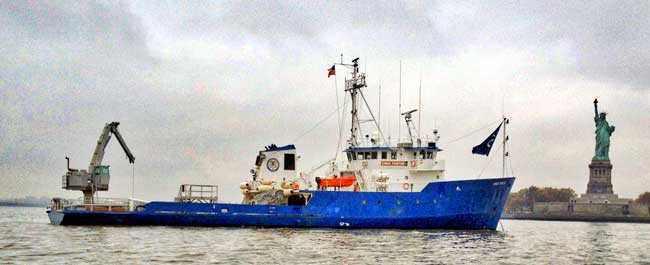
Photo of T/V Kings Pointer anchored off Liberty Island taken by Deck Officer, Liz Strojny. Photo Courtesy of MARAD
On September 13, 2012, NASA transfere the Liberty Star to the U.S. Department of Transportation for use as a training vessel at the United States Merchant Marine Academy. After being refit for training duty, which included additional berthing, she was renamed TV Kings Pointer, the fifth vessel of the Academy to carry that name. The transfer agreement stipulated that NASA could again use the vessel on future missions if required.
A good article on the SRB retrieval mission can be found on the NASA website HERE.
Will 3D Printing Change The World As We Know It? by Brad Hart Imagine you’re steaming across the Pacific Ocean on a container ship on a great circle course to the...
Marking the one-year anniversary of his record breaking solo dive to Challenger Deep in the Mariana Trench, explorer and filmmaker James Cameron is donating his DEEPSEA CHALLENGER submersible to the Woods...
LONDON–Royal Dutch Shell PLC (RDSA) said Thursday that major construction had begun on the world’s first floating vessel that will use new technology to produce liquefied natural gas aboard. The oil...
October 18, 2012
Total Views: 45
Get The Industry’s Go-To News
Subscribe to gCaptain Daily and stay informed with the latest global maritime and offshore news
— just like 107,453 professionals
Secure Your Spot
on the gCaptain Crew
Stay informed with the latest maritime and offshore news, delivered daily straight to your inbox
— trusted by our 107,453 members
Your Gateway to the Maritime World!
Essential news coupled with the finest maritime content sourced from across the globe.

 Join The Club