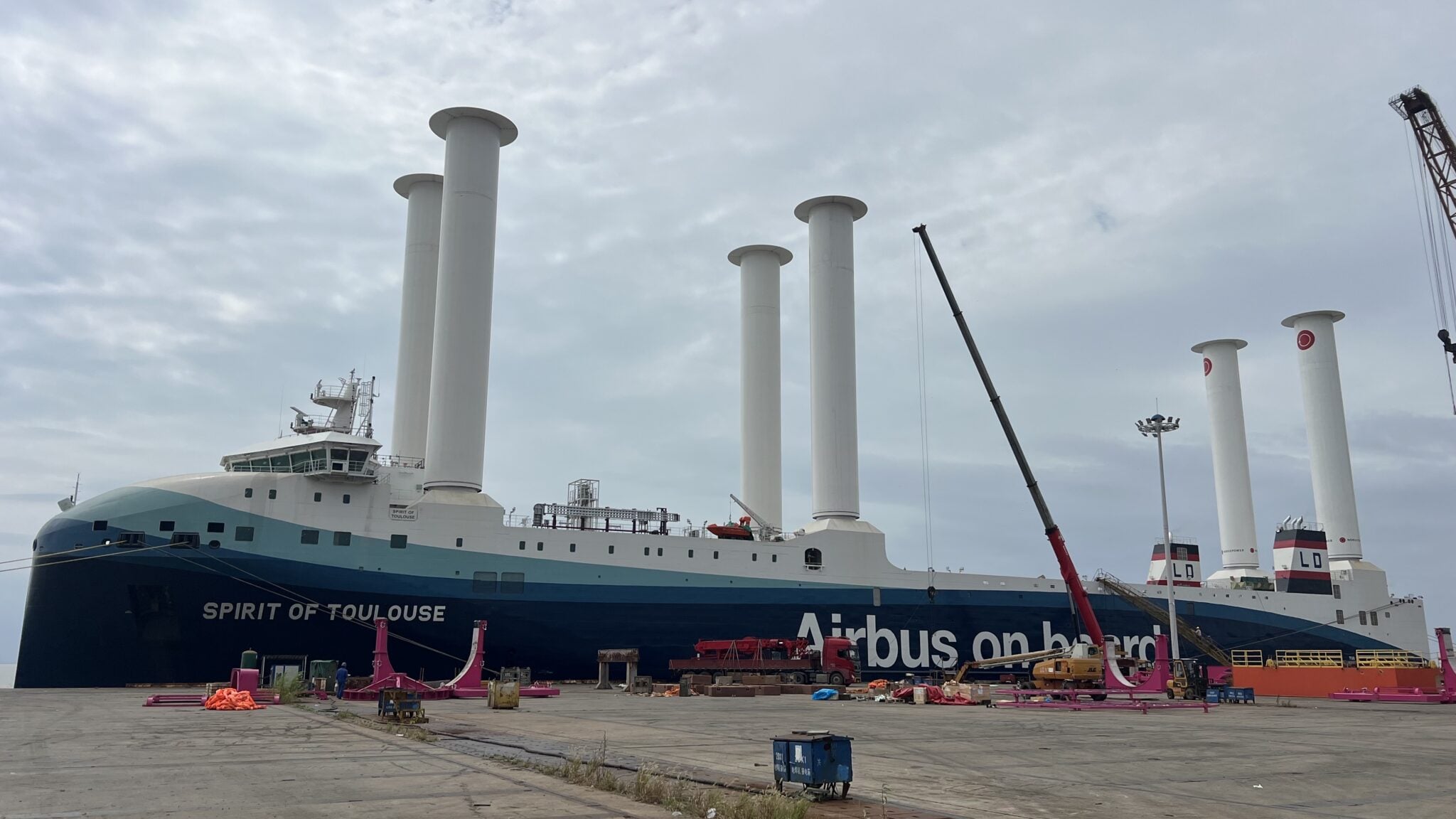
French shipowner LD Armateurs has completed the installation of six towering rotor sails aboard Spirit of Toulouse, a new roll-on/roll-off vessel being built to transport aircraft components for Airbus across the Atlantic.
The installation, completed at a shipyard outfitting site in Shanghai, makes the 168-meter vessel the largest RoRo ship equipped with wind-assisted propulsion and gives it more mechanical sails than any other ship, according to LD Armateurs and Finnish wind propulsion specialist Norsepower.
Each of the six rotor sails stands 35 meters tall and measures 5 meters in diameter. The rotating cylinders harness wind to generate additional thrust, reducing the workload on the ship’s main engines and, in turn, its fuel consumption.
The vessel is also equipped with two dual-fuel main engines and two generator sets capable of operating on e-methanol, bio-methanol or marine diesel oil. The combination is intended to reduce fuel consumption and emissions without relying entirely on alternative fuels.
Spirit of Toulouse is the first of three sister ships being built for LD Armateurs under charter to Airbus. The other two vessels, Spirit of Mobile and Spirit of Mirabel, will also receive six rotor sails each.
The ships will transport large aircraft assemblies between Airbus production facilities in Europe and North America, replacing the manufacturer’s existing transatlantic fleet.
Airbus expects the new fleet to cut annual emissions from its transatlantic shipping operations by more than half, from approximately 68,000 metric tons of CO2 in 2023 to 33,000 metric tons by 2030. Those reductions will depend on a combination of improved vessel efficiency, wind propulsion and the availability of lower-emission fuels.
“Completing installation of six Norsepower Rotor Sails on Spirit of Toulouse is a significant milestone for wind propulsion in the RoRo segment,” said Heikki Pöntynen, CEO of Norsepower.
The vessel was launched in February and is preparing for sea trials, during which the rotor sails will undergo testing. Further adjustments are planned during its maiden voyage from China to France.
Wind Propulsion Gains Ground
The project comes as wind-assisted propulsion moves beyond individual demonstration projects and finds wider use across the commercial shipping fleet.
According to the International Windship Association (IWSA), more than 100 large commercial vessels were equipped with wind propulsion systems as of June 2026, carrying more than 230 individual installations.
That compares with just 21 large vessels in May 2022, representing nearly a fivefold increase in four years.
Tankers and bulk carriers have led the expansion, although RoRo ships, ferries and general cargo vessels are increasingly adopting the technology.
Earlier this year, Berge Bulk completed the installation of four folding rotor sails on its 208,000-dwt Newcastlemax bulk carrier Berge Meru, following a similar project aboard the larger Berge Neblina in 2024. In August, the Ultramax bulk carrier Maria Topic returned to commercial service after receiving a rigid wingsail during a retrofit at Tsuneishi Shipbuilding in Japan.
And in September, Spanish shipowner Marflet Marine installed four 22-meter suction sails aboard the 49,999-dwt chemical tanker Santiago I, with technology supplier bound4blue estimating the system could reduce annual energy consumption by approximately 10% to 15%.
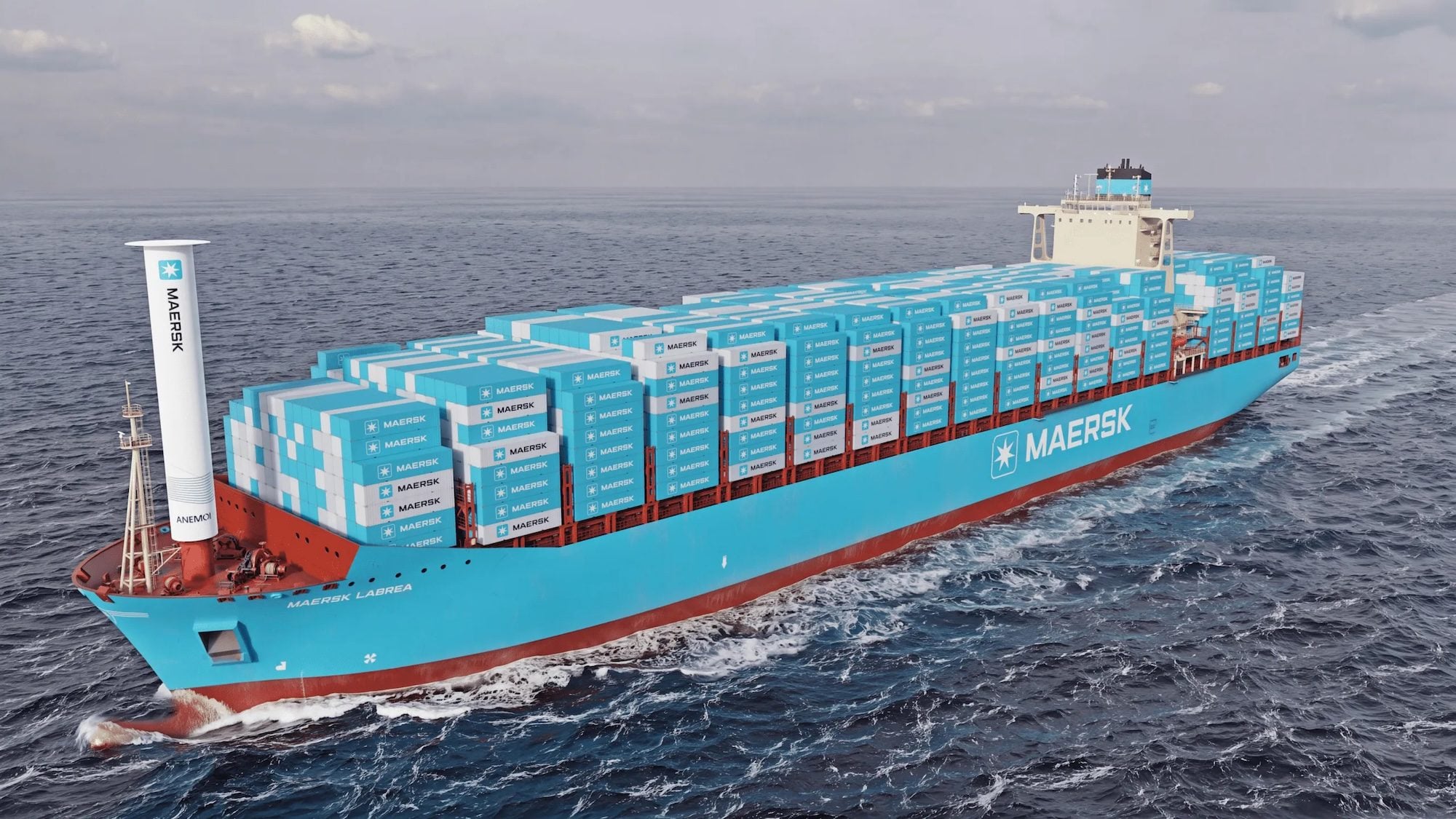
The growing range of installations reflects the different approaches being used to capture wind energy. Rotor sails use spinning cylinders to generate thrust through the Magnus effect, while other systems employ rigid wings, suction sails or even kites.
Unlike conventional sailing vessels, most wind-assisted merchant ships continue to rely on their main engines for propulsion, using wind power to reduce fuel consumption whenever conditions allow.
The technology has also produced measurable results. In an earlier trial involving the Maersk Pelican product tanker, two Norsepower rotor sails delivered an independently validated 8.2% reduction in fuel consumption over one year.
More recently, Cargill reported that the bulk carrier Pyxis Ocean, fitted with two large WindWings, achieved average fuel savings of approximately three metric tons per day during a six-month trial.
With two more Airbus vessels to follow, the project will provide another test of how those technologies perform together in regular commercial service.

 Join The Club