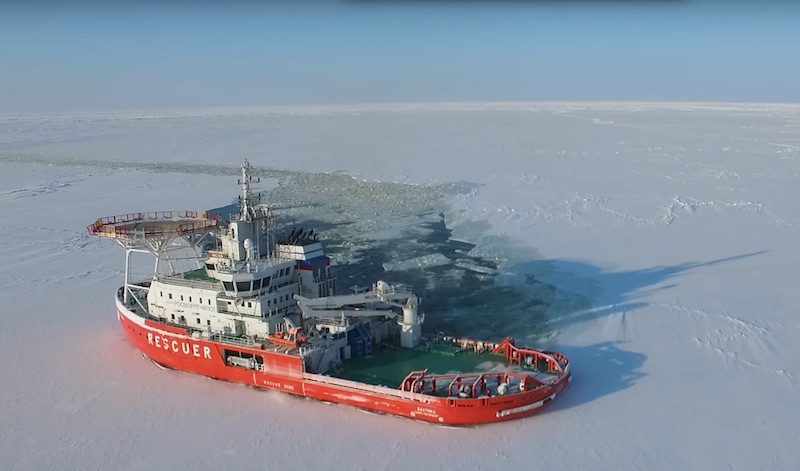
Built by Arctech Helsinki for the Russian Ministry of Transport, the Icebreaking Multipurpose Emergency and Rescue Vessel Baltika is a first-of-its-kind icebreaker built with an asymmetrical hull allowing for not only ahead and astern icebreaking, but also “oblique” (or sideways) icebreaking to create a channel up 50 meters wide.
The first full scale icebreaking tests took place from March to April 2015 in the Kara Sea and Gulf of Ob. The trials involved performance tests in three distinct ice thicknesses during stern and ahead speed tests (40 cm, 94 cm, and 122 cm), followed by the oblique icebreaking tests in 40 cm thick ice.
The oblique test (beginning at 4:10 in the video) was the first time the icebreaking concept had been tested in real life, and the vessel met or exceeded all of its design requirements.
Some highlights from the ice trials:
Ahead speed test reaching over 11 knots in 40 cm (16 in) ice
Astern speed test reaching over 10 nots in 40 cm ice
Ahead speed test reaching over 4 knots in 94 cm (37 in) ice
Astern speed test reaching over 6 knots in 94 cm
Ahead speed test reaching about 1 knot in 122 cm (48 in) ice
Astern speed test reaching over 3 knots in 122 cm ice
Oblique icebreaking test in 40 cm ice (at 4:10)
Small, medium, large, and extreme angle oblique tests
Oblique ice management tests
Baltika (IMO number 9649237) was built by Arctech Helsinki Shipyard (Helsinki, Finland) in co-operation with Shipyard Yantar JSC (Kaliningrad, Russia) based on Aker Arctic’s design , Aker ARC 100. The vessel is 76.4 meters long and has a beam of 20.5 meters and features a diesel-electric power plant consisting of three Wärtsilä 9L26 generating sets with a combined output of 9 MW.
Baltika is propelled by three 2.5 MW Steerprop azimuth thrusters, two in the stern and one in the bow of the vessel. The dynamic positioning system, which also includes the oblique icebreaking mode, has been developed by Navis Engineering. The vessel is classified by the Russian Maritime Register of Shipping and its ice class is Icebreaker 6, capable of breaking 1-2 meters thick.
Baltika is owned by the Federal Agency for Maritime and River Transport of Russia (Rosmorrechflot) and operated by the Russian Marine Emergency Rescue Service (FGI Gosmorspassluzhba).
The vessel is also fitted with a built-in oil recovery system.
Tags:
Subscribe for Daily Maritime Insights
Sign up for gCaptain’s newsletter and never miss an update
Matson has christened the first of three new Jones Act containerships at Hanwha Philly Shipyard, marking another milestone in the carrier’s $1 billion fleet renewal program as the Philadelphia yard...
The American Bureau of Shipping (ABS) and the U.S. Department of Energy (DOE) have signed an agreement to advance the use of nuclear power in commercial shipping, including nuclear-powered vessels,...
Six commercial vessels were reported struck in and around the Strait of Hormuz on October 11, including five tankers and a container ship, as attacks on merchant shipping continue to...
5 hours ago
Total Views: 362
Get The Industry’s Go-To News
Subscribe to gCaptain Daily and stay informed with the latest global maritime and offshore news
— just like 106,899 professionals
Secure Your Spot
on the gCaptain Crew
Stay informed with the latest maritime and offshore news, delivered daily straight to your inbox
— trusted by our 106,899 members
Your Gateway to the Maritime World!
Essential news coupled with the finest maritime content sourced from across the globe.

 Join The Club