Don’t Miss Your Daily Briefing for the Maritime Industry
Join the leading maritime news network
— trusted by our 106,406 members
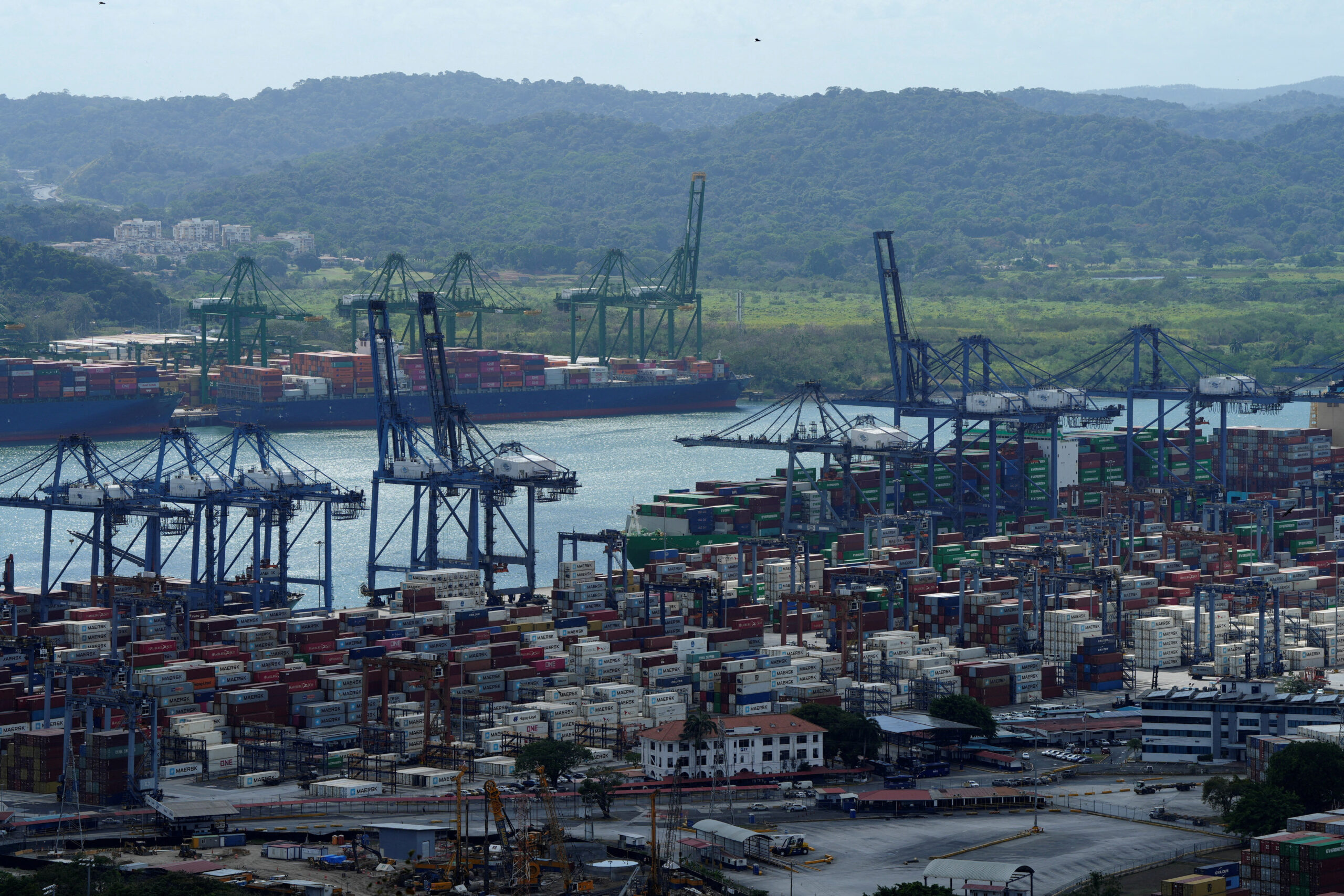
A view of the Balboa Port is pictured after Hong Kong's CK Hutchison agreed to sell its interests in a key Panama Canal port operator to a BlackRock Inc-backed consortium, amid pressure from U.S. President Donald Trump to curb China's influence in the region, Panama City, Panama, March 4, 2025. REUTERS/Enea Lebrun
Two Wealthy Americans Face Off In Bitter Feud Over Panama Port
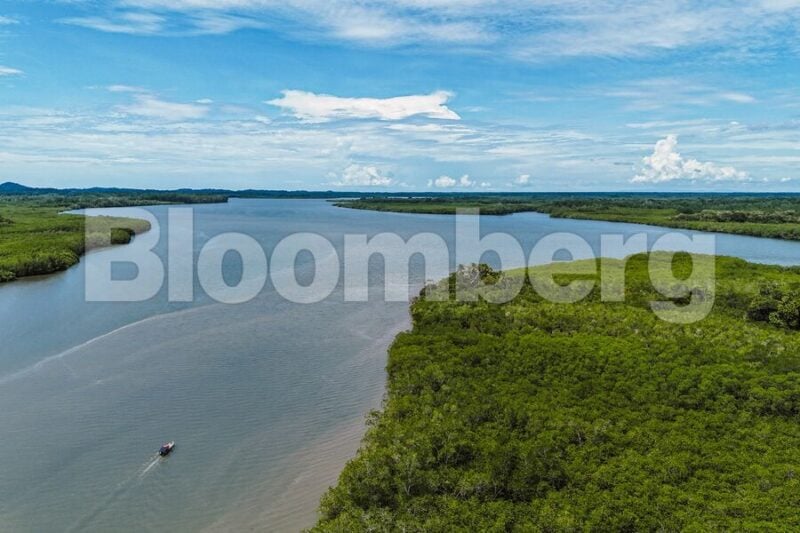
Oct 22, 2026 (Bloomberg) –To hedge-fund billionaire Louis Bacon, the crystalline waters and densely forested riverways of the Gulf of Chiriqui in western Panama are an ecological oasis. To developer John McKeown, the gulf is a conduit to potential markets for the region’s prized produce and a boon for its economy.
Those clashing visions are at the heart of a bitter dispute between the two wealthy Americans, who both say they’re championing Panama’s best interests.
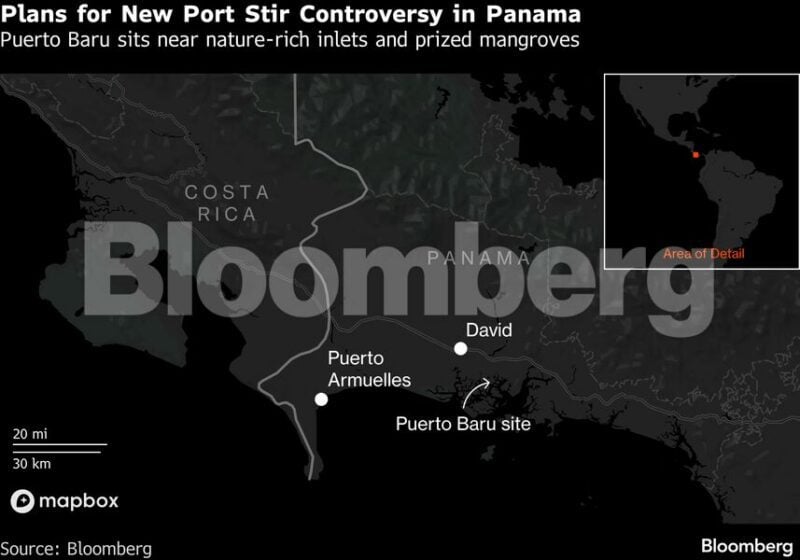
The feud centers on a $260 million port McKeown is seeking to develop on the country’s Pacific coast, just south of the city of David. Ocean Pacific Investments, the company McKeown leads, describes the project, Puerto Baru, as Panama’s first “green” port that will help relieve pressure on trading hubs in Panama City and integrate with trade routes to North America and Asia. Chiriqui, with a population of around 500,000, is Panama’s breadbasket, cultivating foods including coffee, papayas and shrimp.
The battle has escalated all the way to Panama’s Supreme Court, which is weighing the port’s environmental approval after a group of local nonprofits challenged it. Already, the fight has involved civil and criminal complaints against some of those NGOs. The outcome will dictate the fate of an unspoiled pocket of Panama that’s seen little of the wealth that flows through its high-flying capital.
To Bacon, the project poses an unacceptable risk.
“I am concerned that the principals behind this project have no experience developing or operating commercial ports, yet they are proposing a major port in one of the most environmentally sensitive areas in Panama,” he wrote in a statement to Bloomberg News. “A simple look at the map would tell you this is not a suitable development site.”
Ocean Pacific, for its part, said that it has addressed potential environmental impacts and that the campaign to stop the port may be motivated by personal interests.
“If I believed Puerto Baru would cause significant harm to a part of Panama, a country I not only love but call home, I would never have committed myself or my resources to developing this project,” McKeown said in a statement.
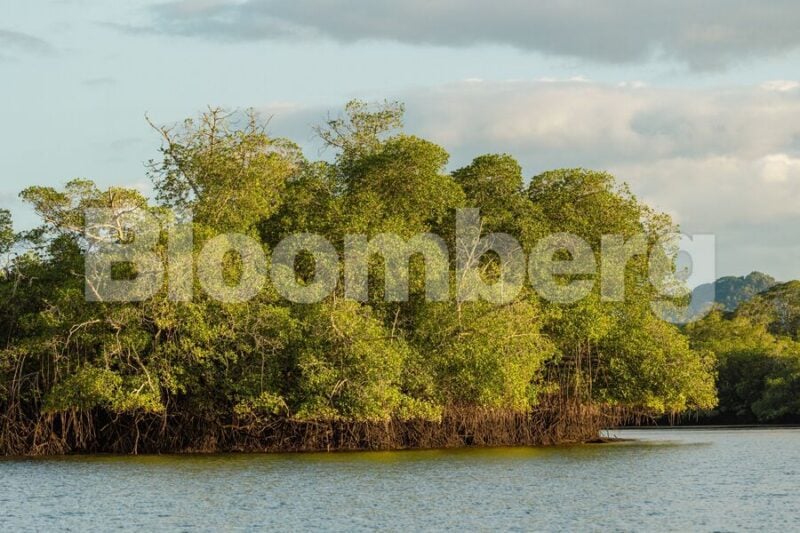
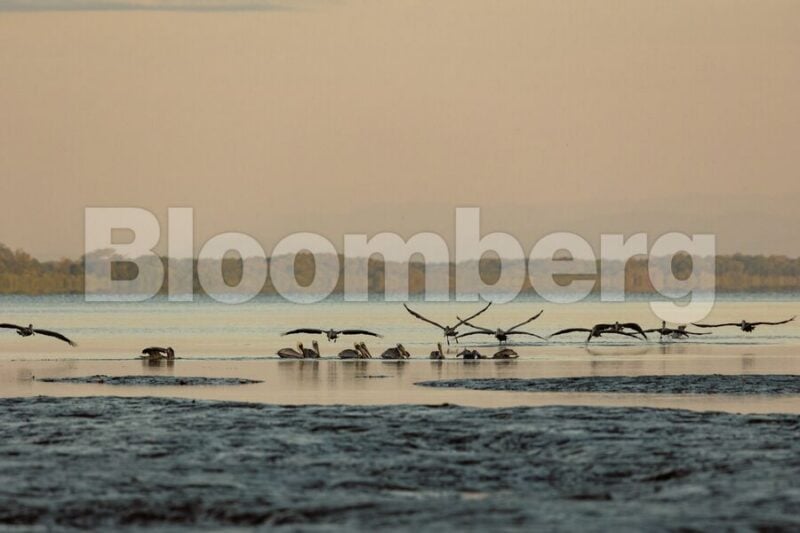
The site at issue is nested among the serpentine channels that hold a quarter of Panama’s mangrove forests. Mangrove trees and their dense root systems fortify coastlines, shelter sea life and suck up enormous amounts of carbon.
Ocean Pacific envisages a 124-hectare (306-acre) commercial port. It would be the biggest private investment in Chiriqui Province’s history, Ocean Pacific says, and the area would benefit not just from an increase in industry but also more tourism, since there will be a dock for leisure vessels. An economic assessment commissioned by the company in 2021 estimated that the project could create upwards of 1,100 jobs.
Six Panamanian environmental groups say the facility, and the resulting cargo-ship traffic, would irreversibly damage the local ecosystem through pollution, water churn and blocked sunlight. Juan Carlos Monterrey Gómez, chief executive officer of environmental consultancy VANGLabs and Panama’s former special representative for climate change, said some impact on the local environment from a project of this size is inevitable. (Monterrey isn’t affiliated with any of the groups opposing it.)
A spokesman for Ocean Pacific said the company “strongly disagrees” that the port will cause irreparable damage and said potential impacts were “studied extensively and addressed in detail” as part of the environmental review, which was approved two years ago and was comparable, he said, to reviews conducted for US infrastructure projects. The analysis took four years, according to Ocean Pacific, and included a well-attended public hearing. A website for the project describes it as designed to meet “high sustainability standards,” with solar panels for all its power needs and dedicated conservation zones.
The spokesman also said the company has always been clear that it is not a port operator itself, and intends to partner with one.
Ocean Pacific has continued to work on the port while the court considers the case. But it struck back at the nonprofits, filing criminal complaints against two of them for slander, libel and crimes against the economy.
Shortly afterwards, the two nonprofits said that their bank accounts were frozen due to a court order. Unable to pay staff or raise funds, the groups are struggling to stay afloat and the staff say the measures have spooked other charities that might otherwise be speaking out. The case is producing the kind of chill associated with so-called SLAPP lawsuits, which are meant to intimidate critics, said Joana Abrego, former legal manager and now an external consultant for CIAM, one of the affected groups.
Ocean Pacific declined to comment on ongoing litigation.
One reason that CIAM and the other accused nonprofit, Adopta Bosque, were able to voice such strong opposition in the first place is Louis Bacon. The 70-year-old financier made a fortune through his hedge fund Moore Capital Management and has poured some of it into land and various conservation efforts around the world. He’s the 70th-biggest landowner in the US, according to the Land Report, and has placed 94% of that land under conservation easements, a legal tool that permanently bans future development.
The term conservationist suggests quiet stewardship, but that’s not Bacon’s style. He co-founded Waterkeeper Alliance, a nonprofit formerly run by Robert F. Kennedy Jr. that aims to enforce environmental laws. Through his nonprofit, the Moore Charitable Foundation, he has often taken an activist approach, collaborating with local advocacy groups to oppose projects near his properties, such as a cement plant in North Carolina. He notably was involved in a bitter yearslong feud with Peter Nygard, the disgraced Canadian fashion mogul, that was tied to their neighboring properties in the Bahamas.
The fight over Baru, too, is personal. Bacon owns Islas Secas, an all-inclusive eco-tourism resort that sits on an archipelago about 30 miles southwest of the proposed port, and where nightly rates start at $3,500. He said the port, if built, is far away enough that it won’t directly affect his island, but the dredging and habitat disruption would have cascading consequences. He’s not fighting the project to defend his luxury hotel, he said, and his commitment to Panama won’t change even if the port goes ahead.
Bacon described Ocean Pacific’s legal action against the nonprofits as extraordinary. “I’ve never had to support environmental advocates facing criminal penalties simply for raising concerns about a development project,” he said. “Lawfare against whistleblowers is abominable.”
Bacon has personally covered Adopta Bosque’s legal costs and also helped fund the broader campaign against the project, which includes an online petition and a website articulating the six nonprofits’ mission, endorsed by nearly four dozen “supportive organizations,” many of which Bacon has funded in the past for their wider work. He paid for an alternative port plan that endorsed moving it about 50 miles west to the city of Puerto Armuelles, and his foundation funded an impact analysis that estimated the port’s environmental toll would come to around $30 million over 20 years.
McKeown also has personal ties to Panama. A part-time resident of the country, he said he first became interested in Chiriqui’s potential as a maritime hub while on a deep-sea fishing excursion; the captain had to travel seven hours to resupply because there was no suitable dock.
He has experience bridging enterprise and conservation efforts. As president of the closely-held Los Angeles-area energy company, Synergy Oil & Gas, he helped create one of California’s biggest protected wetlands with authorities by agreeing to decommission what had been an active oil field. Before Synergy, McKeown was a real estate broker and owned several container and logistics yards. He said he’s raised money for Puerto Baru from various US individuals, whom he declined to identify.
Bacon said he’s expressed his concerns about the project with Panamanian officials personally and through his local foundation, and that he reached out to Ocean Pacific with an offer to help pay for additional scientific analyses and a coastal modeling study but didn’t get a response.
An Ocean Pacific spokesman said McKeown exchanged emails with Bacon’s son Trevor and concluded that new analyses would duplicate work that had already been done. McKeown said Puerto Armuelles was too far from the region’s farms to be feasible.
Panama’s environment minister, Juan Carlos Navarro, said in a statement that the ministry is legally “obliged to respect” the environmental approval for Puerto Baru — which a previous administration signed off on — and that it will abide by the Supreme Court’s decision when it comes. He declined to comment on Ocean Pacific’s lawsuits against the NGOs but said the nature of the suits had ministry officials “deeply concerned.”
“Panama is a democratic country,” he said. “At the Ministry of Environment we value and promote active, robust citizen participation, as well as contributions from civil society and the scientific community to environmental management.”
Panamanian advocates say the port project exposes what they describe as a chasm between Panama’s reputation as a leader on conservation and the environment and its treatment of local nonprofits.
“Organizations like ours are on our own. We don’t have institutions that protect us in this situation,” said Abrego. Two environmentalists opposing Puerto Baru declined to speak on the record out of fear for their safety criticizing the state’s stance on a development project.
The dissonance isn’t that unusual, said Monterrey, the former climate envoy, given the knotty bureaucratic interests that complicate most countries’ policies.
In his view, the port likely wouldn’t deliver what its developers are promising for Panama. “These large projects are usually presented as bringing jobs and development,” he said, “but they often produce social conflict, extract wealth from the communities and send the returns elsewhere.” Whether Ocean Pacific gets the chance to change that narrative is now up to the high court.
MOSCOW, Sept 27 (Reuters) – The Russian defense ministry said on Sunday its forces had carried out overnight drone strikes on logistics centers, port and transport infrastructure, as well as communications centers and vessels that...
CK Hutchison Holdings Ltd. commenced international arbitration proceedings against Panama, seeking more than $1.5 billion in damages over the loss of its investments in two ports on the country’s strategic canal.
SYDNEY, Aug 8 (Reuters) – Workers will continue a two-day strike at BHP’s Port Hedland operations in Western Australia as planned, a union official said on Saturday, after the start of the first major...
August 8, 2026
Total Views: 1082
Get The Industry’s Go-To News
Subscribe to gCaptain Daily and stay informed with the latest global maritime and offshore news
— just like 106,406 professionals
Secure Your Spot
on the gCaptain Crew
Stay informed with the latest maritime and offshore news, delivered daily straight to your inbox
— trusted by our 106,406 members
Your Gateway to the Maritime World!
Essential news coupled with the finest maritime content sourced from across the globe.

 Join The Club