By Lori-Ann LaRocco – Today’s trade flows resemble a windy waterpark slide more than the traditional waterway superhighway.
The three-dimensional chess game being played by ocean carriers and tankers has delivered big bucks in day rates, container rates, and surcharges. But there is a group of winners not currently being highlighted.
The alternative subcontinent ports.
Sub-hub ports are critical for container lines, as they decide where to transfer cargo next. Decisions to avoid geopolitical risk are reshaping shipping networks and elevating alternative ports.
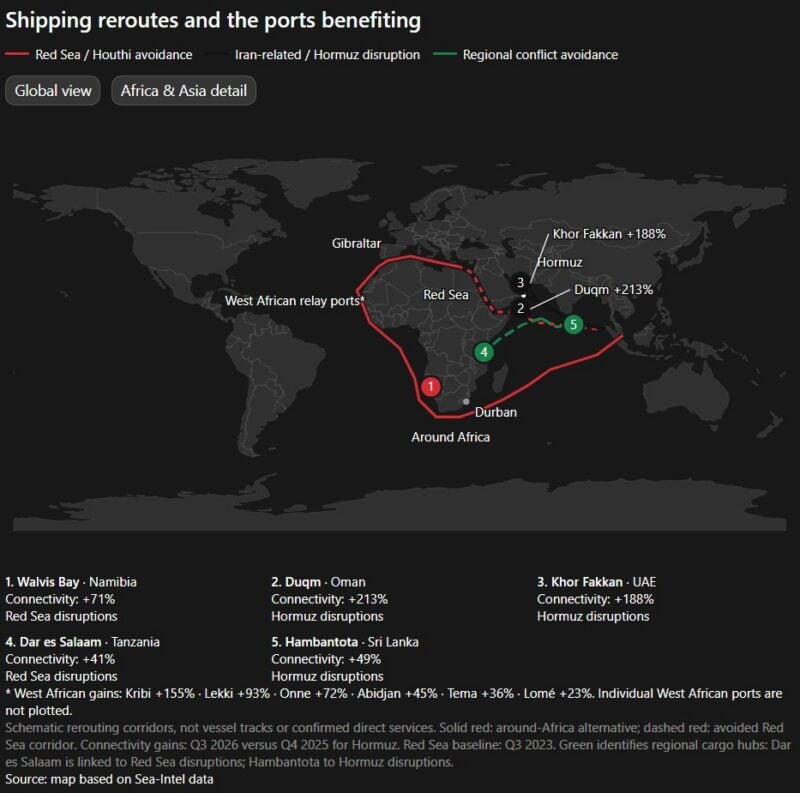
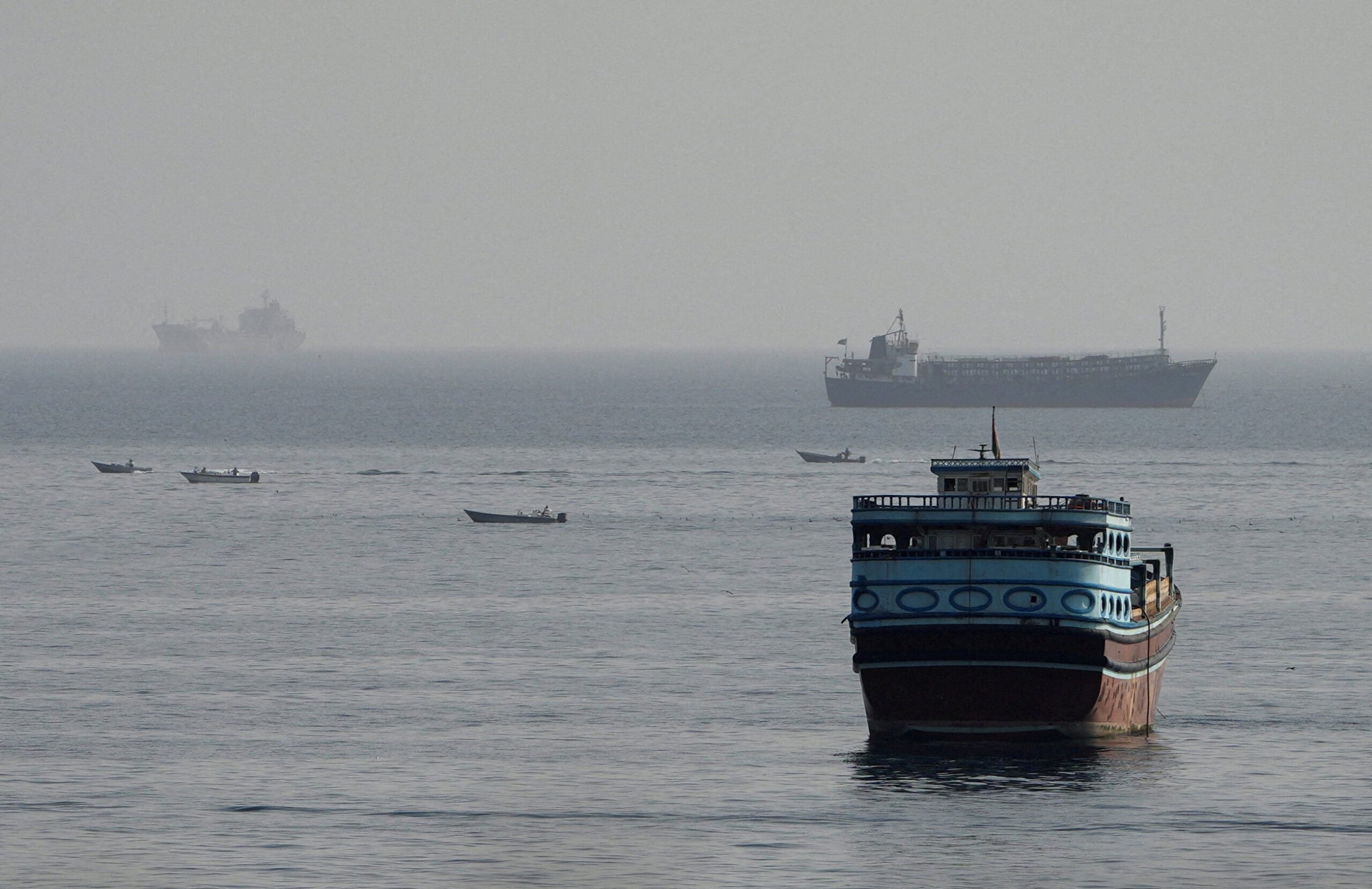
As vessels sail around Africa or seek alternatives to the Strait of Hormuz, ports once peripheral to those networks are taking on larger roles in global trade.
“The geopolitical disruptions in the Middle East have forced shipping lines into substantial network redesign,” said Alan Murphy, CEO of Sea-Intelligence. “As a result, while ports in the impacted regions have lost liner connectivity, ports in the adjoining regions have picked up that slack.”
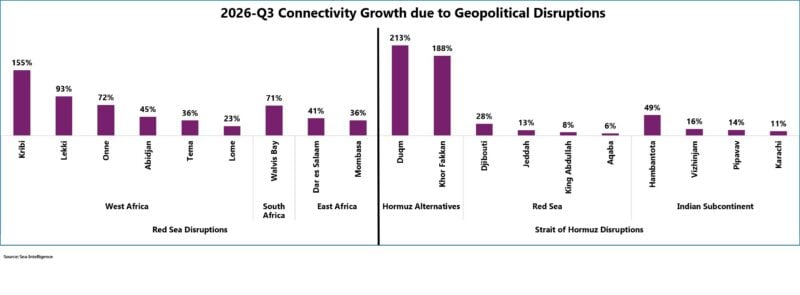
Sea-Intelligence compiled connectivity data from UNCTAD’s Port Liner Shipping Connectivity Index. The data shows growth across these alternative sub-ports in 2026?Q3. The data shows these sub-ports became better connected to shipping routes in July–September 2026, compared to the disruption of July–September 2023 for the Red Sea crisis and October–December 2025 for the Strait of Hormuz closure.
To maintain the longer routes and cargo connections, shipping lines are shifting to transfer hubs to limit additional sailing and congestion delays.
Ocean liner companies have pushed African relay operations south along the Atlantic seaboard. Vessels sailed to the Central and Eastern Mediterranean through the Strait of Gibraltar.
East Africa and Indian Subcontinent ports became the prominent hub for displaced regional cargo. Ports Dar Es Salaam and Hambantota benefited from greater connectivity gains as ocean carriers sought to avoid the conflict region altogether. These moves have significantly increased connectivity for West African ports.
Murphy cited two winners in this trade remapping.
“Walvis Bay, became an alternative to the congested Durban for Asia?Europe vessels sailing around Africa,” said Murphy. “Similarly, ports along the Gulf of Oman have captured the largest connectivity gains due to the closure of the Strait of Hormuz.”
Duqm and Khor Fakkan have recorded massive connectivity increases of 213% and 188% compared to the pre-crisis baseline.
Unlike recurring environmental risks, such as drought, which can be planned for in advance, geopolitical risk cannot be predicted. As previous geopolitical disruptions have shown, vessel capacity is impacted, and routes take time to normalize.
To offset the uncertainty, ocean carriers and tankers adjust, and these alternative routes help create visibility in an otherwise uncertain world. This creates a new cadence for trade flow.
Alternative hubs gain valuable muscle to receive and process this trade. The velocity of the trade may not pick up in terms of time on the water, but the lessons being learned at these ports are invaluable. Money is being made, but those who have the foresight to build in these regions are benefiting too.
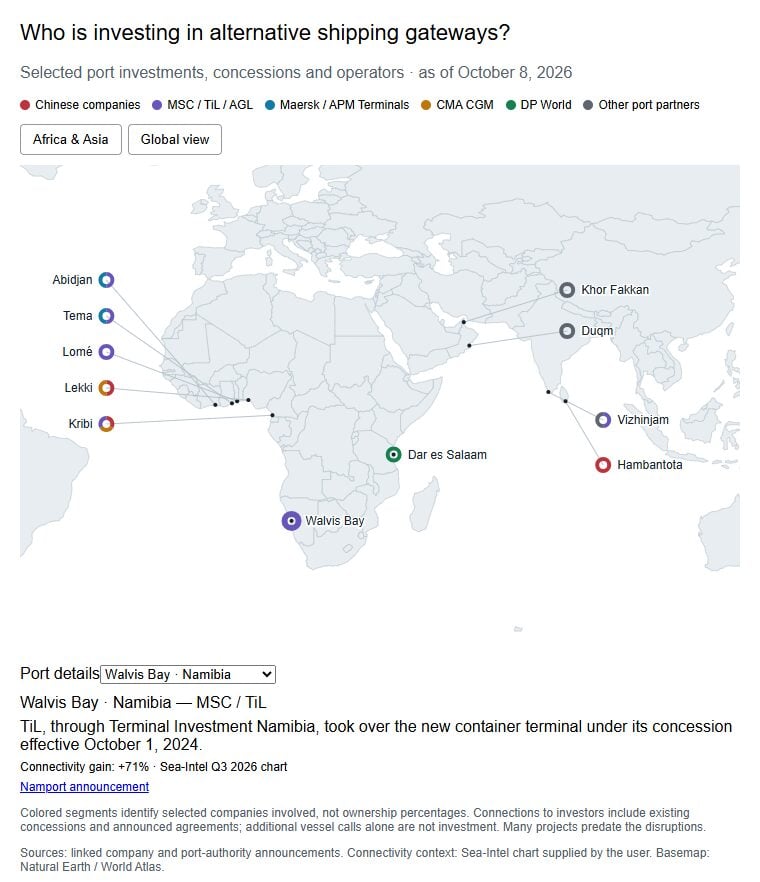
I always say, look to where China, ocean carriers, and integrated logistics providers are investing to see where the new tomorrow will be. Why? Because no one invests billions without expecting a return.
China Merchants Port, China Harbour Engineering, MSC (through TiL and Africa Global Logistics, Maersk (through APM Terminals, DP World, Gulftainer, Asyad, and Consortium Antwerp Port have all invested in alternative gateways in the region before these disruptions. These companies have infrastructure positioned to capture rerouted cargo.
With the ongoing attacks on vessels in the Strait of Hormuz, most recently this morning, as reported by UKMTO, on a Qatari LNG tanker, expect the alternative ports to continue to benefit from the diversions.
Twelve seafarers were injured after a Panama-flagged oil tanker was struck by a projectile while transiting the Strait of Hormuz, according to India’s Ministry of External Affairs, marking one of...
Saudi Arabia is planning an offensive against Iran-backed Houthi militants in Yemen, with options being considered including a coastal push to secure the Red Sea shipping route or an assault on multiple fronts, regional and Western officials told Reuters.
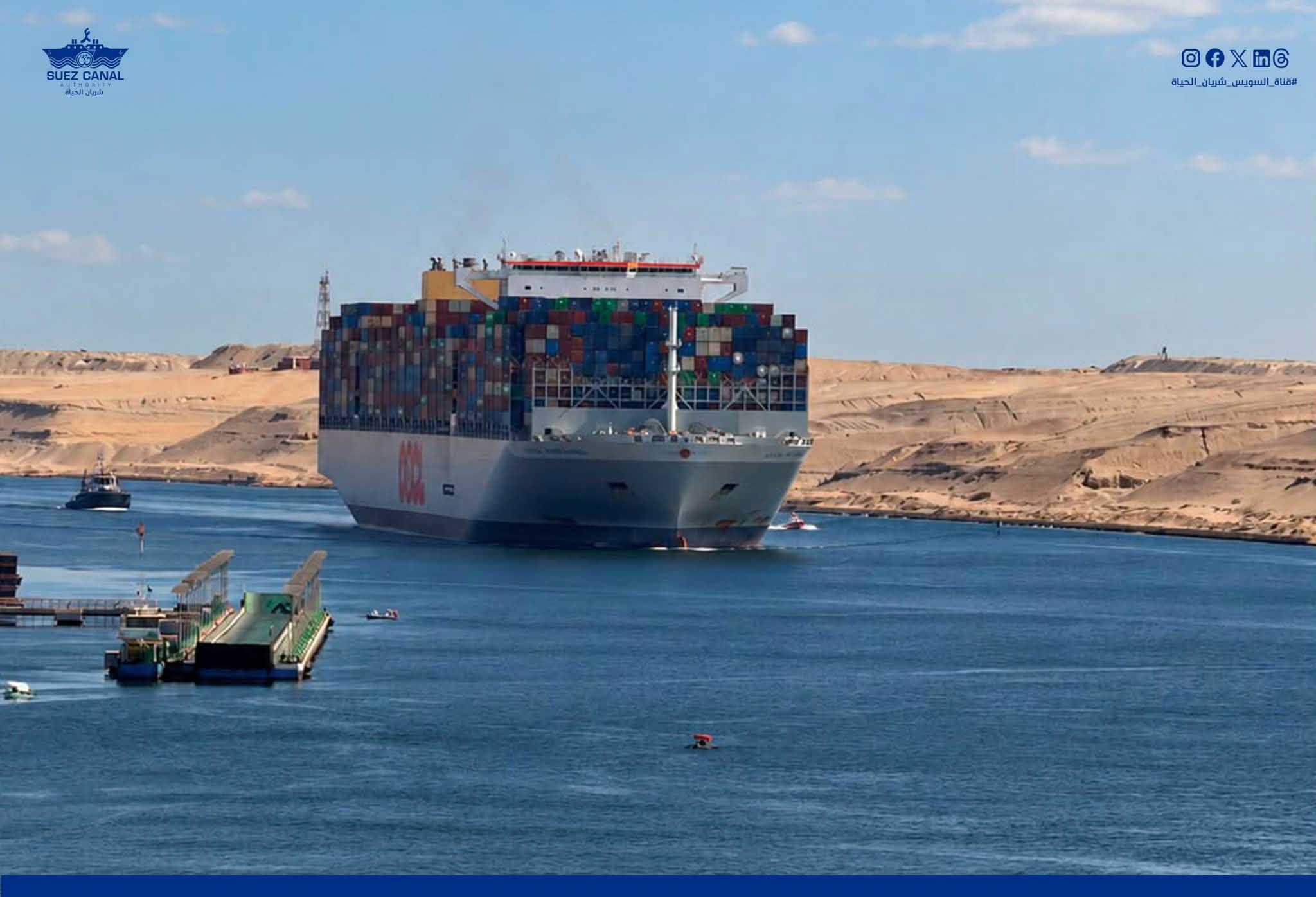
Container carriers are accelerating their return to the Suez Canal, with COSCO’s OOCL Portugal making a milestone transit even as Houthi advances around Bab el-Mandeb raise fresh security concerns.
September 16, 2026
Total Views: 3613
Get The Industry’s Go-To News
Subscribe to gCaptain Daily and stay informed with the latest global maritime and offshore news
— just like 107,053 professionals
Secure Your Spot
on the gCaptain Crew
Stay informed with the latest maritime and offshore news, delivered daily straight to your inbox
— trusted by our 107,053 members
Your Gateway to the Maritime World!
Essential news coupled with the finest maritime content sourced from across the globe.

 Join The Club